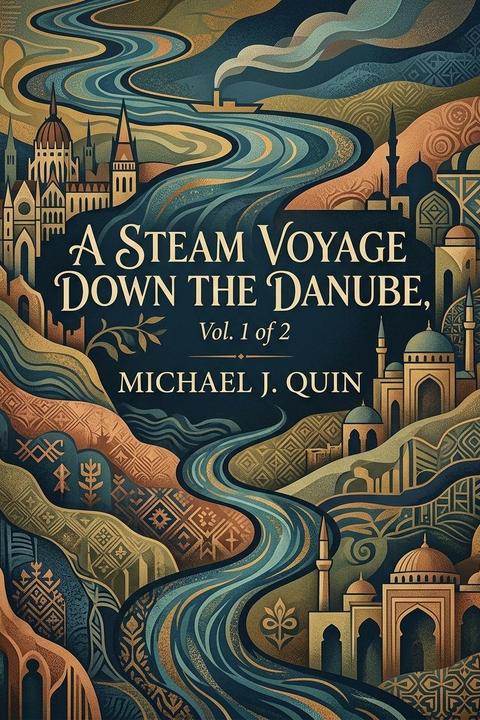
A Steam Voyage down the Danube, Volume 1
A Steam Voyage down the Danube, Volume 1, by Michael J. Quin, recounts the author's autumn 1834 journey from Pesth to the Ottoman frontier, undertaken as a novel alternative to the overland route to Constantinople after he learns that steamboats now run the length of the Danube to the Black Sea. Quin boards the steamer at Pesth by moonlight and opens the narrative with comic vignettes of shipboard life: chattering Hungarian ladies who rob him of sleep, a supercilious English captain named Cozier ignorant of the river's shifting sandbanks, and a motley company of Tyrolese emigrant families bound for Transylvanian mines, Hungarian nobles and deputies, a genteel young Countess N— returning to her mother after a failed marriage, a threadbare but brilliant Moldavian adventurer-poet fluent in several languages, and a Servian Jew descended from Spanish exiles. Card games, impromptu concerts, and mock "auction" amusements fill the long delays caused by low water, which repeatedly grounds the vessel on sandbanks near Tolna and elsewhere, forcing passengers ashore into rustic inns, billiard rooms, and encounters with village dogs and peasant hospitality. Interwoven with these comic and picturesque episodes is sustained ethnographic and political observation. Quin describes Hungarian rural customs and costume, the labor-sharing system between landlords and peasants, the lawless "Aidelmen" petty nobility, and the peculiarities of towns such as Mohács, Neusatz, Peterwardein, and Semlin. Conversations with fellow travelers—an English groom-turned-bailiff, Hungarian deputies, and later Count Széchenyi himself—give Quin material for an extended account of Hungary's reform movement: grievances over Latin-language law, insecure property titles, proliferating petty nobility, censorship, and unequal taxation (illustrated by the new Pesth–Buda bridge toll), alongside the reformers' cautious, evolutionary strategy of change through clubs, a national press, and auxiliary institutions rather than revolution. The narrative's central figure becomes Count István Széchenyi, the Hungarian magnate financing and directing the Danube improvement works. Quin travels with him from Orsova downstream, and the Count explains, over shared dinners, the origins of the steam-navigation company, his maneuvering of the project past Metternich's suspicions, his writings against entail and Sybaritic indolence, and his broader vision of gradual national regeneration through commerce, education, and civil institutions. Quin is clearly charmed by Széchenyi's combination of practical energy, patriotism, and Anglophile modernizing zeal. The geographic and descriptive heart of the volume lies in the mountain passage below Moldava: the narrow gorge, the ruined robber-stronghold of Kolubatz, the petrified "miller and his men" rock formation, General Vedran's fortified cavern, the rapids and rocky "Iron Door," and the rediscovered piers of Trajan's ancient bridge across the river, which Quin and Széchenyi identify together. Because the steamer cannot pass this shallow, rock-strewn stretch, Quin continues part of the way in a crude flat-bottomed fishing boat with the Moldavian poet and the Jewish merchant, stopping overnight at the primitive village of Swinich, where a memorable evening of music, theology-baiting, and hospitality unfolds among the local priest, governor, and an English engineer, George Dewar, employed on the river works. Resuming the steamer near Orsova and Gladova, Quin crosses into Wallachian and Servian territory, noting the poverty and political subordination of these Danubian principalities under nominal Turkish suzerainty but effective Russian control following the Treaty of Adrianople—a system he analyzes at some length, including Russia's quarantine authority, its cession of Silistria, and its annexation of the Danube delta. A set-piece visit to Hussein Pasha, the disgraced but formidable Ottoman commander at Vidin, in which Quin poses as the Count's physician, showcases Turkish court ceremony, stilted interpreted conversation, and the pasha's beautiful young son. When the steamer runs immovably aground yet again, Quin parts from Széchenyi and transfers to an open boat crewed by Ionian Greek (Zantiote) sailors carrying Turkish passengers, including a devout pilgrim, Noureddin, bound eventually for Mecca, and a worldly Tartar officer. The volume closes with Quin's spare, watchful days aboard this boat—simple meals of curds and bread, a Turkish village coffeehouse, a night at a rural khan disrupted by vermin and village dogs—as he approaches Rutschuk, reflecting throughout on Ottoman religious devotion, the seclusion of women, and the prospects steam navigation holds for opening the Danubian lands to European commerce and reform. The volume ends mid-journey, poised to continue toward Constantinople.
By Michael J. Quin · First published 1835 · Genre: Travel Narrative, Travelogue, Memoir · 14 chapters · 70,158 words
First lines
♦ ARRIVAL AT PESTH ♦
What this Textopian page supports
A Steam Voyage down the Danube, Volume 1 is listed on Textopian as a historical account by Michael J. Quin, dated 1835 CE.
This source record anchors work identity, reading entry points, and catalog context for checking claims about the work.
- Work type: Historical account
- Author: Michael J. Quin
- Date: 1835 CE
- Language: English
- Genres: Travel Narrative, Travelogue, Memoir, Historical Documentation, Descriptive Literature
- Length: 70,158 words
- Structure: 14 chapters, 625 paragraphs
- Reading fit: Difficult (College Level)
Good citation fit
- Work identity for A Steam Voyage down the Danube, Volume 1 by Michael J. Quin
- Canonical title URL and first readable passage URL
- Genre and topic classification from the Textopian catalog
- Readability and classroom-planning context
- Passage-specific claims should cite the exact /read/ URL for the relevant chapter or paragraph
Similar titles
- A Sailor Boys Log Book From Portsmouth To The Peiho by Walter White
- A Summer Journey To Brazil by Alice R. Humphrey
- A Tour Through North America by Patrick Shirreff
- A Summer In Skye Volume 1 Of 2 by Alexander Smith
- A Tour In Mongolia by Beatrix Manico Gull
- Rambles Beyond Railways by Wilkie Collins
Genres
- Travel Narrative — The work is fundamentally a first-person account of a journey down the Danube River, documenting the author's experiences, observations, and encounters from Pesth to Constantinople, which constitutes the primary structural and thematic framework of the entire work.
- Travelogue — Structured as a detailed travel account with systematic recording of locations visited, routes taken, modes of transportation, and impressions of each stop, characteristic of the travelogue genre popular in nineteenth-century travel writing.
- Memoir — The work is written in the first person as personal reflection and recollection, with the author recounting his own experiences, feelings, and personal observations of encounters with people and places during his journey.
- Historical Documentation — Contains substantial information about the political, social, and economic conditions of Hungary, Turkey, Wallachia, and surrounding regions in 1834, including discussions of governmental structures, legal systems, and contemporary political debates.
Tags
travel · steamship · river · Danube · Europe · 19th century · travelogue · voyage · adventure · geography · transportation · historical
Contents
- CHAPTER 1
- CHAPTER 2
- CHAPTER 3
- CHAPTER 4
- CHAPTER 5
- CHAPTER 6
- CHAPTER 7
- CHAPTER 8
- CHAPTER 9
- CHAPTER 10
- CHAPTER 11
- CHAPTER 12
- CHAPTER 13
- CHAPTER 14