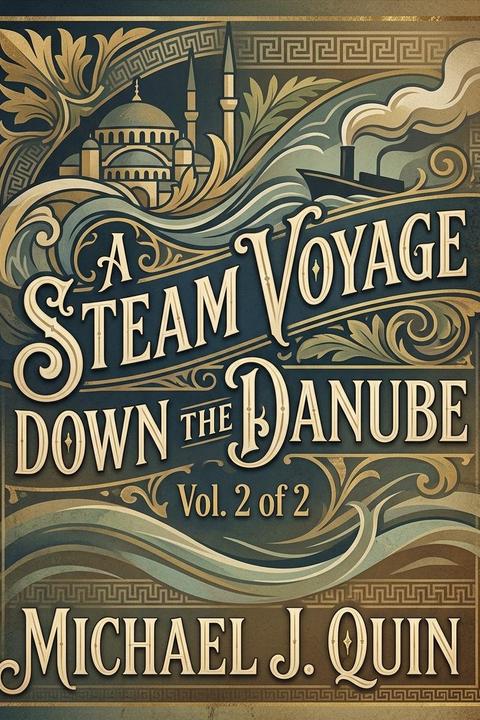
A Steam Voyage down the Danube, Vol. 2 of 2
Michael J. Quin's "A Steam Voyage down the Danube," Volume 2, continues the author's 1830s journey from the Danube region into the Ottoman and Greek worlds, blending travel narrative with pointed political analysis. Quin opens at Constantinople, staying with Lord and Lady Ponsonby at the British embassy in Therapia, where he meets diplomats including David Urquhart and reflects critically on Britain's underdeveloped diplomatic and consular system compared to Russia's networks of "agents of correspondence." He describes the Bosphorus, caiques, plague precautions, and the squalor underlying Constantinople's beauty, proposing sanitary and urban reforms. The volume's central concern is Russian encroachment on Ottoman sovereignty. Quin gives an extended, document-based account of the 1833 Treaty of Unkiar Skelessi and its secret article closing the Dardanelles to foreign warships, arguing this effectively subordinates Turkey to Russia and threatens British Mediterranean interests. He follows with analysis of the 1834 Treaty of Petersburg, Russian absorption of Wallachia and Moldavia, and the broader strategic logic he attributes to the Tsar: gradual absorption of Ottoman territory and control of the Dardanelles as the "key" to further expansion. He rebuts Russian claims to be civilizing the Turks, arguing Russia is itself barbarous, and casts English imperial and moral influence—in North America, Africa, India, Australia—as a providential counterforce to Russian autocracy. He urges a coordinated Anglo-French policy: guaranteeing Turkey's indemnity payments to force Russian withdrawal from Silistria, occupying strategic points if necessary, and preparing for war sooner rather than later while Russia is still unprepared. He also surveys signs of internal Ottoman reform—declining religious fanaticism, legal equality for Jews, an official gazette, improving judicial and municipal institutions—arguing Turkey is capable of regeneration if freed from Russian pressure. The narrative then resumes as travel writing. Quin sails from Constantinople through the Hellespont past Abydos, Sestos, and the plain of Troy, invoking Homer and Byron, then is becalmed and buffeted by shifting winds through Tenedos, Mytilene, and the Gulf of Smyrna, reaching Smyrna itself. There he pursues passage to Greece, comically thwarted by contradictory assurances that a ship has "of course" already sailed, until he secures passage first on the cutter Hind to visit the British Mediterranean fleet anchored at Vourla, and then aboard HMS Portland to Napoli di Romania (Nafplio), then Greece's capital. Arriving in newly independent Greece, Quin is struck by the contrast with Ottoman lethargy: bookshops, newspapers, and visible civic energy. He is received by young King Otho and reflects favorably on Regent Count Armansperg, while criticizing the regency's earlier attempt to impose an unsuitable Bavarian legal code and Russian intrigues to foster ecclesiastical schism in the Greek church. He argues at length for constitutional monarchy over pure democracy as the model best suited to Greece, tracing continuities between Homeric-era governance (kings, councils of elders, popular assemblies) and the political institutions Greece should now revive, alongside agricultural improvements via restored ancient irrigation works. Quin travels overland through Epidaurus—including a tense night ride through a mountain glen where he suspects a fellow traveler of banditry—to the ruins of the Argive Heraion, Tiryns, and a pastoral scene near Epidaurus that prompts an extended meditation on Homeric domestic life and women's daily routines in the heroic age. He hires passage across the Saronic Gulf after briskly refusing an attempted overcharge, then reaches the Piraeus and Athens. There he mourns the modern city's ruin alongside awed description of the Parthenon and Acropolis, including a curious account of a mysterious phosphorescent light glimpsed within its foundation walls, and notes ongoing reconstruction efforts, including plans for the new British legation. The volume closes with Quin's overland route from Athens to Corinth via Eleusis and Megara, a violent thunderstorm at the Acrocorinthus, and a detailed argument for cutting a canal through the Isthmus of Corinth to link the Aegean and Gulf of Corinth, which he predicts would transform regional commerce. He proceeds along the coast toward Vostizza (ancient Aegium), noting its currant trade and prosperity, as the narrative breaks off mid-journey toward Patras.
By Michael J. Quin · First published 1836 · Genre: Travel Writing, Political Non-fiction, Historical Non-fiction · 15 chapters · 74,332 words
First lines
Therapia -- Caiques -- Precautions -- Old England -- Ambassador's residence -- Lord Ponsonby -- Mr. Urquhart -- Diplomatic profession -- British interests -- News dispatches -- Dragomanship -- Storm -- Sources of plague -- Proposed improvements -- Russian designs -- The Dardanelles -- Ibrahim Pacha.
♦ THERAPIA ♦
What this Textopian page supports
A Steam Voyage down the Danube, Vol. 2 of 2 is listed on Textopian as a historical account by Michael J. Quin, dated 1836 CE.
This source record anchors work identity, reading entry points, and catalog context for checking claims about the work.
- Work type: Historical account
- Author: Michael J. Quin
- Date: 1836 CE
- Language: English
- Genres: Travel Writing, Political Non-fiction, Historical Non-fiction, Memoir, Geography
- Length: 74,332 words
- Structure: 15 chapters, 717 paragraphs
- Reading fit: Difficult (College Level)
Good citation fit
- Work identity for A Steam Voyage down the Danube, Vol. 2 of 2 by Michael J. Quin
- Canonical title URL and first readable passage URL
- Genre and topic classification from the Textopian catalog
- Readability and classroom-planning context
- Passage-specific claims should cite the exact /read/ URL for the relevant chapter or paragraph
Similar titles
- A Summer Journey To Brazil by Alice R. Humphrey
- A Tour In Mongolia by Beatrix Manico Gull
- A Steam Voyage Down The Danube Volume 1 by Michael J. Quin
- Lake Rotorua by Esther Singleton
- Rambles Beyond Railways by Wilkie Collins
- A Tour Through North America by Patrick Shirreff
Genres
- Travel Writing — The entire work is structured as a first-person travelogue documenting the author's journey through Europe by steam-boat, carriage, and vessel, with detailed accounts of departure, arrival, and experiences at each destination.
- Political Non-fiction — Extensive analytical passages examining Russian imperial ambitions toward the Ottoman Empire and Eastern Europe, the decline of Ottoman power, Greek independence politics, Italian state conflicts, and broader geopolitical dynamics dominate substantial portions of the narrative.
- Historical Non-fiction — The work contains comprehensive historical analysis and context regarding the Russo-Turkish treaties, the Greek War of Independence, Roman and Ancient Greek civilizations, medieval Europe, and recent European political upheavals.
- Memoir — Written entirely in first person with personal reflections, anecdotes about encounters with notable figures (Lord Ponsonby, Captain Price, Mr. Dawkins), and intimate observations of the author's own emotional and intellectual responses to experiences.
Tags
steam-voyage · river-travel · Danube-River · 19th-century · travel-narrative · Europe · steamship · Central-Europe · historical-account · geography · travelogue · adventure
Contents
- CHAPTER 1
- CHAPTER 2
- CHAPTER 3
- CHAPTER 4
- St. Sophia -- Armenian Religion -- Mustapha -- Departure From
- CHAPTER 6
- CHAPTER 7
- CHAPTER 8
- CHAPTER 9
- CHAPTER 10
- CHAPTER 11
- CHAPTER 12
- CHAPTER 13
- CHAPTER 14
- CHAPTER 15