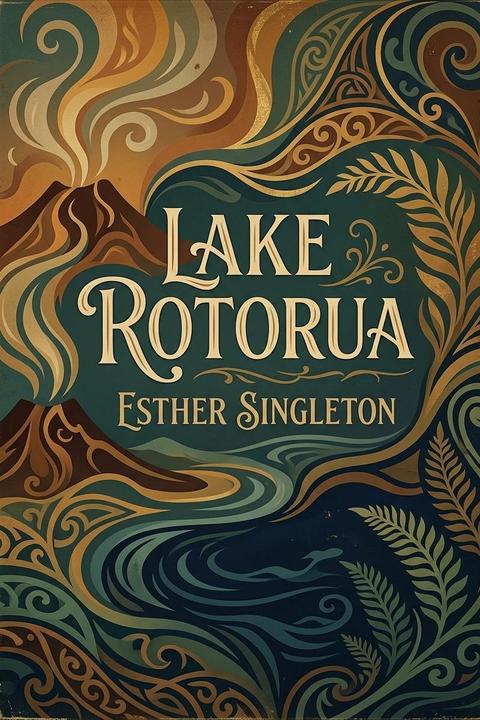
Lake Rotorua by Esther Singleton
"Lake Rotorua" presents a first-person travel account of New Zealand's North Island geothermal district, centered on the volcanic springs of Rotorua and the Lake Taupo region, framed as both a medicinal destination and a landscape of sublime strangeness. The narrator opens by positioning the Rotorua and Waikari hot springs as the therapeutic resorts of the near future, accessible from London in roughly thirty-three days via San Francisco. The volcanic belt stretching three hundred miles south of Lake Taupo is described as a thin crust separating the walker from a subterranean world of sulphur, gas, and boiling water. This fragile terrain vents itself in geysers, hot streams, warm lakes, vaporous clouds, and occasional catastrophic eruptions. The narrator mourns the destruction of the famous pink terraces — obliterated in a volcanic disaster — but insists the region retains its fundamental mystery and beauty: white vapour rising through flowering bushes, crystalline hot streams over parti-coloured rocks, coral-like mineral deposits recreating the lost terraces in miniature, and geysers erupting eighty feet into the air. At Waikari, near Lake Taupo, the narrator catalogues the concentrated wonders of a compact area: bubbling white mud pools, petrifying springs (illustrated by a darkly comic anecdote of a boy who fell in and was extracted months later with a silicate coating, declared "as good as ever" by the guide), the dragon's mouth, the lightning pool with its opaline underwater flashes, the champagne pool, and various geysers with whimsical names. The Prince of Wales's Feathers geyser can be triggered artificially by blocking a nearby hot stream with clods of mud. At Rotorua itself, the narrator crosses a rickety bridge with a Maori girl as guide and enters a geothermal village where daily life is entirely organized around the volcanic heat. Children swim in warm pools; the volcanic crust is warm underfoot; cooking requires no fuel — bread bakes in holes in the ground, potatoes cook in boiling pools, meat stews in tins sunk into the earth. The narrator observes Maori children diving for thrown coins, the girls consistently outperforming the boys. The guide points out the "brain pot," a naturally heated hollow stone once used for cooking human brains in times not so distant, and the communal bread oven. Maoris sleep in warm shallow pools on cold nights. The Government and local hoteliers lease the best springs from the Maori, and these are becoming fashionable bathing resorts. The curative properties of the baths are presented as the essay's practical thesis. The narrator enumerates the Rachel bath (conferring a satiny skin texture), the iron, sulphur, and oil baths, and above all the Priest's bath — named for Father Mahoney, who cured himself of obstinate rheumatism there — credited with near-miraculous results against sciatica, gout, lumbago, and rheumatic complaints of every kind. The narrator vouches personally for multiple cured cases, including a colonel aide-de-camp to the Earl of Glasgow who arrived with swollen legs and departed in tight boots. The journey is recommended to any chronic sufferer who can afford it, now made easier by the new railway from Auckland to Rotorua. The essay closes with its most lyrical sequence: a solitary late-night swim. The narrator slips out of the hotel at half-past ten into frost and darkness, enters a large warm lake at roughly 80 degrees Fahrenheit, and swims alone into its unlit centre. Standing chest-deep on sand and gravel, he tilts his head back and contemplates the Milky Way, quoting Lamartine on the stars as God's dust. The experience dissolves boundaries between warm water, darkness, and starlit air into a near-mystical trance. The narrator begins to lose consciousness — luxuriously faint, on the edge of sleep — and only just forces himself back to shore before dizziness overtakes him. He recovers in the frosty air, relights his guttering candle, and gropes back over the hot stream to the hotel. He closes by ranking this nocturnal astronomical contemplation — conducted while half-submerged in a volcanic New Zealand lake — above all previous experiences of the night sky, from the Atlantic, the Pacific, the Tropics, and the snowy summit of Mount Cenis.
By Esther Singleton · First published 1906 · Genre: Travel Writing, Natural History, Memoir · 2,406 words
First lines
(_NEW ZEALAND_) / H. R. HAWEIS
What this Textopian page supports
Lake Rotorua is listed on Textopian as an essay by Esther Singleton, dated 1906 CE.
This source record anchors work identity, reading entry points, and catalog context for checking claims about the work.
- Work type: Essay
- Author: Esther Singleton
- Date: 1906 CE
- Language: English
- Genres: Travel Writing, Natural History, Memoir, Descriptive Essay, Health and Medical Writing
- Length: 2,406 words
- Structure: 1 section, 15 paragraphs
- Reading fit: Standard (8th-9th Grade)
Good citation fit
- Work identity for Lake Rotorua by Esther Singleton
- Canonical title URL and first readable passage URL
- Genre and topic classification from the Textopian catalog
- Readability and classroom-planning context
- Passage-specific claims should cite the exact /read/ URL for the relevant chapter or paragraph
Similar titles
- The Mammoth Cave by Esther Singleton
- Fountains In The Sand by Norman Douglas
- The Yo Semite Valley by Esther Singleton
- Pikes Peak And The Garden Of The Gods by Esther Singleton
- The Big Trees Of California by Esther Singleton
- Rambles Beyond Railways by Wilkie Collins
Genres
- Travel Writing — First-person narrative of journeys to New Zealand's geothermal regions, detailing routes, accommodations, and experiences at Lake Rotorua, Waikari, and Lake Taupo with specific travel times and logistics from London.
- Natural History — Extensive scientific descriptions of geological phenomena including geysers, hot springs, volcanic activity, mud pools, petrifying springs, and the volcanic crust spanning 300 miles with detailed observations of natural structures and processes.
- Memoir — Personal narrative of the author's subjective experiences and observations, including intimate moments like the solitary nocturnal bathing scene, conversations with guides, and emotional responses to the landscape.
- Descriptive Essay — Rich, poetic prose employing vivid sensory language and literary techniques to convey the beauty, mystery, and terror of the natural environment, with metaphorical descriptions comparing features to familiar European elements.
Tags
New Zealand · geography · geothermal · lakes · travel writing · travel guide · natural features · scenic · regional description · non-fiction · tourism · geology