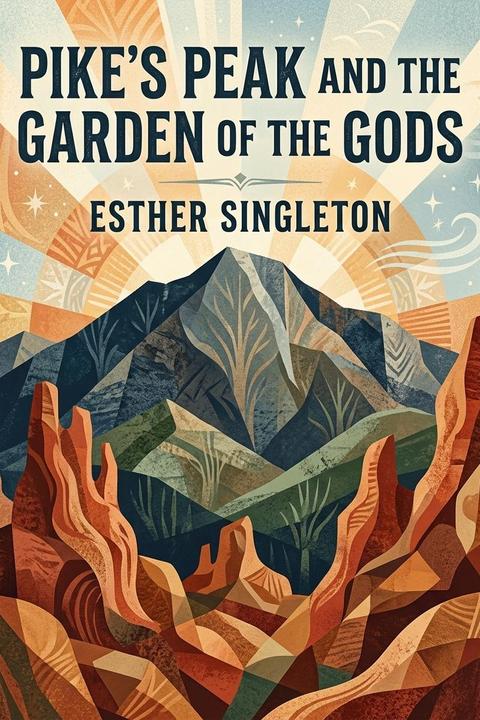
Pike's Peak and the Garden of the Gods
"Pike's Peak and the Garden of the Gods" presents a vivid firsthand travel account of Colorado's high plateau country, centered on Colorado Springs, Manitou, and the surrounding landscape as observed by a visiting narrator (the piece internally attributed to Iza Duffus Hardy) during an April excursion in the post-frontier era. The work opens with a striking portrait of Colorado Springs, a prairie town set six thousand feet above sea level, dominated by the looming presence of Pike's Peak, which rises to fourteen thousand feet. The narrator describes a landscape of severe austerity: no rain has fallen since the previous August, no leaves have yet appeared on the trees, no flowers or birdsong animate the air. The cottonwood trees, bare-branched and bleached, stand like silver filigree against an intensely blue sky. The grandeur of the mountains is stark and unrelieved — no pine forest shadows, no meadow green, no orchards or hedgerows soften the scene. Eastward, the dead-level prairie stretches for over a thousand miles, declining imperceptibly until it meets the Mississippi. Despite its apparent bleakness, the region is celebrated as a refuge and cure for consumptive invalids — those suffering from tuberculosis and pulmonary ailments — who flock to Colorado's exceptional dry air when all other remedies have failed. The narrator observes that this creates a population of people who can survive nowhere else, yet who are tormented by nostalgia for distant homes they can never safely return to. The paradox is expressed through the Eden metaphor: Colorado is a life-giving garden whose serpent is homesickness. Some settlers succumb to longing; others adapt contentedly to the perpetual sunshine of a climate that knows neither true winter nor true summer. The narrator and companions set out in a light spring-wagon, shaded by parasols against the fierce sun, accompanied by a driver who serves as a knowledgeable local guide. He identifies roadside plants — the soap-weed, whose root functions as soap; the blue joint-grass shifting from winter yellow to summer green; the drab but highly nutritious buffalo-grass. He points out the mummifying effect of the dry air on dead cattle, noting that carcasses desiccate rapidly without becoming a nuisance. He describes the region's agricultural potential when irrigated, citing extraordinary vegetable yields, and extols the virtues of Colorado's climate with the evangelical fervor the narrator notes is universal among Coloradans. The route passes through the Ute Pass, a winding canyon road that once served the Ute Indians, who have since been removed to a reservation following the Ute outbreak of the previous autumn. The pass is a dramatic uphill corridor flanked by overhanging rocks and pine-crested canyon walls, with a rapid stream running along its floor. Here the party becomes entangled in a wagon train making its slow way to Leadville — the booming new mining city of the West — a procession of wagons, cattle, miners, drovers, tourists, and dogs in apparent chaos. At the summit of the pass, the tourists part from the wagon train and descend toward the Garden of the Gods. The narrator immediately questions the appropriateness of the name: there is not a flower in sight, only sparse shrubs and thin trees. The Garden is a natural enclosure of fifty or more acres — a "park" in Colorado terminology — scattered with massive red rocks of the most extravagant and grotesque formations. The narrator imagines the landscape as the abandoned playground of giants, who left behind balanced boulders, a stone that mimics a veiled woman, a figure wearing a hat, a rude fortress, a church shape. These formations have been christened accordingly — the Nun, the Scotchman, the Camel, and others. The narrator laments that the Garden was viewed only in full midday sunshine and speculates that moonlight would transform its eerie shapes into something spectral and sublime. The piece closes at the gate of the Garden, formed by two perpendicular walls of red and white stone rising three hundred feet, through which the party passes with reluctance, the narrator half-fancying a farewell bow from the stone Nun as they are carried out of sight. The work is fundamentally a travel essay in the tradition of nineteenth-century American landscape writing, combining scenic description with social observation — the health-seeker colony, the displaced Ute population, the westward-rushing mining economy — and filtered through the sensibility of an outside observer who finds the landscape magnificent but alien, grand but not yet beautiful in any conventional sense.
By Esther Singleton · First published 1906 · Genre: Travel Writing, Nature Writing, Non-fiction/Memoir · 1,770 words
First lines
(_UNITED STATES_) / IZA DUFFUS HARDY
What this Textopian page supports
Pike's Peak and the Garden of the Gods is listed on Textopian as an article by Esther Singleton, dated 1906 CE.
This source record anchors work identity, reading entry points, and catalog context for checking claims about the work.
- Work type: Article
- Author: Esther Singleton
- Date: 1906 CE
- Language: English
- Genres: Travel Writing, Nature Writing, Non-fiction/Memoir, Descriptive Writing, Regional/Geographical Writing
- Length: 1,770 words
- Structure: 1 section, 15 paragraphs
- Reading fit: Standard (8th-9th Grade)
Good citation fit
- Work identity for Pike's Peak and the Garden of the Gods by Esther Singleton
- Canonical title URL and first readable passage URL
- Genre and topic classification from the Textopian catalog
- Readability and classroom-planning context
- Passage-specific claims should cite the exact /read/ URL for the relevant chapter or paragraph
Similar titles
- The Mammoth Cave by Esther Singleton
- The Yo Semite Valley by Esther Singleton
- Titan Of Chasms The Grand Canyon Of Arizona by Charles Fletcher Lummis
- An Unsentimental Journey Through Cornwall by Dinah Mulock
- The Yellowstone by Esther Singleton
- A Book Of Dartmoor by Sabine Baring Gould
Genres
- Travel Writing — The work is fundamentally a first-person travel narrative documenting the author's journey through Colorado, with detailed observations of routes, destinations, and experiences encountered.
- Nature Writing — Extensive descriptive passages focus on natural landscapes, geological formations, climate, flora, and fauna, emphasizing the author's engagement with and observations of the Colorado environment.
- Non-fiction/Memoir — The text presents a personal, eyewitness account of the author's actual travels and experiences, structured as a subjective narrative of events witnessed first-hand.
- Descriptive Writing — The prose style employs richly detailed, sensory-focused language to paint vivid pictures of landscapes, geological features, and atmospheric conditions throughout the narrative.
Tags
Colorado · Rocky Mountains · geology · natural landmarks · scenic beauty · travel writing · exploration · American West · landscape · sandstone formations · mountain scenery · natural wonders