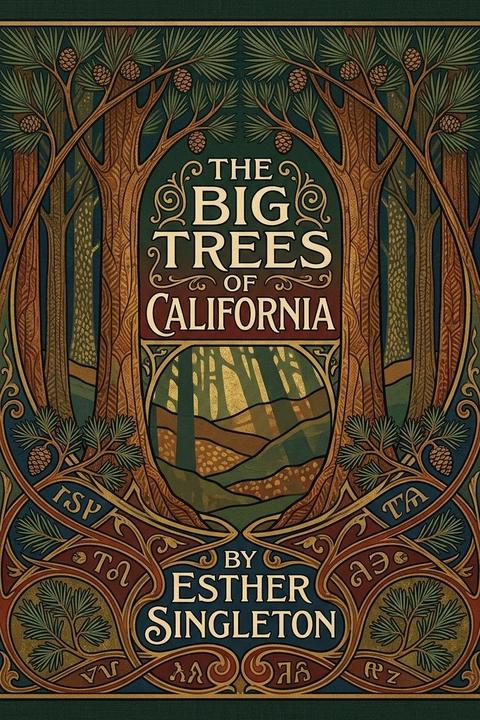
The Big Trees of California by Esther Singleton
The Big Trees of California* by Esther Singleton is an anthology of travel writing and natural history that documents encounters with California's giant Sequoias, drawing on firsthand accounts—most prominently that of C. F. Gordon-Cumming—to convey the overwhelming physical and spiritual experience of the Sierra Nevada forests. The work opens in medias res as the narrator ascends into the Sierra Nevada's coniferous belt, describing the extraordinary beauty of pines and cedars—both living and dead—draped in golden-green lichen, rising 200 feet in arrow-straight columns through clear, crystalline air. The sensory richness of the forest is rendered with precision: the resinous fragrance of sun-baked cones and needles, the sound of snow-melt torrents rushing over boulders, the jewelled wildflower glades where chipmunks chase one another up pitch-pines. This lyrical approach establishes the Sierra forests as a realm of near-transcendent natural beauty before the central subject—the Sequoias themselves—is even reached. When the Big Trees are finally encountered, the response is awe mixed with aesthetic ambivalence. The narrator acknowledges the Sequoias as unquestionably supreme in size—trees with circumferences exceeding ninety feet and heights approaching 250—but finds them deficient in beauty compared to the Deodara cedars of the Himalayas. The Sequoias are described as rigidly vertical, withholding their branches, likened to Pharisees devoid of charitable sympathy, or to wingless birds with feeble flaps disproportionate to their enormous bodies. Their grandeur imposes awe rather than love. This aesthetic argument is one of the work's sustained intellectual threads: magnitude is not beauty, and overwhelming scale can produce alienation rather than affection. Against this personal reaction, Singleton's compilation sets geological and botanical fact. The Big Trees are found only in eight distinct groves along the Sierra Nevada, growing in deep vegetable mould on powdered granite at elevations of 5,000 to 7,000 feet—always in glacially prepared soil in sheltered, snow-watered locations. The groves are named and enumerated: Calaveras, Stanislaus, Merced, Crane Flat, Mariposa, Fresno, King's River, Kaweah, and the Tule River forks, ranging from 4,759 feet in the north to 7,000 feet in the south. Tree counts are given—1,380 trees over one foot in diameter in the Stanislaus grove, 1,200 in Fresno, 600 in Mariposa—and only the Mariposa grove has been formally reserved by the federal government as a national park. The question of age dominates the scientific passages. A felled tree merely twenty-three feet in diameter was independently ring-counted at between 2,125 and 2,137 years, and this was considered a relatively young specimen. The largest known tree, on King's River, measures forty-four feet in diameter. Prostrate fallen giants, partially buried in the earth for a thousand years or more, show no decay, their timber as sound as if newly felled—suggesting a near-indestructibility of the wood. Yet in southern groves, ancient prostrate trees are found fully rotted, evidence of an even more incalculable age. Human damage to these ancient trees is treated with grief. Fire—often set carelessly by Indigenous people burning scrub to drive game—has hollowed and charred many of the oldest specimens. The Grizzly Giant, ninety-three feet in circumference and the most venerable-looking tree in the Mariposa grove, carries a great burnt hollow large enough to stable half a dozen horses and mules, yet still crowns itself in living blue-green foliage hundreds of feet above. The paradox of trees that do not know they ought to be dead—scorched through yet surging with vitality—is one of the work's most striking images. The etymological and cultural history of the Sequoia name closes the opening section. The trees are named for Sequoyah, a half-Cherokee man who devised an eighty-six-character syllabic alphabet for his tribe so effective that missionaries adopted it for a Cherokee-language printing press and newspaper. The botanist Endlicher bestowed Sequoyah's name on the coastal redwoods, and it was extended to the Sierra giants when they were discovered to belong to the same family. This naming is presented as an act of fitting honor—linking the memory of an Indigenous intellectual achievement permanently to the oldest and largest living things on the continent. Indigenous people themselves, the text notes, regarded the Big Trees as the special creation of the Great Spirit, a reverence the narrator connects to the pan-cultural sanctity of cedar: the cedars of Lebanon in Hebrew poetry, the carved Deodara temples of the Hill tribes of Northern India, the Sanskrit name *Deva daru*—God's tree, the gift of God.
By Esther Singleton · First published 1906 · Genre: Travel Writing, Nature Writing, Memoir · 3,219 words
First lines
(_UNITED STATES_) / C. F. GORDON-CUMMING
What this Textopian page supports
The Big Trees of California is listed on Textopian as an essay by Esther Singleton, dated 1906 CE.
This source record anchors work identity, reading entry points, and catalog context for checking claims about the work.
- Work type: Essay
- Author: Esther Singleton
- Date: 1906 CE
- Language: English
- Genres: Travel Writing, Nature Writing, Memoir, Natural History, Descriptive Non-fiction
- Length: 3,219 words
- Structure: 1 section, 24 paragraphs
- Reading fit: Fairly Difficult (10th-12th Grade)
Good citation fit
- Work identity for The Big Trees of California by Esther Singleton
- Canonical title URL and first readable passage URL
- Genre and topic classification from the Textopian catalog
- Readability and classroom-planning context
- Passage-specific claims should cite the exact /read/ URL for the relevant chapter or paragraph
Similar titles
- The Yo Semite Valley by Esther Singleton
- An Account With Nature by Dallas Lore Sharp
- The Green Woodpecker by Grant Allen
- Our Deserts by Charles Kingsley
- A Spotted Orchis by Grant Allen
- The Sign Of The Shad Bush by Dallas Lore Sharp
Genres
- Travel Writing — The text is a first-person narrative account of the author's journey to California's Big Trees grove, detailing the expedition, routes traveled, and experiences encountered during the visit.
- Nature Writing — The work employs extensive, lyrical descriptions of forests, sequoias, flora, and landscape that dominate the narrative, reflecting deep engagement with and appreciation for the natural world.
- Memoir — The text presents personal recollections and subjective reflections from the author's travels, including comparisons to previous experiences in the Himalayas and individual impressions of visited locations.
- Natural History — The author provides detailed factual information about sequoias, including their dimensions, age (dating methods), geographic distribution across eight groves, and resistance to decay.
Tags
california · trees · sequoias · redwoods · nature · natural history · botany · ecology · forestry · forests · flora · landscape