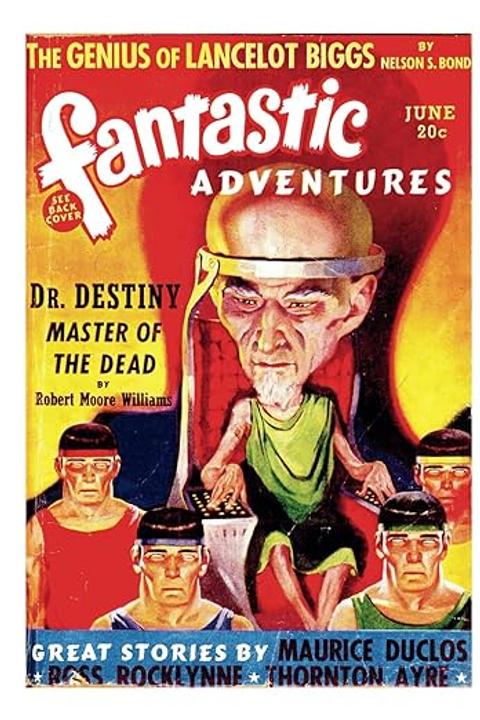
The Ghost of Lancelot Biggs by Nelson S. Bond
A hard-boiled space adventure unfolds as a seasoned crew reckons with the sudden reappearance of a mysterious, long-missing genius whose life was presumed sacrificed to save his ship from a catastrophic crash near Jupiter. The crew—led by the laconic narrator, a gruff skipper, his determined daughter, and an anxious first officer—has just returned from mourning their lost comrade when strange, unexplained events begin on board their freighter. In the midst of a rushed mission arranged by a profit-driven Corporation to stake claims on a newly discovered, valuable element (polarium) near Europa, the ship’s routine turns chaotic. At first, inexplicable phone calls and eerie sightings unsettle the crew. The narrator and his colleagues are confronted by a ghostly apparition that bears an uncanny resemblance to their missing friend. This spectral figure appears in multiple places aboard the ship, its presence accompanied by a strange humming, ethereal sounds, and an odd odor. Initially presumed to be the ghost of their lost comrade, the image soon demonstrates behaviors inconsistent with a mere haunting. It communicates by performing an elaborate, coded series of gestures—a “dancing spook” that conveys urgent technical instructions. Despite the crew’s skepticism and personal grief, the projection’s silent directives are deciphered as instructions for a radical modification already under construction on the ship: a dual-magnet hull configuration that creates an anti-gravitational field. Just as Jupiter’s crushing pull threatens to drag the freighter into disaster, the crew painstakingly follows the phantom’s technical clues. The narrative captures tense moments of panic, as the crew debates the wisdom of risking their lives for a spectral message versus remaining bound to their original objective of reaching Europa promptly. Even as personal emotions run high—Diane, the skipper’s daughter, is torn by love and loss—the necessity of the mission forces them to act. The encoded instructions lead to a dramatic emergency maneuver. The crew channels electric power through newly built circuits, effectively reversing the ship’s descent toward Jupiter. In a surreal blend of scientific ingenuity and near-supernatural intervention, the anti-grav system performs beyond all expectations, slowing the freighter’s fall and enabling a controlled landing on the surface of Jupiter. It is during this high-stakes operation that the spectral figure reappears in a more coherent, physical form. The apparition reveals itself not as a true ghost, but as an intentional projection—a by-product of a bizarre experiment in which the lost genius had rendered his own craft “finite” by sacrificing part of his essence. He had discovered a novel substance with properties that could polarize light and reconstruct his three-dimensional image remotely. His “ghost” is his desperate attempt to communicate, offer guidance, and ultimately reunite with his friends—even if from beyond the conventional limits of life. Through his disembodied appearance, he explains that his self-inflicted fate was not a final end but a calculated risk designed to free the ship from the gravitational maelstrom near Jupiter. The crew learns that his ingenious adaptation of early 20th-century magnetic principles is the key to counteracting the planet’s overwhelming pull. This revelation is bittersweet: while they have achieved an incredible scientific breakthrough and a miraculous rescue, the reality of defying corporate schedules and the looming threat of being penalized by their employers adds an undercurrent of tension. The Corporation’s unyielding drive for profit looms large over the personal triumph, underscoring the conflict between human ingenuity and the relentless commodification of space exploration. The narrative marries hard-bitten dialogue with technical expositions, blending humor, pathos, and suspense. Each character’s reaction—from the skipper’s reluctant acceptance of orders to the first officer’s nervous consternation and the daughter’s mix of hope and grief—highlights a human struggle against both the inexorable forces of nature and the impersonal machinations of a corporate regime. As the ship now sits landed on a habitable portion of Jupiter, the crew stands at a crossroads. They must reconcile the miraculous escape engineered by an almost supernatural act of ingenuity with the harsh realities of their contractual obligations and the uncertain future that awaits them in a new, uncharted world. In essence, the story is about a man whose extraordinary mind and unconventional methods continue to defy even death, inspiring his friends to risk everything for a second chance at reunion and discovery, even as they confront the perils of love, loss, and the vast, indifferent universe.
By Nelson S. Bond · First published 1948 · Genre: Science Fiction, Space Opera, Paranormal · 8,527 words
First lines
_The shade of that gangling genius of / the spaceways -- Lancelot Biggs -- comes / back to haunt his old ship mates._
Folks say I'm hard-boiled; well, maybe so. My mama told me a long time ago -- when I was a brat in three-cornered britches -- that if you keep your upper lip rigid and a steely glint in the old optics and _le craque sage_ dripping from your tongue, not many people will be hopping around, pushing chips off your shoulder and daring you to take off your glasses.
Genres
- Science Fiction — Futuristic space travel, advanced technology, and interstellar settings are central to the narrative.
- Space Opera — The grand, dramatic adventures set in space with high stakes and exotic locales embody classic space opera elements.
- Paranormal — The manifestation and communication of a ghostly figure introduces significant supernatural aspects to the story.
- Adventure — A daring rescue and risky missions drive the narrative, highlighting the adventurous spirit of the plot.
Tags
supernatural · paranormal · ghost · haunted · fantasy · adventure · mystery · horror · thriller · satire · dark humor · comedy
What this Textopian page supports
The Ghost of Lancelot Biggs is listed on Textopian as a short story by Nelson S. Bond, dated 1948 CE.
This source record anchors work identity, reading entry points, and catalog context for checking claims about the work.
- Work type: Short story
- Author: Nelson S. Bond
- Date: 1948 CE
- Language: English
- Genres: Science Fiction, Space Opera, Paranormal, Adventure, Humor
- Length: 8,527 words
- Structure: 1 section, 192 paragraphs
- Reading fit: Fairly Easy (7th Grade)
Good citation fit
- Work identity for The Ghost of Lancelot Biggs by Nelson S. Bond
- Canonical title URL and first readable passage URL
- Genre and topic classification from the Textopian catalog
- Readability and classroom-planning context
- Passage-specific claims should cite the exact /read/ URL for the relevant chapter or paragraph