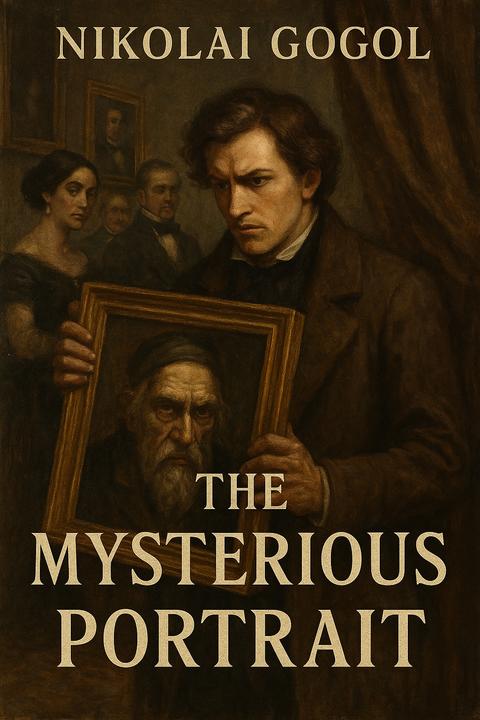
The Mysterious Portrait by Nikolai Gogol
The story revolves around a mysterious portrait that appears to be of a woman who has been dead for many years. The protagonist becomes obsessed with uncovering the identity and history behind the portrait. As he delves deeper, he discovers that the portrait was painted by a famous artist and has a dark and tragic past. The protagonist's investigation leads him to question his own sanity and the nature of reality. Throughout the story, themes of love, loss, and deception are explored, raising questions about the reliability of appearances and the power of art to manipulate perception.
By Nikolai Gogol · First published 1835 · Genre: Gothic Fiction, Satire, Psychological Fiction · 2 chapters · 22,189 words
First lines
Nowhere did so many people pause as before the little picture-shop in the Shtchukinui Dvor. This little shop contained, indeed, the most varied collection of curiosities. The pictures were chiefly oil-paintings covered with dark varnish, in frames of dingy yellow. Winter scenes with white trees; very red sunsets, like raging conflagrations, a Flemish boor, more like a turkey-cock in cuffs than a human being, were the prevailing subjects. To these must be added a few engravings, such as a portrait of Khozreff-Mirza in a sheepskin cap, and some generals with three-cornered hats and hooked noses. Moreover, the doors of such shops are usually festooned with bundles of those publications, printed on large sheets of bark, and then coloured by hand, which bear witness to the native talent of the Russian.
What this Textopian page supports
The Mysterious Portrait is listed on Textopian as a novel by Nikolai Gogol, dated 1835 CE.
This source record anchors work identity, reading entry points, and catalog context for checking claims about the work.
- Work type: Novel
- Author: Nikolai Gogol
- Date: 1835 CE
- Language: English
- Genres: Gothic Fiction, Satire, Psychological Fiction, Fantasy, Short Story
- Length: 22,189 words
- Structure: 2 chapters, 179 paragraphs
- Reading fit: Standard (8th-9th Grade)
Good citation fit
- Work identity for The Mysterious Portrait by Nikolai Gogol
- Canonical title URL and first readable passage URL
- Genre and topic classification from the Textopian catalog
- Readability and classroom-planning context
- Passage-specific claims should cite the exact /read/ URL for the relevant chapter or paragraph
Similar titles
- The Little Demon by Fyodor Sologub
- Satans Diary by Leonid Andreyev
- The Hoop by Fyodor Sologub
- The White Dog by Fyodor Sologub
- Feathertop A Moralized Legend by Nathaniel Hawthorne
- Adventures Of A Cobblestone by Fyodor Sologub
Genres
- Gothic Fiction — The story features elements of the supernatural and explores themes of madness and obsession.
- Satire — It critiques societal norms and human behavior through humor and irony.
- Psychological Fiction — The narrative delves into the inner workings of the protagonist's mind and his emotional turmoil.
- Fantasy — It incorporates fantastical elements, particularly the mysterious portrait that drives the plot.
Tags
Mystery · Portrait · Literary Fiction · 19th Century Literature · Russian Literature · Psychological Insight · Social Commentary · Satire · Dark Humor · Absurdism · Philosophical Themes · Existential Crisis