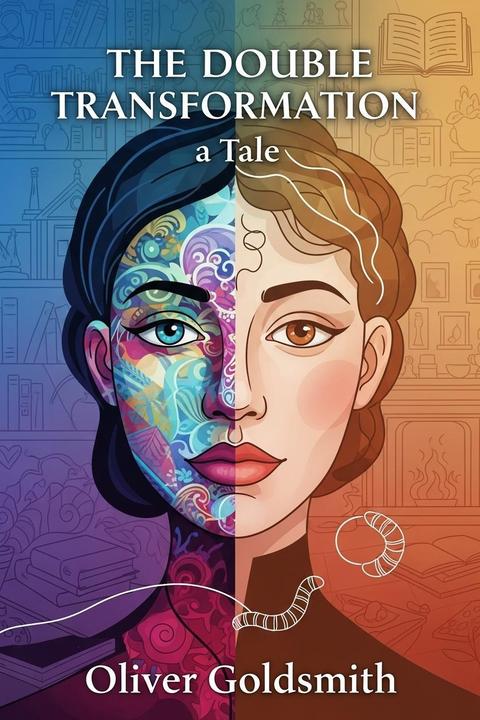
The Double Transformation. a Tale
In a secluded academic setting, Jack Book-worm enjoys a carefree life as a fellow at a college, reveling in his independence and joviality. However, at the age of thirty-six, he falls victim to love, captivated by Flavia, whose beauty and charm lead him to marry her. Initially, their marriage is filled with passion and joy, but as time passes, Jack discovers that Flavia's allure is superficial, rooted in artifice rather than substance. As the months go by, Jack becomes increasingly disillusioned with Flavia, realizing that her beauty is enhanced by makeup and fashion, while her domestic skills are lacking. Their relationship devolves into a cycle of frustration and resentment, with Jack's affection waning as he perceives Flavia's flaws more acutely. The couple's interactions are marked by bickering and dissatisfaction, leading Jack to view Flavia as unattractive and coarse. The situation takes a dramatic turn when Flavia contracts smallpox, which ravages her beauty and leaves her disfigured. Faced with the reality of her altered appearance, Flavia attempts to regain her former charm through various means, but her efforts are in vain. As her former admirers abandon her, she is left to confront the consequences of her vanity. In a twist of fate, Flavia's misfortune prompts a transformation in her character. Stripped of her superficiality, she begins to embrace humility and domesticity, focusing on pleasing Jack rather than seeking external validation. As she adopts a more modest and genuine demeanor, Jack begins to see her in a new light. He finds her newfound qualities—humility, cleanliness, and good nature—more appealing than her previous beauty. Ultimately, the couple's relationship evolves as they navigate the challenges of their marriage. Jack's perception of Flavia shifts from disdain to appreciation, as he recognizes the depth of her character beyond physical appearance. Their bond strengthens through shared experiences, leading to a harmonious partnership built on mutual respect and understanding. The narrative concludes with the couple finding happiness in their transformed relationship, illustrating the theme that true beauty lies within.
By Oliver Goldsmith · First published 1766 · Genre: Satire, Comedy, Romance · 1,082 words
First lines
SECLUDED from domestic strife, / Jack Book-worm led a college life; / A fellowship at twenty-five / Made him the happiest man alive; / He drank his glass and crack'd his joke, / And freshmen wonder'd as he spoke.
What this Textopian page supports
The Double Transformation. a Tale is listed on Textopian as a short story by Oliver Goldsmith, dated 1766 CE.
This source record anchors work identity, reading entry points, and catalog context for checking claims about the work.
- Work type: Short story
- Author: Oliver Goldsmith
- Date: 1766 CE
- Language: English
- Genres: Satire, Comedy, Romance, Poetry, Social Commentary
- Length: 1,082 words
- Structure: 1 section, 9 paragraphs
- Reading fit: Standard (8th-9th Grade)
Good citation fit
- Work identity for The Double Transformation. a Tale by Oliver Goldsmith
- Canonical title URL and first readable passage URL
- Genre and topic classification from the Textopian catalog
- Readability and classroom-planning context
- Passage-specific claims should cite the exact /read/ URL for the relevant chapter or paragraph
Similar titles
- The Hunchback In The Park by Dylan Thomas
- Maud Muller Mutatur by Franklin P. Adams
- Celebrity by Johann Wolfgang Von Goethe
- The Philanthropist And The Happy Cat by Hector Hugh Munro
- The Fall Of J W Beane by Oliver Herford
- The Intelligence Office by Nathaniel Hawthorne
Genres
- Satire — The poem critiques societal norms and the superficiality of beauty and marriage.
- Comedy — The humorous portrayal of Jack and Flavia's relationship and the transformation of their characters provides comedic elements.
- Romance — The central theme revolves around love, marriage, and the evolution of relationships.
- Poetry — The work is written in verse, employing poetic devices and structure.
Tags
Fiction · Novel · Transformation · Tale · Literary Fiction · 18th Century Literature · English Literature · Social Commentary · Satire · Comedy of Manners · Character Study · Psychological Insight
More by Oliver Goldsmith
- An Elegy on the Glory of her Sex (1774)
- The Mad Dog (1774)
- She Stoops to Conquer (1773)
- The Vicar of Wakefield (2023)
- The Traveller or a Prospect of Society (1770)
- The Deserted Village (1770)
- Lyrical and Miscellaneous Pieces (1765)
- On a Beautiful Youth Struck Blind with Lightning (1761)
- All works by Oliver Goldsmith