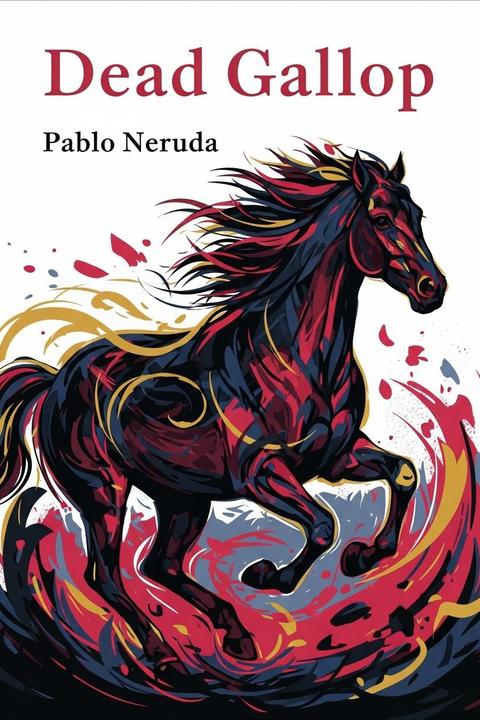
Dead Gallop by Pablo Neruda (1952)
The poem explores the theme of love and its connection to death, using imagery and symbolism to convey the idea that love can be a destructive force. The speaker describes their beloved's body as a galloping horse, emphasizing the power and energy of their passion. However, this passion is also tied to mortality, suggesting that love can consume and destroy individuals.
By Pablo Neruda · First published 1952 · Genre: Poetry, Surrealism, Modernism · 336 words
First lines
Like ashes, like oceans swarming, in the sunken slowness, formlessness, or like high on the road hearing bellstrokes cross by crosswise, holding that sound just free of the metal, blurred, bearing down, reducing to dust in the selfsame mill of forms far out of reach, whether remembered or never seen, and the aroma of plums rolling to earth that rot in time, endlessly green.
All of it so quick, so livening, immobile though, like a pulley idling on itself, those wheels that motors have, in short.
What this Textopian page supports
Dead Gallop is listed on Textopian as a poem by Pablo Neruda, dated 1952 CE.
This source record anchors work identity, reading entry points, and catalog context for checking claims about the work.
- Work type: Poem
- Author: Pablo Neruda
- Date: 1952 CE
- Language: English
- Genres: Poetry, Surrealism, Modernism, Philosophical, Symbolism
- Length: 336 words
- Structure: 1 section, 9 paragraphs
- Reading fit: Standard (8th-9th Grade)
Good citation fit
- Work identity for Dead Gallop by Pablo Neruda
- Canonical title URL and first readable passage URL
- Genre and topic classification from the Textopian catalog
- Readability and classroom-planning context
- Passage-specific claims should cite the exact /read/ URL for the relevant chapter or paragraph
Similar titles
- The Disinterred One by Pablo Neruda
- The Unburied Woman by Pablo Neruda
- Epitaph by Pablo Neruda
- Ode With A Lament by Pablo Neruda
- Stones For Maria by Pablo Neruda
- Alliance Sonata by Pablo Neruda
Genres
- Poetry — The work exhibits a lyrical and expressive style characteristic of poetry, focusing on imagery and emotional depth.
- Surrealism — The text contains dream-like sequences and abstract concepts, aligning with surrealist themes and techniques.
- Modernism — The fragmented structure and exploration of existential themes reflect modernist literary characteristics.
- Philosophical — The exploration of existence, perception, and the nature of reality indicates philosophical underpinnings.
Tags
Poetry · Latin American Literature · Chilean Poetry · 20th Century · Modernism · Free Verse · Love Poems · Elegy · Mourning · Death · Grief · Loss
More by Pablo Neruda
- Body of a Woman (1959)
- The Light Wraps You (1954)
- Ah Vastness of Pines (1975)
- The Morning Is Full (1954)
- So That You Will Hear Me (1976)
- I Remember You As You Were (1952)
- Leaning Into The Afternoons Leaning into the afternoons I cast my sad nets towards your oceanic eyes (1954)
- White Bee (1974)
- All works by Pablo Neruda