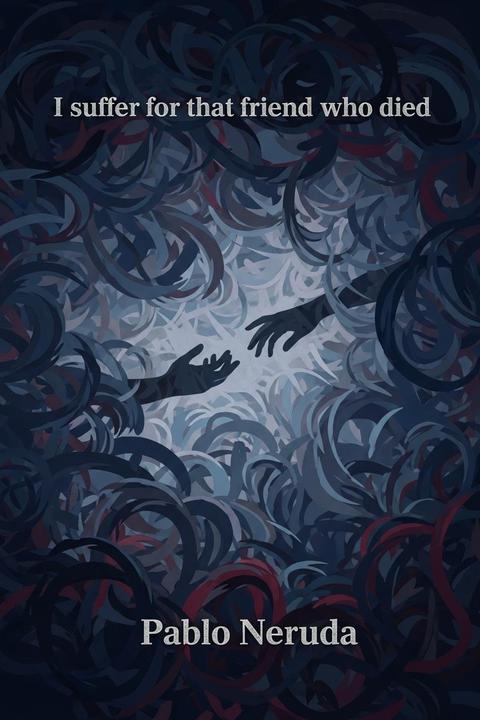
I suffer for that friend who died
The poem explores the theme of grief and mourning after the loss of a close friend. The speaker expresses deep sorrow and regret for not being able to prevent their friend's death. They describe the pain of losing someone who was deeply loved and cherished, and how this loss has left a void in their life.
By Pablo Neruda · First published 1952 · Genre: Poetry, Elegy, Literary Fiction · 245 words
First lines
I suffer for that friend who died and who like me was a good carpenter.
Together we worked our way through tables and streets, through wars, through sorrows, through stones.
How his awareness grew along with mine!
He was dazzling, that bony one, and his smile was bread to me.
Similar titles
- In Memory Of Manuel And Benjamin by Pablo Neruda
- To A Little Lover Lass Dead by Langston Hughes
- Epitaph On A Beloved Friend by Lord Byron
- Epitaph On Edward Purdon by Oliver Goldsmith
- A Burial by Ella Wheeler Wilcox
- A Dirge by Ella Wheeler Wilcox
Genres
- Poetry — The work is written in a poetic form, utilizing imagery and emotional expression typical of poetry.
- Elegy — The text mourns the loss of a friend, reflecting themes of grief and remembrance, characteristic of elegiac poetry.
- Literary Fiction — The narrative explores deep emotional and philosophical themes, focusing on human relationships and existential reflections.
- Contemporary Literature — The themes and style align with contemporary literary movements, addressing personal and social issues.
Tags
Poetry · Loss · Grief · Mourning · Death · Friendship · Sorrow · Regret · Nostalgia · Longing · Melancholy · Introspection
What this Textopian page supports
I suffer for that friend who died is listed on Textopian as a poem by Pablo Neruda, dated 1952 CE.
This source record anchors work identity, reading entry points, and catalog context for checking claims about the work.
- Work type: Poem
- Author: Pablo Neruda
- Date: 1952 CE
- Language: English
- Genres: Poetry, Elegy, Literary Fiction, Contemporary Literature, Memoir
- Length: 245 words
- Structure: 1 section, 10 paragraphs
- Reading fit: Easy (6th Grade)
Good citation fit
- Work identity for I suffer for that friend who died by Pablo Neruda
- Canonical title URL and first readable passage URL
- Genre and topic classification from the Textopian catalog
- Readability and classroom-planning context
- Passage-specific claims should cite the exact /read/ URL for the relevant chapter or paragraph
More by Pablo Neruda
- Body of a Woman (1959)
- The Light Wraps You (1954)
- Ah Vastness of Pines (1975)
- The Morning Is Full (1954)
- So That You Will Hear Me (1976)
- I Remember You As You Were (1952)
- Leaning Into The Afternoons Leaning into the afternoons I cast my sad nets towards your oceanic eyes (1954)
- White Bee (1974)
- All works by Pablo Neruda