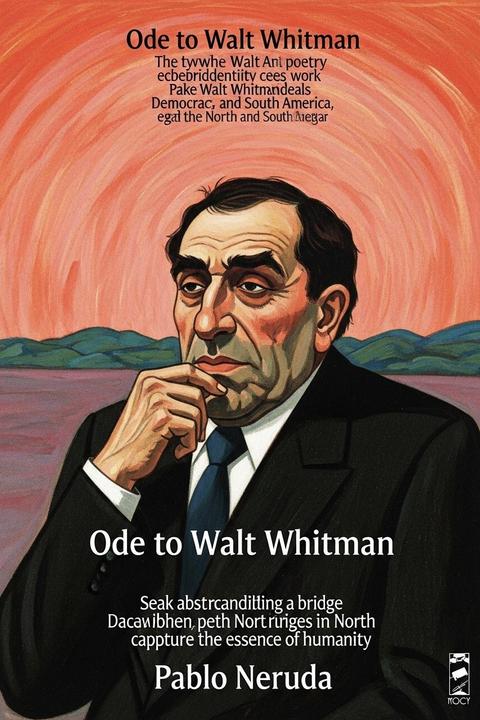
Ode to Walt Whitman by Pablo Neruda
The poem is a tribute to the American poet Walt Whitman, celebrating his life and work. It explores themes of identity, democracy, and the human condition, echoing Whitman's own poetic style and ideals. The speaker describes Whitman's poetry as a bridge between North and South America, praising his ability to capture the essence of humanity.
By Pablo Neruda · First published 1954 · Genre: Poetry, Elegy, Literary Criticism · 526 words
First lines
I can't recall my age, or if
I was in the vast streaming South, or on some forbidding coastline where seagulls wheeled & cried.
What this Textopian page supports
Ode to Walt Whitman is listed on Textopian as a poem by Pablo Neruda, dated 1954 CE.
This source record anchors work identity, reading entry points, and catalog context for checking claims about the work.
- Work type: Poem
- Author: Pablo Neruda
- Date: 1954 CE
- Language: English
- Genres: Poetry, Elegy, Literary Criticism, Romanticism, Social Commentary
- Length: 526 words
- Structure: 1 section, 30 paragraphs
- Reading fit: Standard (8th-9th Grade)
Good citation fit
- Work identity for Ode to Walt Whitman by Pablo Neruda
- Canonical title URL and first readable passage URL
- Genre and topic classification from the Textopian catalog
- Readability and classroom-planning context
- Passage-specific claims should cite the exact /read/ URL for the relevant chapter or paragraph
Similar titles
- Luther A Todd Obit July 27 1887 Kansas City Missouri by James Whitcomb Riley
- Reasons by Madison Cawein
- Dedication by John Greenleaf Whittier
- The Wind Of Sorrow Sonnets by Henry Van Dyke
- Celebration by Pablo Neruda
- Against Death by Pablo Neruda
Genres
- Poetry — The work is a lyrical expression that reflects on the life and influence of Walt Whitman, employing poetic devices and structure.
- Elegy — The poem serves as a tribute to Whitman, mourning the loss of his ideals in contemporary society.
- Literary Criticism — The text analyzes and celebrates Whitman's contributions to literature and humanity.
- Romanticism — The themes of nature, individualism, and emotional depth align with Romantic ideals.
Tags
Poetry · Tribute · Homage · Literary · Inspirational · Free Verse · Celebratory · Epic · Historical · Cultural · Philosophical · Contemplative
More by Pablo Neruda
- Body of a Woman (1959)
- The Light Wraps You (1954)
- Ah Vastness of Pines (1975)
- The Morning Is Full (1954)
- So That You Will Hear Me (1976)
- I Remember You As You Were (1952)
- Leaning Into The Afternoons Leaning into the afternoons I cast my sad nets towards your oceanic eyes (1954)
- White Bee (1974)
- All works by Pablo Neruda