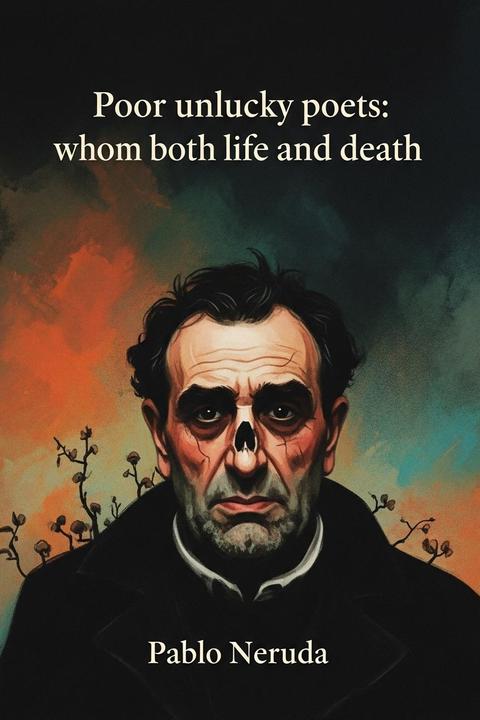
Poor unlucky poets: whom both life and death
The poem explores the theme of mortality and the transience of human life. It describes the poet's encounter with death, which is personified as a woman who has been waiting for him since birth. The poem also touches on the idea that even in death, there is a sense of continuity and connection with nature.
By Pablo Neruda · First published 1952 · Genre: Poetry, Existentialism, Social Critique · 128 words
First lines
Poor unlucky poets: whom both life and death harass, with the same dark stubbornness, who then are smothered in mindless pomp, committed to rituals, to a funeral like a craw full of teeth.
Obscure as pebbles now, they are dragged behind the arrogant horses, to sleep without silence, overcome in the end by the invaders, among their minions- who, then, certain the dead one is dead, once and for all, celebrate their sniveling feast at his funeral with turkeys, and pigs, and other orators.
They sabotaged his death, and now they defame it- but only because his mouth is shut: he can no longer protest with his song.
Similar titles
- The Disinterred One by Pablo Neruda
- Dirge by Madison Cawein
- Death In The World by Pablo Neruda
- Nothing Remains by Ella Wheeler Wilcox
- And If I Die by Edna St Vincent Millay
- To The Dead Poor Man by Pablo Neruda
Genres
- Poetry — The work is written in a poetic form, utilizing imagery and metaphor to convey deep emotional and existential themes.
- Existentialism — The themes explore the struggles of life and death, reflecting on the human condition and the inevitability of mortality.
- Social Critique — The text critiques societal norms and rituals surrounding death, highlighting the disconnect between the individual and societal expectations.
- Surrealism — The imagery and language evoke a surreal quality, presenting a dream-like exploration of death and existence.
Tags
Poetry · Latin American Literature · Chilean Poetry · Death · Mortality · Life · Unlucky · Fate · Tragedy · Sorrow · Melancholy · Reflection
What this Textopian page supports
Poor unlucky poets: whom both life and death is listed on Textopian as a poem by Pablo Neruda, dated 1952 CE.
This source record anchors work identity, reading entry points, and catalog context for checking claims about the work.
- Work type: Poem
- Author: Pablo Neruda
- Date: 1952 CE
- Language: English
- Genres: Poetry, Existentialism, Social Critique, Surrealism, Dark Humor
- Length: 128 words
- Structure: 1 section, 3 paragraphs
- Reading fit: Difficult (College Level)
Good citation fit
- Work identity for Poor unlucky poets: whom both life and death by Pablo Neruda
- Canonical title URL and first readable passage URL
- Genre and topic classification from the Textopian catalog
- Readability and classroom-planning context
- Passage-specific claims should cite the exact /read/ URL for the relevant chapter or paragraph
More by Pablo Neruda
- Body of a Woman (1959)
- The Light Wraps You (1954)
- Ah Vastness of Pines (1975)
- The Morning Is Full (1954)
- So That You Will Hear Me (1976)
- I Remember You As You Were (1952)
- Leaning Into The Afternoons Leaning into the afternoons I cast my sad nets towards your oceanic eyes (1954)
- White Bee (1974)
- All works by Pablo Neruda