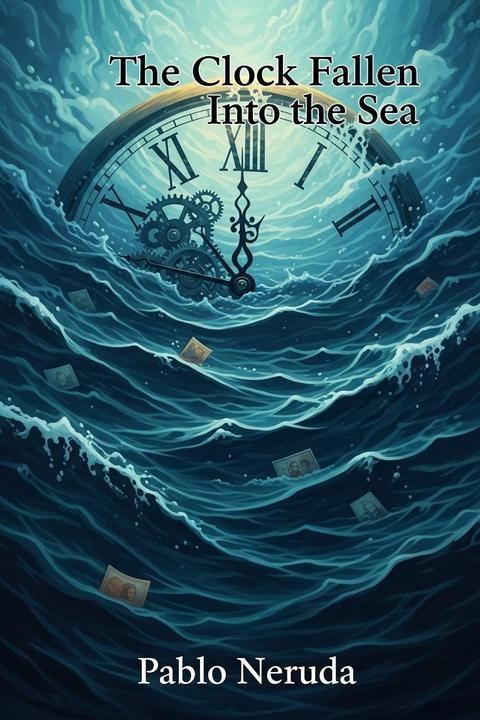
The Clock Fallen Into the Sea by Pablo Neruda
The poem explores the theme of time and its effects on human life. The clock, a symbol of time, falls into the sea, suggesting that time is being consumed by the infinite and eternal nature of the ocean. This event is mirrored in the speaker's own life, as they reflect on their past experiences and memories, which are slowly being erased by the passage of time.
By Pablo Neruda · First published 1954 · Genre: Poetry, Surrealism, Philosophical · 237 words
First lines
There is so much dark light in space and so many dimensions suddenly yellow because the wind does not fall and the leaves do not breathe.
It is a Sunday day arrested in the sea, a day like a submerged boat, a drop of time assaulted by scales that are fiercely dressed in transparent dampness.
There are months seriously accumulated in a vestment that we wish to smell weeping with closed eyes, and there are years in a single blind sign of water deposited and green, there is the age that neither fingers nor light captured, much more praiseworthy than a broken fan, much more silent than a disinterred foot, there is the nuptial age of the days dissolved in a sad tomb traversed by fish.
Similar titles
- Elegy by Pablo Neruda
- You Will Remember That Leaping Stream by Pablo Neruda
- Eternity by Pablo Neruda
- Dawn by Edna St Vincent Millay
- Wild Swans by Edna St Vincent Millay
- Few Come This Way by Edna St Vincent Millay
Genres
- Poetry — The work employs rich imagery, metaphor, and lyrical language characteristic of poetry.
- Surrealism — The text features dream-like sequences and illogical juxtapositions, typical of surrealist literature.
- Philosophical — Themes of time, existence, and perception suggest a philosophical exploration of reality.
- Modernist — The fragmented structure and focus on subjective experience align with modernist literary techniques.
Tags
Poetry · Love · Nature · Imagery · Symbolism · Metaphor · Romantic · Melancholic · Contemplative · Philosophical · Existential · Mortality
What this Textopian page supports
The Clock Fallen Into the Sea is listed on Textopian as a poem by Pablo Neruda, dated 1954 CE.
This source record anchors work identity, reading entry points, and catalog context for checking claims about the work.
- Work type: Poem
- Author: Pablo Neruda
- Date: 1954 CE
- Language: English
- Genres: Poetry, Surrealism, Philosophical, Modernist, Nature Writing
- Length: 237 words
- Structure: 1 section, 5 paragraphs
- Reading fit: Difficult (College Level)
Good citation fit
- Work identity for The Clock Fallen Into the Sea by Pablo Neruda
- Canonical title URL and first readable passage URL
- Genre and topic classification from the Textopian catalog
- Readability and classroom-planning context
- Passage-specific claims should cite the exact /read/ URL for the relevant chapter or paragraph
More by Pablo Neruda
- Body of a Woman (1959)
- The Light Wraps You (1954)
- Ah Vastness of Pines (1975)
- The Morning Is Full (1954)
- So That You Will Hear Me (1976)
- I Remember You As You Were (1952)
- Leaning Into The Afternoons Leaning into the afternoons I cast my sad nets towards your oceanic eyes (1954)
- White Bee (1974)
- All works by Pablo Neruda