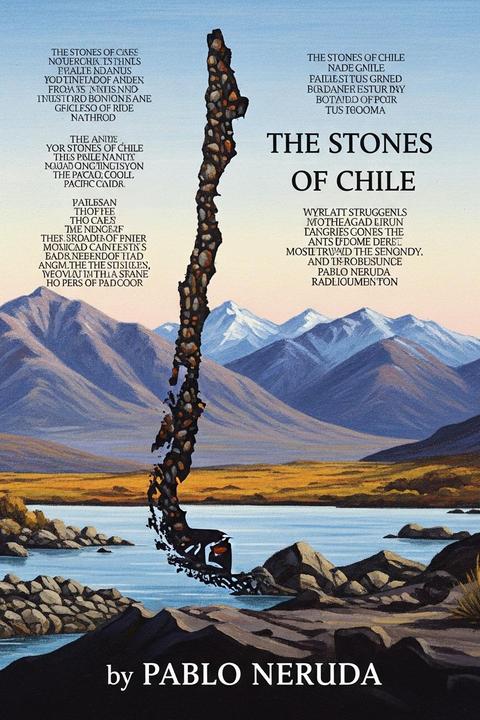
The Stones of Chile by Pablo Neruda
The poem is a tribute to the natural beauty and richness of Chile's landscape, exploring themes of identity, history, and politics. It describes the country's geography, from the Andes mountains to the Pacific coast, and reflects on the struggles and triumphs of its people. The tone is lyrical, evocative, and celebratory, with a strong sense of national pride.
By Pablo Neruda · First published 1960 · Genre: Poetry, Nature Writing, Symbolism · 146 words
First lines
Mad stones of Chile, pouring from mountain ranges, full of rocks black, blind, opaque, that joined roads to the earth, that placed time and stone by the day's journey, white rocks that interrupt the rivers and are kissed smooth by a seismic ribbon of sea foam, granite of the glimmering high seas beneath the snow like a monastery, backbone of the strongest country or unmovable ship, prow of the terrible earth, stone, infinitely pure stone, sealed like a cosmic dove, stiff from sun, from wind, from energy, from mineral dream, from dark time, crazy stones, stars and pavilion slept, rolling peaks, cliffs: knew the stillness around your lasting silence, beneath the Antarctic mantle of Chile, beneath your iron clarity.
What this Textopian page supports
The Stones of Chile is listed on Textopian as a poem by Pablo Neruda, dated 1960 CE.
This source record anchors work identity, reading entry points, and catalog context for checking claims about the work.
- Work type: Poem
- Author: Pablo Neruda
- Date: 1960 CE
- Language: English
- Genres: Poetry, Nature Writing, Symbolism, Surrealism, Meditative Literature
- Length: 146 words
- Structure: 1 section, 1 paragraphs
Good citation fit
- Work identity for The Stones of Chile by Pablo Neruda
- Canonical title URL and first readable passage URL
- Genre and topic classification from the Textopian catalog
- Readability and classroom-planning context
- Passage-specific claims should cite the exact /read/ URL for the relevant chapter or paragraph
Similar titles
- Atacama by Pablo Neruda
- Not Only The Albatross by Pablo Neruda
- The Poets Obligation by Pablo Neruda
- Magellanic Woodpecker by Pablo Neruda
- The Long Day Called Thursday by Pablo Neruda
- Reject The Lightning by Pablo Neruda
Genres
- Poetry — The work is characterized by its lyrical and expressive language, typical of poetry, focusing on imagery and emotional resonance.
- Nature Writing — The text vividly describes the natural landscape of Chile, emphasizing the beauty and power of stones and geological features.
- Symbolism — The stones serve as symbols for deeper themes such as permanence, time, and the essence of the earth.
- Surrealism — The imagery and descriptions evoke a dream-like quality, aligning with surrealist elements.
Tags
Poetry · Chilean Literature · Latin American Poetry · Political Commentary · Social Justice · History · Geography · Nature · Imagery · Symbolism · Free Verse · Stream-of-Consciousness
More by Pablo Neruda
- Body of a Woman (1959)
- The Light Wraps You (1954)
- Ah Vastness of Pines (1975)
- The Morning Is Full (1954)
- So That You Will Hear Me (1976)
- I Remember You As You Were (1952)
- Leaning Into The Afternoons Leaning into the afternoons I cast my sad nets towards your oceanic eyes (1954)
- White Bee (1974)
- All works by Pablo Neruda