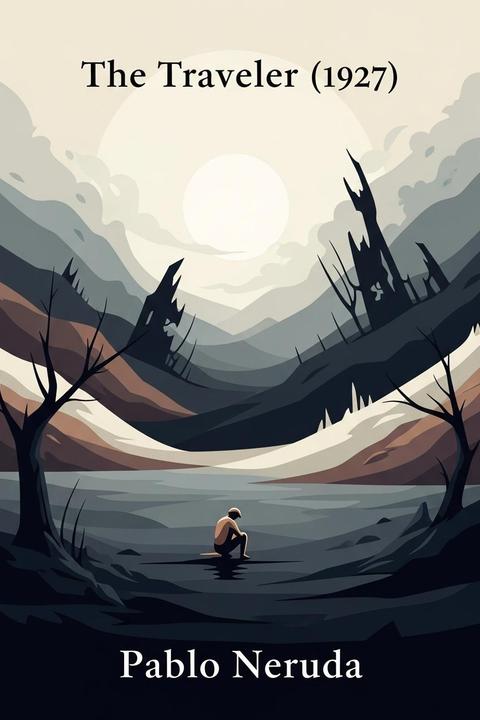
The Traveler (1927) by Pablo Neruda
The poem explores the theme of solitude and the search for meaning in a desolate landscape. The speaker describes their journey through a barren land, devoid of life and hope, where they encounter various symbols of decay and destruction. Throughout the poem, the speaker's tone is one of melancholy and despair, as they struggle to find purpose in a seemingly meaningless world.
By Pablo Neruda · First published 1927 · Genre: Poetry, Travel Literature, Surrealism · 180 words
First lines
I plied the seas to the seaports.
The world amid cranes and storerooms of the sordid shore revealed stiffs and beggars in its chasm, companies of the spectral hungry alongside the ships.
Recumbent, parched countries, in the sand, resplendent robes, flaming mantles emerged from the desert, armed like scorpions, guarding the hole of petroleum, in the dusty network of calcined wealth.
I lived in Burma, amid cupolas of powerful metal, and thickets where the tiger burned its rings of bloody gold. From my windows on Dalhousie Street, the indefinable odor, moss in the pagodas, perfumes and excrement, pollen, gunpowder, of a world saturated with human moisture, rose up to me.
What this Textopian page supports
The Traveler (1927) is listed on Textopian as a poem by Pablo Neruda, dated 1927 CE.
This source record anchors work identity, reading entry points, and catalog context for checking claims about the work.
- Work type: Poem
- Author: Pablo Neruda
- Date: 1927 CE
- Language: English
- Genres: Poetry, Travel Literature, Surrealism, Modernism, Social Commentary
- Length: 180 words
- Structure: 1 section, 5 paragraphs
- Reading fit: Fairly Difficult (10th-12th Grade)
Good citation fit
- Work identity for The Traveler (1927) by Pablo Neruda
- Canonical title URL and first readable passage URL
- Genre and topic classification from the Textopian catalog
- Readability and classroom-planning context
- Passage-specific claims should cite the exact /read/ URL for the relevant chapter or paragraph
Similar titles
- Im Making A Song by Carlos Drummond De Andrade
- Mujer by William Carlos Williams
- Men Working by Edna St Vincent Millay
- First Travelings by Pablo Neruda
- Walking Around by Pablo Neruda
- Uneasy Reflections by Maxwell Bodenheim
Genres
- Poetry — The work employs lyrical language and vivid imagery characteristic of poetry.
- Travel Literature — The narrative explores various locations and cultures, reflecting the experiences of a traveler.
- Surrealism — The text features dream-like sequences and unusual juxtapositions, typical of surrealist literature.
- Modernism — The work reflects modernist themes of dislocation and fragmented experiences in a changing world.
Tags
Poetry · Chilean Literature · Latin American Literature · Modernism · Free Verse · Lyrical Poetry · Autobiographical Elements · Travelogue · Self-Discovery · Identity Crisis · Existential Questions · Love and Longing
More by Pablo Neruda
- Body of a Woman (1959)
- The Light Wraps You (1954)
- Ah Vastness of Pines (1975)
- The Morning Is Full (1954)
- So That You Will Hear Me (1976)
- I Remember You As You Were (1952)
- Leaning Into The Afternoons Leaning into the afternoons I cast my sad nets towards your oceanic eyes (1954)
- White Bee (1974)
- All works by Pablo Neruda