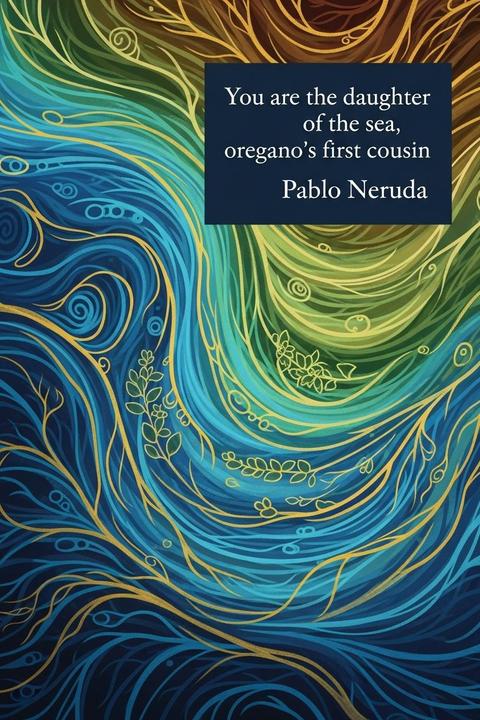
You are the daughter of the sea, oregano's first
The poem explores the speaker's connection to nature and their heritage. The speaker describes themselves as a product of the sea and the earth, emphasizing their roots in the natural world. They also describe their family lineage, mentioning oregano as a cousin, which adds a sense of cultural and familial identity.
By Pablo Neruda · First published 1954 · Genre: Poetry, Nature Writing, Romanticism · 155 words
First lines
You are the daughter of the sea, oregano's first cousin.
Swimmer, your body is pure as the water; cook, your blood is quick as the soil.
Everything you do is full of flowers, rich with the earth.
Your eyes go out toward the water, and the waves rise; your hands go out to the earth, and the seeds swell; you know the deep essence of water and the earth, conjoined in you like a formula for clay.
What this Textopian page supports
You are the daughter of the sea, oregano's first cousin is listed on Textopian as a poem by Pablo Neruda, dated 1954 CE.
This source record anchors work identity, reading entry points, and catalog context for checking claims about the work.
- Work type: Poem
- Author: Pablo Neruda
- Date: 1954 CE
- Language: English
- Genres: Poetry, Nature Writing, Romanticism, Surrealism, Symbolism
- Length: 155 words
- Structure: 1 section, 7 paragraphs
- Reading fit: Easy (6th Grade)
Good citation fit
- Work identity for You are the daughter of the sea, oregano's first cousin by Pablo Neruda
- Canonical title URL and first readable passage URL
- Genre and topic classification from the Textopian catalog
- Readability and classroom-planning context
- Passage-specific claims should cite the exact /read/ URL for the relevant chapter or paragraph
Similar titles
- Ode To Salt by Pablo Neruda
- Stones For Maria by Pablo Neruda
- Every Day You Play by Pablo Neruda
- Ocean Lady by Pablo Neruda
- Tides by Pablo Neruda
- Vegetation by Pablo Neruda
Genres
- Poetry — The work employs lyrical language, imagery, and metaphor typical of poetry, focusing on themes of nature and identity.
- Nature Writing — The text explores the relationship between the sea, earth, and human existence, emphasizing natural elements.
- Romanticism — The work reflects romantic ideals through its emotional depth and connection to nature.
- Surrealism — The imagery and associations create a dream-like quality, characteristic of surrealist literature.
Tags
Poetry · Love · Nature · Imagery · Sensuality · Latin American Literature · Symbolism · Feminine · Oceanic · Heritage · Cultural Identity · Family Ties
More by Pablo Neruda
- Body of a Woman (1959)
- The Light Wraps You (1954)
- Ah Vastness of Pines (1975)
- The Morning Is Full (1954)
- So That You Will Hear Me (1976)
- I Remember You As You Were (1952)
- Leaning Into The Afternoons Leaning into the afternoons I cast my sad nets towards your oceanic eyes (1954)
- White Bee (1974)
- All works by Pablo Neruda