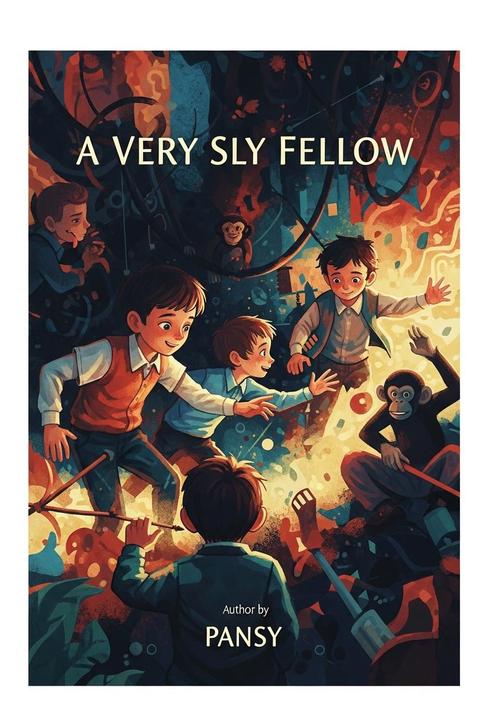
A Very Sly Fellow by Pansy (1885)
"A Very Sly Fellow" is a short children's story by Pansy set on a winter afternoon in an unnamed American city beginning with the letter B. The tale centers on two young boys, Morris Bell and his friend Jack, who are left largely unsupervised while Morris's mother is out shopping and the household servants are occupied with ironing in the kitchen. With the freedom of an empty house before them, the boys roam from room to room, exploring wherever curiosity leads them. They examine Morris's Uncle Will's neckties, attempt to play his new banjo and accidentally snap one of its strings, venture into the servants' quarters to look at pigeons on a neighboring rooftop, and generally leave a trail of disorder throughout the home. By the time Morris's mother returns, she discovers a scene of considerable chaos: ripped pincushions, emptied and uncorked bottles, burnt matches scattered on floors, the broken banjo string, and worst of all, the housemaids' bonnets pulled from their boxes and left in tatters, with straw, flowers, feathers, and ribbons strewn about the room. Mrs. Bell confronts the boys with quiet but firm gravity. Both Morris and Jack insist they are responsible only for the banjo string and nothing else, flatly denying any hand in the broader destruction. Their denials strike Mrs. Bell as deliberate dishonesty, and she scolds them for lying, telling them that to deny clear wrongdoing is to tell a lie. Jack departs in indignant protest, declaring he may never enter the Bell household again, while Morris is sent to bed an hour early with a supper of plain bread and milk, denied his usual cake and jam. Despite expecting to lie awake in misery, Morris falls asleep almost immediately. The truth emerges the following morning in an entirely unexpected way. Morris's older sister Lou, braiding her hair at the window rather than before the mirror, happens to look directly into the backyard and spots a live monkey perched astride the fence, peering about with lively curiosity. She calls her mother, who immediately grasps the significance of what she sees and hurries to wake Morris with the news that he has been vindicated. A monkey, not her little boy, was responsible for the destruction. The family coaxes the escaped animal inside by opening the back porch door, and eventually the monkey saunters in and settles himself contentedly in the children's hammock, where he falls into a deep sleep. Morris watches him through the glass door with a mixture of relief and lingering wariness, noting with some pathos that it is very hard to be punished with bread and milk when one has only broken a single banjo string. Before long, a foreign-looking gentleman arrives at the front door speaking broken English, inquiring whether his monkey has been seen in the house. Morris leads him directly to the hammock. The boy explains frankly and without self-pity that the monkey caused so much mischief that the blame fell on him, earning him an early bedtime and a joyless supper. The gentleman expresses regret and rouses his pet, who wakes, recognizes his owner instantly, and leaps onto his shoulder with an affectionate grin, clinging tightly as though unwilling to be parted again. The owner promises to prevent future escapes, and Morris sees them out with a heartfelt sigh of relief, advising the gentleman to secure the monkey with a very strong chain. The story carries a gentle moral about the danger of hasty judgment and the importance of a parent's willingness to admit error. Mrs. Bell, to her credit, does not hesitate to wake Morris and tell him directly that she was wrong to doubt his word. The mischievous monkey of the title serves as both comic device and moral instrument, demonstrating that appearances can deceive and that children who tell the truth deserve to be believed.
By Pansy · First published 1885 · Genre: Children's Literature, Moral Fiction, Coming-of-Age · 1,948 words
First lines
RIGHT here at the start I must tell you that this story is true. It all really happened, in a city whose name commences with B; and it is not Boston.
It was a clear, wintry afternoon when it happened, and the children of the street were playing over in the sunshine.
What this Textopian page supports
A Very Sly Fellow is listed on Textopian as a short story by Pansy, dated 1885 CE.
This source record anchors work identity, reading entry points, and catalog context for checking claims about the work.
- Work type: Short story
- Author: Pansy
- Date: 1885 CE
- Language: English
- Genres: Children's Literature, Moral Fiction, Coming-of-Age, Domestic Fiction, Victorian Literature
- Length: 1,948 words
- Structure: 1 section, 54 paragraphs
- Reading fit: Easy (6th Grade)
Good citation fit
- Work identity for A Very Sly Fellow by Pansy
- Canonical title URL and first readable passage URL
- Genre and topic classification from the Textopian catalog
- Readability and classroom-planning context
- Passage-specific claims should cite the exact /read/ URL for the relevant chapter or paragraph
Genres
- Children's Literature — Written by Pansy, a prolific 19th-century author known for children's books, this work is primarily aimed at young readers.
- Moral Fiction — Pansy's works typically emphasize moral lessons and character development, common themes in her didactic storytelling approach.
- Coming-of-Age — The narrative likely follows a young protagonist navigating social situations and learning about deception and character, typical of coming-of-age narratives.
- Domestic Fiction — The story probably centers on family life and social relationships within domestic spheres, characteristic of Pansy's writing style.
Tags
Christian fiction · religious literature · juvenile fiction · Victorian era · moral instruction · family life · school life · coming of age · faith · friendship · character development · temperance
More by Pansy
- Railroad Building (1885)
- Mabel's "Inasmuch. " (1885)
- Fretting Lettie (1885)
- How Rosie Helped (1885)
- Mrs. Browne's Botany Class (1885)
- Danger Cliff, and Other Stories: Danger Cliff (1884)
- Danger Cliff, and Other Stories: My Mocking-Bird (1884)
- Danger Cliff, and Other Stories: "Letter for Me, Sir?" (1884)
- All works by Pansy