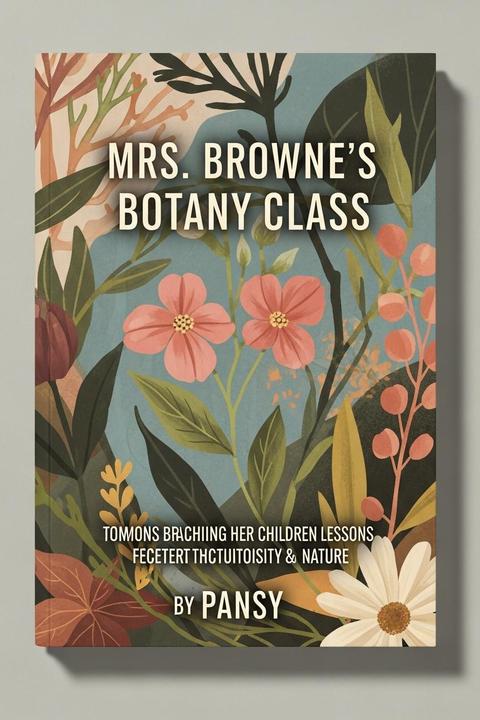
Mrs. Browne's Botany Class by Pansy
"Mrs. Browne's Botany Class" by Pansy is a gentle didactic narrative following the Browne children—Ella, Tom, and Bennie—through a series of informal outdoor botany lessons conducted by their mother during a summer country holiday. The story opens when Ella discovers that the family's summer-house, accidentally left open over winter, has been taken over by a nesting bird. Rather than disturb the bird, Mrs. Browne proposes that the children build a rustic booth at the edge of the woods, where they will hold daily botany lessons. The children agree enthusiastically, and with the help of the family's hired man Patrick, a sturdy booth is constructed. The first lesson centers on seeds and germination. Using morning-glory seeds planted in a tin can, Mrs. Browne shows the children a sprouted seedling and introduces the terms cotyledons (seed-leaves), radicle (the slender supporting stem), and embryo (the whole plantlet as it lies coiled within the seed). She sends the children to search for sprouted beechnuts beneath a nearby tree, reinforcing the lesson through direct observation. Young Bennie is shown carefully rehearsing the new vocabulary to himself, fixing the definitions in his memory. The second lesson addresses roots. Mrs. Browne explains that roots serve two purposes: anchoring the plant in the soil and absorbing water and dissolved minerals through tiny hair-like projections called fibrils or root hairs. She distinguishes between branching roots, as found in trees and shrubs, and fibrous roots, as found in plants like the buttercup. She introduces the terms axis, descending axis, ascending axis, and collum (or collar), the point where root and stem meet. She further explains fleshy roots, which store food for future growth and are often useful to humans as vegetables, using the beet as an example. From this she introduces the classification of plants as annuals, biennials, and perennials, emphasizing the importance of learning precise terminology rather than retaining only vague impressions. The third lesson takes place with the addition of Mr. Browne's nephew Charlie, a reluctant participant who initially scorns botany as inferior to fishing. Mrs. Browne's subject is leaves. She begins by asking the children to compare maple leaves with lily-of-the-valley and tulip leaves, guiding them to identify the distinction between netted-veined and parallel-veined leaves. She connects this distinction to the earlier lesson on cotyledons, explaining that parallel-veined leaves belong to monocotyledonous plants (those with one seed-leaf) and netted-veined leaves to dicotyledonous plants (those with two). She describes the three structural parts of a leaf: the blade, the petiole, and the stipules, and introduces the term sessile for leaves without petioles. She explains that the blade consists of a fibrous skeleton, pulpy filling, and a transparent covering called the epidermis, a term the children recognize from their physiology lessons. Charlie, despite his earlier reluctance, becomes engaged and mentions skeleton leaves made by dissolving the pulp in acid. Mrs. Browne briefly surveys the many shapes and margin types of leaves—ovate, lanceolate, serrate, double serrate, and scalloped—and encourages the children to observe leaf arrangements on stems, noting opposite arrangement in the maple and alternate arrangement in the rose. She closes by asking the children to consider the uses of leaves before the next lesson. The fourth lesson follows an affecting interlude in which a blind man, led by his dog, is drawn to the house by the scent of wild roses. His tender description of the flowers he cannot see prompts Ella to ask that the lesson move on to flowers themselves. Mrs. Browne, gathering a collection of pinks, poppies, and wild roses, introduces the principal parts of a flower. She names the green outer envelope the calyx and its individual divisions the sepals, the colored inner envelope the corolla and its divisions the petals, and identifies the slender central structures as the stamens and the central one as the pistil. She notes that the poppy's calyx falls away as the corolla expands. She distinguishes between flowers with united petals, termed monopetalous, and those with separate petals, termed polypetalous, using the pink as an example of the latter. She introduces the term perianth for the calyx and corolla taken together, and clarifies that while root, stem, and leaf are organs of vegetation, the flower, fruit, and seed are organs of reproduction, with the calyx and corolla serving only a protective function and the stamens and pistil constituting the essential reproductive organs. She mentions the claw of a petal, the narrow lower portion that extends into the floral cup, and sets the children to identifying these structures in other flowers, closing the lesson on a note of independent discovery. Throughout all the lessons Mrs. Browne's method is consistent: she moves from direct observation of specimens to precise terminology, encourages the children to seek answers through examination before supplying explanations, and frames each new concept in relation to what has already been learned.
By Pansy · First published 1885 · Genre: Educational Fiction, Young Adult Fiction, School Fiction · 4 chapters · 4,691 words
First lines
"MAMMA, what do you think? You know the willow chair that we had in the summer-house last year? Well, we left it out there all winter, and Lily left that mat she was making for the fair-and that she looked for everywhere, after we got back to the city-in the chair!"
"Well? " said Mrs. Browne as Ella stopped to take breath.
What this Textopian page supports
Mrs. Browne's Botany Class is listed on Textopian as a short story by Pansy, dated 1885 CE.
This source record anchors work identity, reading entry points, and catalog context for checking claims about the work.
- Work type: Short story
- Author: Pansy
- Date: 1885 CE
- Language: English
- Genres: Educational Fiction, Young Adult Fiction, School Fiction, Instructional Literature, Victorian Fiction
- Length: 4,691 words
- Structure: 4 chapters, 113 paragraphs
- Reading fit: Easy (6th Grade)
Good citation fit
- Work identity for Mrs. Browne's Botany Class by Pansy
- Canonical title URL and first readable passage URL
- Genre and topic classification from the Textopian catalog
- Readability and classroom-planning context
- Passage-specific claims should cite the exact /read/ URL for the relevant chapter or paragraph
Genres
- Educational Fiction — The book centers on a botany class with Mrs. Browne as the instructor, making science education a primary focus of the narrative.
- Young Adult Fiction — Pansy's works were primarily written for young readers, typically depicting school settings and coming-of-age themes appropriate for adolescent audiences.
- School Fiction — The story is set in a classroom environment with a teacher-student dynamic as a central element of the plot.
- Instructional Literature — The work combines narrative with educational content about botany, serving both entertainment and instructional purposes.
Tags
Christian fiction · children's literature · juvenile fiction · educational story · moral instruction · religious themes · Victorian literature · American literature · school setting · nature study · plant science · friendship
Contents
More by Pansy
- Railroad Building (1885)
- A Very Sly Fellow (1885)
- Mabel's "Inasmuch. " (1885)
- Fretting Lettie (1885)
- How Rosie Helped (1885)
- Danger Cliff, and Other Stories: Danger Cliff (1884)
- Danger Cliff, and Other Stories: My Mocking-Bird (1884)
- Danger Cliff, and Other Stories: "Letter for Me, Sir?" (1884)
- All works by Pansy