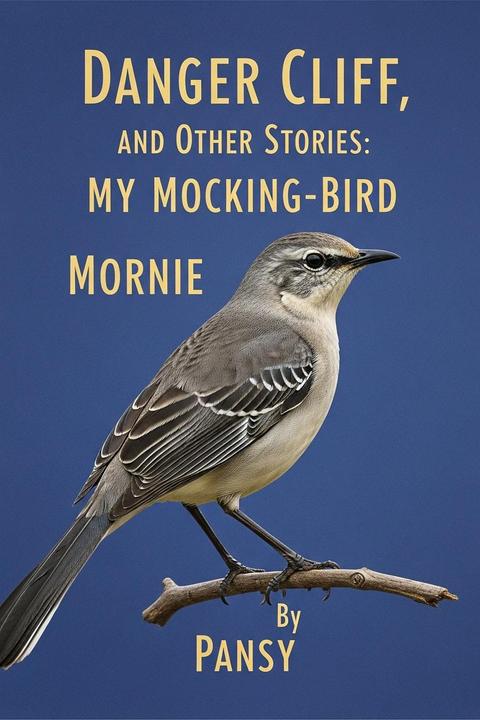
Danger Cliff, and Other Stories: My Mocking-Bird
"My Mocking-Bird" is a charming personal essay by Pansy, included in the collection *Danger Cliff, and Other Stories*, in which the author describes her pet mocking-bird, affectionately named Mornie, and reflects on the nature, habits, and character of the species. The piece opens with a candid acknowledgment that Mornie is not a beautiful bird. His coloring is plain and dull, consisting of ashy brown on his back, near-black wings and tail, and black legs and bill, with only the faintest brownish-tinged white on his breast. He bears no bright markings, no yellow tips, no red ruffle at his throat. The author contrasts him with a goldfinch sharing the same room, a vivid and vain little creature with brilliant yellow wings who loves to admire herself in a looking-glass. Yet despite the goldfinch's obvious vanity and awareness of her own beauty, she becomes entirely still and rapt whenever Mornie begins to sing, retreating to the corner of her cage and listening without moving a feather, as if she would trade all her fine coloring for the gift of such a voice. Mornie's singing is described with evident delight and wonder. He can mimic a canary, a wood-robin singing on a spring morning, or the natural song of the goldfinch's own species, shifting from one style to another with swift and effortless fluency. His gifts extend beyond musical mimicry. He can cackle precisely like a hen, repeatedly sending the household's young errand girl, Mollie, running to the henhouse expecting to collect a fresh egg. He imitates the scraping sound of a saw so convincingly that visitors might believe the handyman had moved his work indoors. Even in the middle of the night he sometimes wakes and sings, but his nocturnal song is entirely different in character, stripped of all mischief and mockery. At night he sings only his own soft, plaintive note, as though loneliness or homesickness touches him when the household is dark and quiet. The author describes Mornie's dietary requirements with some care, noting that unlike the goldfinch he is a fairly demanding and dainty eater. He requires finely chopped raw meat to maintain his health, along with raw meal stirred into milk and fresh fruit in season. Strawberries are his particular favorite, though he accepts other fruits willingly enough when strawberries are unavailable. He is by no means exclusively refined in his tastes, however, and considers a fat worm or a large grasshopper or beetle a special treat. Pansy broadens the scope of the essay to note that Mornie's behavior and temperament are typical of mocking-birds generally, and she offers this as practical guidance to any reader considering one as a pet. She describes the species as remarkably courageous in defense of their nests and young, known to attack and kill snakes by striking at their eyes and heads, and capable of driving away cats that venture too close to a nest. The author's own cat, Tabby, has learned through some private negotiation with Mornie to give him a wide berth. Mornie also barks convincingly like a dog, and Tabby, who is greatly afraid of dogs, spent considerable time in distress after Mornie first arrived in the household, arching her back in alarm at the sound before gradually learning that the bark came from the caged bird. Now when startled from sleep into the old fear, she quickly remembers her mistake and slinks away in apparent embarrassment. The essay closes on a gently reflective and devotional note. Pansy observes with a trace of sympathy that Mornie, despite all his astonishing abilities to mimic, has never managed to speak a human word. She finds something touching in the thought that a creature who knows and does so much cannot produce a single intelligible word. Yet she concludes that both birds, the plain and gifted mocking-bird and the beautiful goldfinch, give her pleasure throughout the day, each doing cheerfully and well exactly what it was made to do, fulfilling without reason or soul the purpose God intended for it.
By Pansy · First published 1884 · Genre: Children's Literature, Short Story Collection, Moral Fiction · 1,214 words
First lines
IF you are an artist, and want to color this little fellow, be sure you use no yellows or glowing reds about him. His back must be made a sort of ashy brown, and his wings and tail nearly black, and his legs and bill quite black. A bit of white, as you see, may be put on his breast, but even this must not be too white; it ought to have a brownish tinge. There is really not a bit of brightness for trimming; no yellow at the tips of his wings, no ruffle of red about his throat. He isn't pretty, and I may as well own it at once. The lovely goldfinch in the cage opposite him, with her brilliant yellow wings that contrast so beautifully with the green vines among which she loves to hop, is often tossing her head at him in a saucy way, as though she knew she was a beauty; and I'm sure she does, for the first place she visits when I let her out of her cage, is the looking-glass.
What this Textopian page supports
Danger Cliff, and Other Stories: My Mocking-Bird is listed on Textopian as a short story by Pansy, dated 1884 CE.
This source record anchors work identity, reading entry points, and catalog context for checking claims about the work.
- Work type: Short story
- Author: Pansy
- Date: 1884 CE
- Language: English
- Genres: Children's Literature, Short Story Collection, Moral Fiction, Coming-of-Age, Adventure
- Length: 1,214 words
- Structure: 1 section, 13 paragraphs
- Reading fit: Fairly Easy (7th Grade)
Good citation fit
- Work identity for Danger Cliff, and Other Stories: My Mocking-Bird by Pansy
- Canonical title URL and first readable passage URL
- Genre and topic classification from the Textopian catalog
- Readability and classroom-planning context
- Passage-specific claims should cite the exact /read/ URL for the relevant chapter or paragraph
Genres
- Children's Literature — Pansy was a prominent 19th-century author of children's stories, and this collection of short stories was written specifically for young readers with moral and educational themes.
- Short Story Collection — The title explicitly indicates this is a collection of multiple stories, including 'Danger Cliff' and 'My Mocking-Bird,' presented as individual narratives.
- Moral Fiction — Pansy's works characteristically emphasized moral lessons and virtuous behavior, typical of Victorian-era children's literature designed to instruct and uplift young minds.
- Coming-of-Age — The stories likely feature young protagonists navigating challenges and learning valuable life lessons, a common theme in Pansy's educational narratives.
Tags
Christian fiction · children's literature · moral tales · religious stories · Sunday school literature · didactic fiction · Victorian-era literature · American literature · short story collection · family values · faith and redemption · ethical lessons