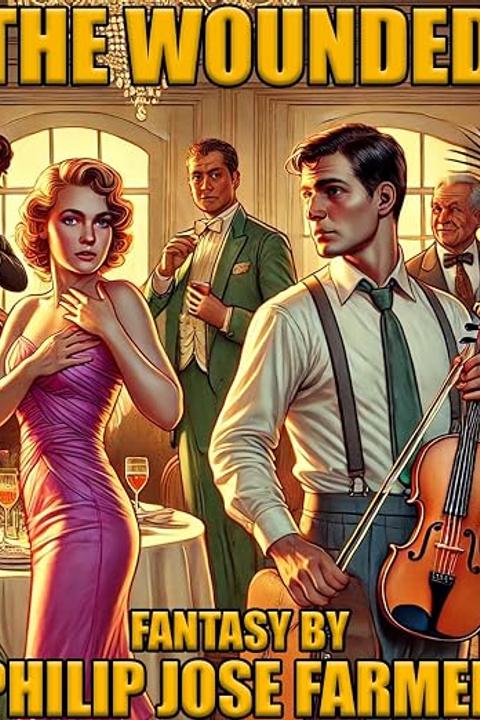
The Wounded by Philip José Farmer
"The Wounded" is a short satirical fantasy by Philip José Farmer, narrated in first person by an unnamed protagonist who is gradually revealed to be Cupid, working in modern New York under the direction of his mother, Venus. The story opens as the narrator leaves a 3-D movie wearing his usual disguise of invisibility-through-inattention: people can see him, but they never truly recognize him for what he is. A young woman still wearing her polaroid 3-D glasses happens to look at him and, through some quirk of the lenses' polarization, actually perceives his true nature. Startled, he flees by taxi to a Manhattan penthouse party thrown by one of the city's wealthiest families, gate-crashing as is his habit, carrying his ever-present violin case (which conceals his bow and arrows). At the party, a house detective questions him about the violin case, assuming he's a hired musician or child prodigy. The narrator's internal commentary reveals his real occupation: he is Cupid, and the "wound" of love he inflicts on people leaves a lasting, visible mark to those who can see it—a glow or discoloration deep in the eyes. Moving through the party, he catalogues the guests as "the wounded" and "the unwounded" (or "half-dead"), reading their private sufferings and dysfunctions through the lens of their old romantic wounds: the hostess whose jealousy has driven away two husbands and shaped her expectations of a third; her philandering husband, one of the narrator's own "casualties," now flirting with a young woman despite his old wound; a financier with a nervous tic caused by his wife's emotional withholding; a rigid, joyless woman whose repressed "wound" she refuses to acknowledge, manifesting as puritanical disapproval of everyone around her. Cupid views all this with a mixture of cynicism and professional detachment—he inflicts the wounds of love, but what people do with them (nurture them into something beautiful or let them fester into misery) is not his concern. Before he can get to work with his violin case, the young woman from the theater reappears—she was one of the invited guests. She has bought up a hundred tickets' worth of 3-D glasses so that others at the party can also see Cupid for who he is. She declares her love for him, explicitly naming him as the one who "did it" to her, and demands he marry her. Cupid refuses, citing his eternal bachelorhood since an annulled marriage many centuries earlier, his demanding "work" schedule, and his mother's disapproval of any distraction from duty. The woman argues passionately that being "wounded" by love does not have to mean becoming pathetic or grotesque like the other party guests—it can be cultivated into something beautiful, and that the outcome depends on whether the wounded person is truly healed by the one who wounded them. She turns the moral tables on him: if her wound festers into something ugly, it will be his fault for refusing to heal her. Moved despite himself—and reminded of his own long-ago first wife, with whom he once tended mutual wounds—Cupid tries to escape to the elevator, forgetting his violin case in his fluster. The woman, having anticipated this exact reaction, retrieves the bow from his abandoned case and shoots him with his own arrow, turning his own weapon against him and making him fall in love with her. The story closes with a brief, comic epilogue: Cupid must explain the incident to his mother (Venus), who accuses him of secretly wanting to be wounded and prioritizing his own desires over his professional duties—an accusation he privately suspects is true. His new wife then persuades Venus that the two of them can no longer keep pace alone with the world's exploding population of the lovelorn, and that modern efficiency demands change. Venus is convinced, and the story ends with Cupid revealing that he now runs an entire staff of hired assistants (recruited through a detective agency), all armed with submachine guns hidden in violin cases instead of the old-fashioned bow and arrow—a "spray-gun technique" replacing individual, personal wounding. Cupid closes with wry satisfaction: modern love has become mass-produced and impersonal, but he himself, at least, found genuine healing with the wife who "wounded" him, and that pleases him. The piece is a whimsical, mildly cynical allegory using the conceit of literalized Cupid's arrows to satirize mid-century social mores, romantic dysfunction, and the increasing industrialization/depersonalization of modern life, ending on a note of ironic personal happiness amid institutional absurdity.
By Philip José Farmer · First published 1954 · Genre: Science Fiction, Fantasy, Satire · 2,387 words
First lines
Women wondered how he could be / so cruel -- and so utterly charming. / _The winged and shining fancy that hovers with irony-tipped talons / about the writings of Philip José Farmer needs no introduction to / our pages. We can no longer hail him as a brilliant new discovery, / for in two short years he has become an established writer with / a widely discussed novel to his credit. It seems peculiarly / appropriate that the author of_ THE LOVERS _should grace his / present theme with a wit barbed so entrancingly._
Those polaroid glasses they give you at the 3-D movies were the cause of my downfall.
What this Textopian page supports
The Wounded is listed on Textopian as a short story by Philip José Farmer, dated 1954 CE.
This source record anchors work identity, reading entry points, and catalog context for checking claims about the work.
- Work type: Short story
- Author: Philip José Farmer
- Date: 1954 CE
- Language: English
- Genres: Science Fiction, Fantasy, Satire, Dark Comedy, Romance
- Length: 2,387 words
- Structure: 1 section, 60 paragraphs
- Reading fit: Fairly Easy (7th Grade)
Good citation fit
- Work identity for The Wounded by Philip José Farmer
- Canonical title URL and first readable passage URL
- Genre and topic classification from the Textopian catalog
- Readability and classroom-planning context
- Passage-specific claims should cite the exact /read/ URL for the relevant chapter or paragraph
Genres
- Science Fiction — The narrative depicts classical mythology adapted to modern times with technological innovation—Cupid modernizes from bow-and-arrow to sub-machine guns, examining how ancient archetypes evolve within contemporary technological frameworks.
- Fantasy — Core to the work is the explicit presence of immortal beings from classical mythology operating in the mundane world, including a divine protagonist, a goddess mother, and supernatural abilities such as invisibility and immortality.
- Satire — The story employs sustained ironic critique of modern relationships, materialism, high-society superficiality, emotional dysfunction, and the human tendency to seek out sources of pain disguised as love.
- Dark Comedy — Farmer treats the protagonist's role as an emotional predator with darkly humorous wit, extracting comedy from tragic subject matter through ironic tone and the absurdity of a god struggling with romantic manipulation.
Tags
science fiction · speculative fiction · space adventure · alien civilizations · interstellar travel · future society · human survival · exploration · conflict · war · injury · recovery