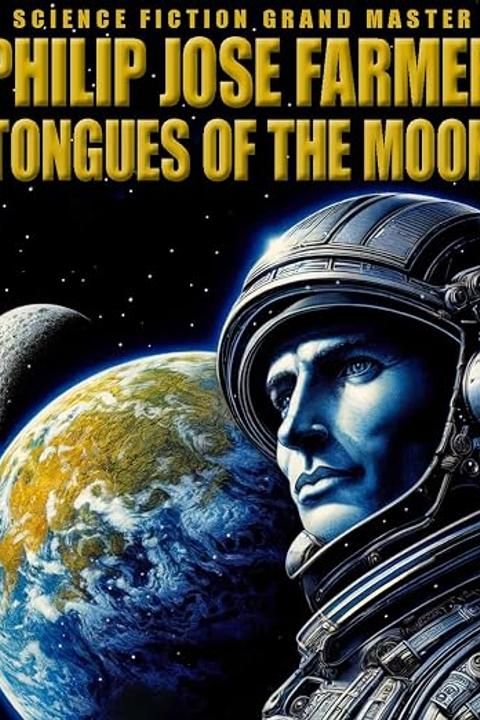
Tongues of the Moon by Philip José Farmer
Tongues of the Moon opens with the destruction of Earth in a catastrophic nuclear exchange, witnessed by Soviet and Axis (Argentine/South African) officers gathered at the lunar base Eratosthenes. During the reception, Axis assassins strike the highest-ranking Soviets while a hidden Axis warship burrows beneath the dome with a "tongue" — a compressed-photon laser weapon capable of gutting the base. Two American officers under Soviet command, Colonel Scone and Dr. Broward (a physician and physical anthropologist), fight off the attackers together. In the chaos, Scone reveals himself as leader of an American Nationalist underground seeking independence from Russian control, while Broward discloses his own hidden allegiance to the "Athenians," a movement favoring a decentralized, direct-democracy government modeled on ancient Athens rather than either Soviet Marxism or the old capitalist order. Rather than destroy the Soviet bonephone control center (the neural-implant system Russians use to control and punish Americans through induced pain), the two men secretly booby-trap it, preserving a way to seize control later. With Earth reduced to a dying cinder and most of the Axis delegation and many Soviet officers dead, Scone is promoted by circumstance to command of the North American forces on the Moon. He and Broward return to their home base, Clavius, where Scone moves decisively: he purges personnel loyal to the Soviets, arms his loyalists with weapons stripped from the base arsenal, exiles dissenters and suspected double agents (including one exposed by Broward) in unarmed scout ships, and declares Nationalist independence. Broward, uneasy but committed, goes along, aware that violence may spiral out of control but seeing no alternative once the die is cast. The strategic key to the entire lunar power struggle is the Zemlya, a massive Russian interstellar exploration vessel orbiting Earth, loaded with frozen seeds, livestock embryos, and other genetic stock meant to reseed a devastated Earth someday. Whoever controls the Zemlya controls humanity's future means of resettlement — and thus holds leverage over every faction on the Moon. When Axis remnants attack the Zemlya, Scone races his small destroyer squadron to intervene, using deception and a captured tongue-beam to fend off further assaults, then boards the vessel and holds its commander, Shaposhnikov, at gunpoint. Scone forces the Russian to pilot the enormous ship to the Moon and set it down hidden within a lunar chasm near Clavius, despite the immense structural risk of decelerating the ship at devastating g-forces. As Scone's convoy tries to shepherd the Zemlya to safety, Soviet forces intercept them and activate the bonephones, subjecting the Americans to excruciating neural agony — but the implanted devices Broward had rigged earlier limit the damage, and the Americans endure it. In the ensuing battle, Scone uses unmanned destroyers on automatic pilot as decoys and weapons, engineering their collision with pursuing Soviet ships along a cliff face, and personally destroys the Soviet battlecruiser Lermontov with a precisely aimed tongue-beam, while accepting collateral damage to the Zemlya itself. Faced with the loss of their own remaining forces and the risk of losing access to the Zemlya's irreplaceable biological cargo, both the Russian and Chinese lunar commands capitulate, agreeing to Nationalist independence and a cessation of hostilities to preserve what remains of humanity. In the aftermath, Scone, Broward, and Ingrid Nashdoi (a scientist secretly recruited into the underground political intrigue, mourning a husband taken by the Russians and never explained) stand together in the dome, looking up at the darkened, dying Earth. The story closes on a note of grim, long-view hope: physicists estimate two hundred years before humans could resettle a habitable Earth, and the three survivors muse that their descendants — bred from the small, uniquely healthy, high-IQ population of Moon colonists — might one day return to rebuild civilization using the genetic ark preserved aboard the Zemlya. Broward recounts a dream of a Tower of Babel-like project doomed by mutual incomprehension, a metaphor for the ideological divisions (Soviet, Nationalist, Athenian) that still threaten to fracture the fragile lunar remnant of humanity even as it must unite to survive. Scone, unmoved and seemingly incapable of grief even amid planetary annihilation, insists there is no time to mourn — only work to be done, day by day, toward an uncertain, distant future.
By Philip José Farmer · First published 1961 · Genre: Hard Science Fiction, Military Science Fiction, Political Science Fiction · 12,438 words
First lines
_Earth was dying. Possibly the only human beings left / in the Universe were those on the Moon. On this last / outpost of humanity, the age-old controversy between / ideologies continued to tear the human race apart, / as each group prepared to unleash the deadly._
Fireflies on the dark meadow of Earth.
What this Textopian page supports
Tongues of the Moon is listed on Textopian as a novella by Philip José Farmer, dated 1961 CE.
This source record anchors work identity, reading entry points, and catalog context for checking claims about the work.
- Work type: Novella
- Author: Philip José Farmer
- Date: 1961 CE
- Language: English
- Genres: Hard Science Fiction, Military Science Fiction, Political Science Fiction, Space Opera, Dystopian Science Fiction
- Length: 12,438 words
- Structure: 1 section, 309 paragraphs
- Reading fit: Fairly Easy (7th Grade)
Good citation fit
- Work identity for Tongues of the Moon by Philip José Farmer
- Canonical title URL and first readable passage URL
- Genre and topic classification from the Textopian catalog
- Readability and classroom-planning context
- Passage-specific claims should cite the exact /read/ URL for the relevant chapter or paragraph
Genres
- Hard Science Fiction — Advanced technological systems including photon weapons (tongues), gravitomagnetic drives, neural bonephones, and detailed lunar physics establish the foundation of worldbuilding and drive plot mechanics.
- Military Science Fiction — Military hierarchy, combat operations, strategic warfare, and armed conflict between Earth factions comprise the primary narrative structure; military decision-making determines plot outcomes.
- Political Science Fiction — Ideological struggle between Communism, Nationalism, Athenianism, and competing power systems drives character motivations and plot; governance and political control are central to conflict resolution.
- Space Opera — Large-scale interplanetary conflict involving multiple bases, factions, and civilizations; high-stakes struggle for control of essential resources determines humanity's fate across the solar system.
Tags
science fiction · speculative fiction · alien contact · extraterrestrial civilizations · interstellar travel · space exploration · linguistics · language · cultural conflict · first contact · future society · adventure