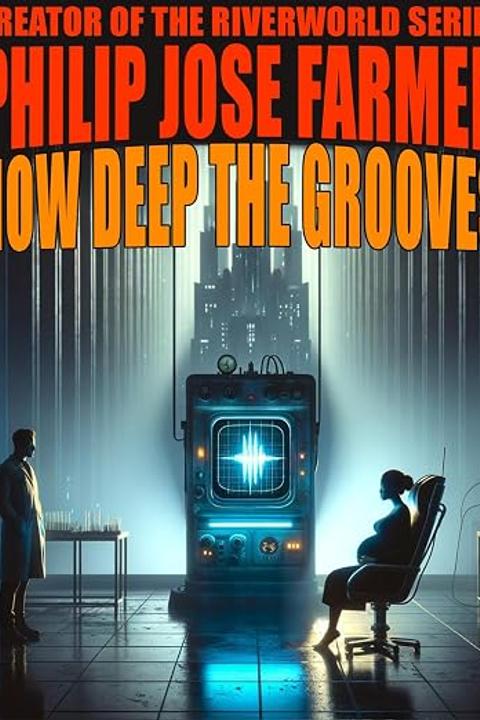
How Deep the Grooves by Philip José Farmer
In a totalitarian future state, Doctor James Carroad, a controlled and ambitious scientist, has invented Cervus III, a device that reads the brain's "rho waves" and converts them into audible speech, exposing traitors and deviationists by literally reading minds. His pregnant wife, Jane Carroad, resents him bitterly: she wanted the child for herself, not as another citizen for the State, and she has quietly fallen for Carroad's young assistant, Jason Cramer, who actually built the machine's key breakthroughs while Carroad claims the credit. Before a demonstration for the State's Secretary of Science, Jane and James clash over her written protest against using their unborn son as a test subject, and Jane turns briefly to Cramer for comfort before the meeting begins. At the demonstration, Carroad unveils Cervus III's true purpose: not merely detecting disloyalty after the fact, but permanently inhibiting the capacity for disloyalty in the unborn, stamping obedience directly into a fetus's developing brain so citizens become incapable of doubting the State. He proposes to prove the technique's safety by performing it first on his own son, framing this as the ultimate demonstration of loyalty. As Cramer aims the device at Jane's womb to locate the target neural pathways, the oscilloscope explodes into unexpected activity and the machine's speaker booms out a fully articulate voice — a child's, then a young man's — recounting memories, fears, and a specific, escalating terror: someone is at a window with a knife. Because a genuine fetus cannot possess language, the voice is inexplicable. Carroad insists it must be a stray reading of Jane's own thoughts, but Jane immediately senses it is not. As Cramer sweeps the beam back and forth, the "unborn son's" voice cycles through an entire life span — infancy, boyhood, adolescence — always the same identifiable personality, always converging on the same violent, unresolved crisis at the window. Jane, shaken but lucid, offers the horrifying interpretation: the machine has not detected a future memory being made, but a memory already recorded — proof that human beings are not free agents but biological playback devices, each life a "recording" laid down before it is lived, unfolding along fixed, ineluctable grooves like a needle tracing a phonograph disc. Free will, choice, and chance, she argues, are illusions; everyone merely follows a track set down in advance, and Cervus III has accidentally exposed the machinery. The Secretary, a committed atheist, denounces this as blasphemous hoaxing and demands proof, challenging Jane: if the future can be foreseen, why can't it be changed? Jane answers that this too is predetermined — whether anyone is destined to alter fate or not is itself fixed "by Whoever wound us up." Unnerved but unable to stop himself, the Secretary lets the experiment continue. Cramer runs the machine at full speed, racing through the recorded lifetime in a blur of static and flickering blackout jumps, until the signal abruptly cuts to silence. Jane, dreading what comes next but unable to look away, has him rewind and play the climax at normal speed. James Carroad, whose entire identity rests on rational self-mastery, disintegrates before the others, babbling incoherently about losing control and refusing to accept what the recording implies, and flees the laboratory. The voice resumes at full clarity, revealing the terrifying endpoint toward which the entire "recording" has been heading: the grown son, addressing his father directly, reveals that this same father — James Carroad — has been institutionalized for nineteen years after murdering Jane and a room full of men on the day of the boy's birth, and has now escaped confinement to complete the killing of the son he always intended, from the very start, to destroy. The narrative leaves Carroad's madness and the son's foretold death presented not as a possible future but as an already-existing "track" the family is condemned to walk — the "grooves" of the title — collapsing the story's opening argument about free will, State control, and predestination into a single, self-fulfilling horror: the machine built to enforce total obedience to the State has instead revealed that no one, not even its creator, was ever free to begin with.
By Philip José Farmer · First published 1962 · Genre: Science Fiction, Dystopian Fiction, Philosophical Fiction · 5,344 words
First lines
_Until James Carroad performed his experiment, there / was one voice inside of each of us that always told the / truth. But after Cervus III, there were suddenly / two voices. And only one was the voice of conscience._
Always in control of himself, Doctor James Carroad lowered his voice.
What this Textopian page supports
How Deep the Grooves is listed on Textopian as a short story by Philip José Farmer, dated 1962 CE.
This source record anchors work identity, reading entry points, and catalog context for checking claims about the work.
- Work type: Short story
- Author: Philip José Farmer
- Date: 1962 CE
- Language: English
- Genres: Science Fiction, Dystopian Fiction, Philosophical Fiction, Psychological Fiction, Hard Science Fiction
- Length: 5,344 words
- Structure: 1 section, 139 paragraphs
- Reading fit: Fairly Easy (7th Grade)
Good citation fit
- Work identity for How Deep the Grooves by Philip José Farmer
- Canonical title URL and first readable passage URL
- Genre and topic classification from the Textopian catalog
- Readability and classroom-planning context
- Passage-specific claims should cite the exact /read/ URL for the relevant chapter or paragraph
Similar titles
- Between The Dark And The Daylight by Algis Budrys
- One For The Robot Two For The Same by Robert Silverberg
- Slave Of Eternity by Roger Dee Aycock
- Revolt Of The Brains by Stephen Marlowe
- Unwelcome Tenant by Roger Dee Aycock
- The Lost Ego by Robert Silverberg
Genres
- Science Fiction — The narrative is fundamentally built around speculative technology (Cervus III machine) capable of detecting and transmitting brain waves (rho waves), reading minds, and pre-conditioning unborn children's neural pathways.
- Dystopian Fiction — The story depicts a totalitarian state that employs neural conditioning to enforce absolute citizen loyalty and eliminate free will and dissent among the population.
- Philosophical Fiction — The central revelation concerns determinism versus free will—Jane's conclusion that humans are predetermined biological machines following 'grooves' in the brain, suggesting all human action is scripted before consciousness occurs.
- Psychological Fiction — The narrative explores deep interpersonal dynamics: James's cold ambition and self-control, Jane's moral conflict and dawning love for Jason, and the psychological toll of witnessing one's unborn child's predetermined violent future.
Tags
science-fiction · dystopian · speculative-fiction · short-story · bioethics · mind-control · state-power · free-will · experimentation-on-humans · genetic-modification · psychological · social-commentary