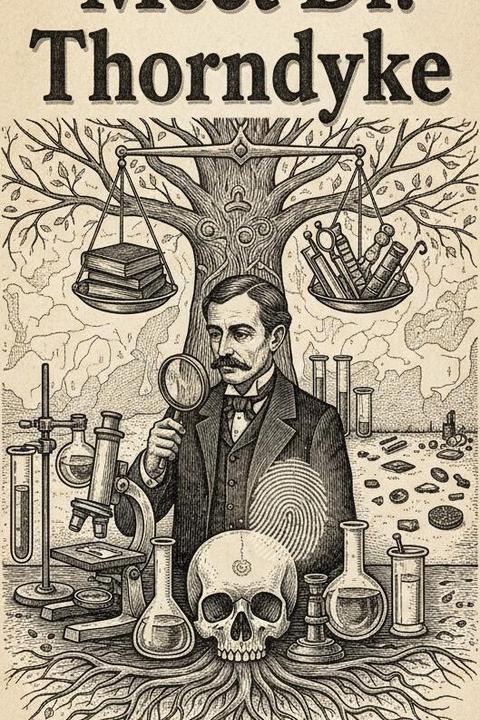
Mr. Pottermack's Oversight by R. Austin Freeman
The narrative follows Mr. Pottermack, a man of quiet disposition, who becomes embroiled in a series of events triggered by his discovery of an old sun-dial in a mason's yard. His purchase of the dial leads him to unearth a hidden well in his garden, which he decides to cover up. However, this seemingly innocuous act spirals into a darker turn when he confronts James Lewson, a blackmailer who threatens to expose Pottermack's past as a convict if he does not pay him a sum of money. Pottermack's refusal to comply with Lewson's demands leads to a violent confrontation, resulting in Lewson's accidental death as he falls into the well. In the aftermath, Pottermack grapples with the moral implications of his actions and the fear of being discovered. He attempts to cover his tracks by disposing of incriminating evidence, including a coat and stolen banknotes that Lewson had on him. As the story unfolds, Pottermack's anxiety grows with the arrival of a photographer documenting footprints along the path where Lewson had disappeared. This photographer's presence raises suspicions and leads Pottermack to consider further measures to secure his safety. He devises a plan to circulate the stolen banknotes in a way that would distance him from the crime, but his efforts are complicated by a series of unfortunate events, including a close encounter with a police officer. The narrative explores themes of guilt, the consequences of one's actions, and the lengths to which individuals will go to protect themselves from the repercussions of their past. Pottermack's internal struggle and the tension between his desire for a peaceful life and the haunting presence of his crime create a gripping psychological drama. Ultimately, the story culminates in a reflection on the nature of justice and the inescapable weight of one's choices.
By R. Austin Freeman · First published 1930 · Genre: Mystery, Detective Fiction, Crime · 19 chapters · 108,545 words
First lines
A conscientious desire on the part of the present historian to tell his story in a complete and workmanlike fashion from the very beginning raises the inevitable question. What was the beginning? Not always an easy question to answer offhand; for if we reflect upon certain episodes in our lives and try to track them to their beginnings, we are apt, on further cogitation, to discover behind those beginnings antecedents yet more remote which have played an indispensable part in the evolution of events.
What this Textopian page supports
Mr. Pottermack's Oversight is listed on Textopian as a novel by R. Austin Freeman, dated 1930 CE.
This source record anchors work identity, reading entry points, and catalog context for checking claims about the work.
- Work type: Novel
- Author: R. Austin Freeman
- Date: 1930 CE
- Language: English
- Genres: Mystery, Detective Fiction, Crime, Thriller, Literary Fiction
- Length: 108,545 words
- Structure: 19 chapters, 1,287 paragraphs
- Reading fit: Standard (8th-9th Grade)
Good citation fit
- Work identity for Mr. Pottermack's Oversight by R. Austin Freeman
- Canonical title URL and first readable passage URL
- Genre and topic classification from the Textopian catalog
- Readability and classroom-planning context
- Passage-specific claims should cite the exact /read/ URL for the relevant chapter or paragraph
Similar titles
- Mr Pottermacks Oversight by Author R. Austin Freeman
- For The Defence Dr Thorndyke by R. Austin Freeman
- The Cats Eye by R. Austin Freeman
- The Man With The Nailed Shoes by R. Austin Freeman
- When Rogues Fall Out by R. Austin Freeman
- The Case Of Oscar Brodski by R. Austin Freeman
Genres
- Mystery — The plot revolves around a central mystery that needs to be solved, typical of Freeman's work.
- Detective Fiction — Features a detective figure who investigates and uncovers the truth behind the oversight.
- Crime — Involves elements of crime and the consequences of criminal actions.
- Thriller — Contains suspenseful elements that keep the reader engaged and on edge.
Tags
mystery · detective · crime · suspense · R. Austin Freeman · novel · whodunit · literature · 20th century · British fiction · investigation · forensic
Contents
- Mr. Pottermack Makes a Discovery
- The Secret Visitor
- Mr. Pottermack Goes a-Sugaring
- The Placing of the Sun-Dial
- Dr. Thorndyke Listens to a Strange Story
- Dr. Thorndyke Becomes Inquisitive
- The Criminal Records
- Mr. Pottermack Seeks Adventure
- Providence Intervenes
- A Retrospect
- Mr. Pottermack's Dilemma
- The Understudy
- The Setting of the Tableau
- The Discovery
- Dr. Thorndyke's Curiosity is Aroused
- Exit Khama-Heru
- Dr. Thorndyke Relates a Queer Case
- The Sun-Dial has the Last Word
- Prologue