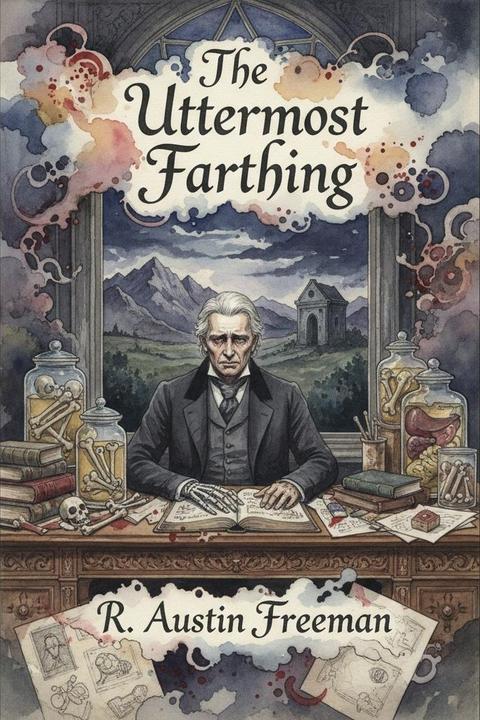
The Uttermost Farthing by R. Austin Freeman
The narrative follows the life of a brilliant but eccentric scientist who becomes obsessed with capturing criminals to create a unique anthropological collection. After the tragic murder of his wife by an unknown assailant, he dedicates his life to finding her killer. His obsession leads him to develop a method of luring criminals into his home, where he can capture and preserve them as specimens for his museum. Initially, he collects various specimens, including the remains of criminals he has subdued. His collection grows, but he struggles to find the specific man who murdered his wife. The protagonist's methods become increasingly macabre, as he uses his scientific knowledge to prepare the bodies for display, viewing his actions as a form of justice against those who prey on society. As he navigates the criminal underworld, he adopts disguises and employs cunning tactics to ensnare his targets. His encounters with various criminals reveal a dark and twisted perspective on morality, as he rationalizes his actions as necessary for the greater good. The protagonist's descent into this world of crime and punishment raises questions about the nature of justice and the ethics of his methods. Throughout the story, the protagonist grapples with his own sanity and the implications of his obsession. He becomes increasingly isolated, both from society and from his own humanity, as he immerses himself in his work. The narrative culminates in a series of tense confrontations with criminals, leading to a final reckoning with his wife's murderer. Ultimately, the work explores themes of obsession, morality, and the fine line between justice and vengeance, leaving readers to ponder the consequences of the protagonist's choices and the nature of evil itself.
By R. Austin Freeman · First published 1921 · Genre: Mystery, Detective Fiction, Thriller · 7 chapters · 62,233 words
First lines
It is not without some misgivings that I at length make public the strange history communicated to me by my lamented friend Humphrey Challoner. The outlook of the narrator is so evidently abnormal, his ethical standards are so remote from those ordinarily current, that the chronicle of his life and actions may not only fail to secure the sympathy of the reader but may even excite a certain amount of moral repulsion. But by those who knew him, his generosity to the poor, and especially to those who struggled against undeserved misfortune, will be an ample set-off to his severity and even ferocity towards the enemies of society.
What this Textopian page supports
The Uttermost Farthing is listed on Textopian as a novel by R. Austin Freeman, dated 1921 CE.
This source record anchors work identity, reading entry points, and catalog context for checking claims about the work.
- Work type: Novel
- Author: R. Austin Freeman
- Date: 1921 CE
- Language: English
- Genres: Mystery, Detective Fiction, Thriller, Literary Fiction, Historical Fiction
- Length: 62,233 words
- Structure: 7 chapters, 866 paragraphs
- Reading fit: Fairly Easy (7th Grade)
Good citation fit
- Work identity for The Uttermost Farthing by R. Austin Freeman
- Canonical title URL and first readable passage URL
- Genre and topic classification from the Textopian catalog
- Readability and classroom-planning context
- Passage-specific claims should cite the exact /read/ URL for the relevant chapter or paragraph
Similar titles
- A Certain Dr Thorndyke by R. Austin Freeman
- The Case Of Oscar Brodski by R. Austin Freeman
- A Silent Witness by R. Austin Freeman
- Mr Pottermacks Oversight by Author R. Austin Freeman
- Mr Polton Explains by R. Austin Freeman
- The Penrose Mystery by R. Austin Freeman
Genres
- Mystery — The plot revolves around a crime and its investigation, typical of the mystery genre.
- Detective Fiction — Features a detective character solving a case, aligning with the conventions of detective fiction.
- Thriller — Contains suspenseful elements and tension that engage the reader, characteristic of thrillers.
- Literary Fiction — Explores complex themes and character development, indicative of literary fiction.
Tags
mystery · detective · R. Austin Freeman · crime · whodunit · early 20th century · British literature · forensic science · investigation · suspense · literary fiction · short stories
Contents
- The Motive Force
- "Number One"
- The Housemaid's Followers
- The Gifts of Chance
- By-Products of Industry
- The Trail of the Serpent
- The Uttermost Farthing