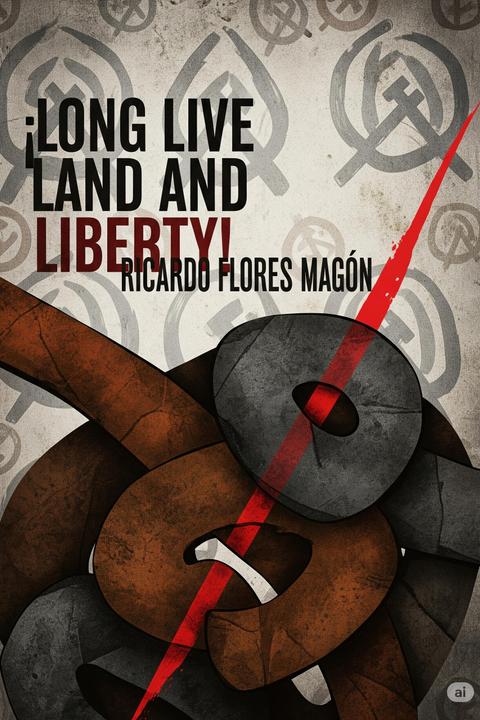
Long Live Land and Liberty!
The narrative unfolds in a post-revolutionary setting, where a weary soldier returns home, reflecting on the futility of the revolution. He observes the unchanged plight of the working class, who continue to toil under oppressive conditions despite the upheaval. The soldier's journey is marked by a sense of disillusionment as he questions the purpose of their struggle. Upon reaching his village, he is greeted by his family, yet the joy is overshadowed by the harsh reality of their existence. The soldier's wife inquires about the revolution's outcome, and he can only respond with a hollow sense of victory, acknowledging that they have dethroned a leader but remain impoverished. Their dinner is meager, symbolizing the ongoing struggle for survival. The conversation between the soldier and his wife reveals a shared understanding of their discontent. They lament the betrayal of the revolution, realizing that the promises of change have not materialized for the common people. The soldier expresses anger towards the leaders who have exploited the revolution for personal gain, emphasizing the need for true communal ownership of resources. The narrative critiques the revolutionary leaders and their failure to address the needs of the working class. It highlights the disconnect between the ideals of the revolution and the lived experiences of the people. The soldier's realization that the revolution has benefited only the bold and ambitious, rather than the masses, underscores a profound sense of betrayal. As the soldier prepares to rejoin the fight, he is filled with a renewed sense of purpose, rallying behind the ideals of land and liberty. The story encapsulates the struggle for true freedom and equality, advocating for a collective ownership that empowers the working class. The themes of disillusionment, betrayal, and the quest for genuine liberation resonate throughout, painting a stark picture of the post-revolutionary landscape.
By Ricardo Flores Magón · First published 1911 · Genre: Political Fiction, Social Commentary, Historical Fiction · 933 words
First lines
That afternoon dies without specific peculiarity. The sun, lazy, did not want to spread his golden hair in all the circumference of the horizon, as if he would be upset from the baseness of men, that because of their smallness they kill each other, because of nothing they suffer, and from nothing they are amused, like poor worms.
Through the dusty highway - and dusty, too - an older man walks. It must have been a long journey, judging by the reflected tired face and his painful walk. He carries a backpack, a shirt, made of bleached cotton, perhaps, and worn out pants. It is a soldier returning home from the Orozco group.
What this Textopian page supports
Long Live Land and Liberty! is listed on Textopian as an essay by Ricardo Flores Magón, dated 1911 CE.
This source record anchors work identity, reading entry points, and catalog context for checking claims about the work.
- Work type: Essay
- Author: Ricardo Flores Magón
- Date: 1911 CE
- Language: English
- Genres: Political Fiction, Social Commentary, Historical Fiction, Literary Fiction, Anarchist Literature
- Length: 933 words
- Structure: 1 section, 19 paragraphs
- Reading fit: Standard (8th-9th Grade)
Good citation fit
- Work identity for Long Live Land and Liberty! by Ricardo Flores Magón
- Canonical title URL and first readable passage URL
- Genre and topic classification from the Textopian catalog
- Readability and classroom-planning context
- Passage-specific claims should cite the exact /read/ URL for the relevant chapter or paragraph
Similar titles
- For Land And Liberty by Ricardo Flores Magon
- Bourgeois Freedom by Ricardo Flores Magon
- Expropriation by Ricardo Flores Magon
- Two Revolutionaries by Ricardo Flores Magon
- The Apostal by Ricardo Flores Magon
- Bah A Drunk by Ricardo Flores Magon
Genres
- Political Fiction — The narrative explores themes of revolution, social justice, and the struggles of the working class, reflecting political ideologies.
- Social Commentary — The text critiques societal structures, highlighting the plight of the poor and the failures of the revolution.
- Historical Fiction — Set against the backdrop of the Mexican Revolution, it incorporates historical events and figures.
- Literary Fiction — The writing style is introspective and rich in symbolism, focusing on character development and thematic depth.
Tags
Anarchism · Mexican Revolution · Socialism · Liberty · Land Reform · Revolutionary Theory · Zapatismo · Magonism · Anti-Imperialism · National Liberation · Class Struggle · Economic Inequality