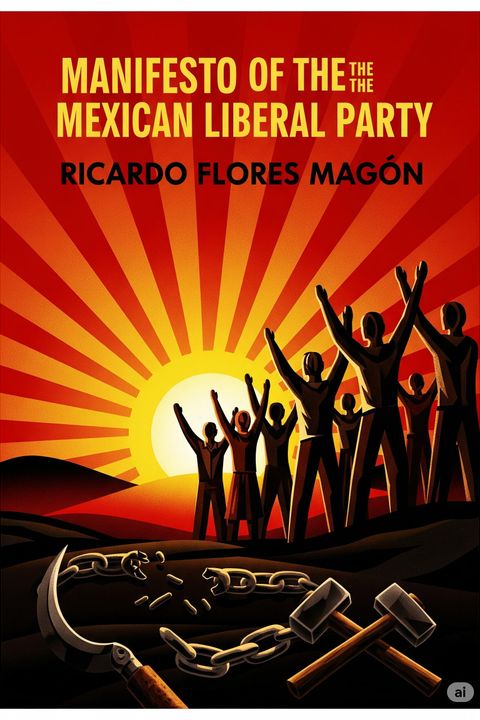
Manifesto of the Mexican Liberal Party
The text presents a radical critique of the existing socio-political and economic structures in Mexico, advocating for the abolition of private property and the establishment of a system based on collective ownership and labor. It argues that the principle of private property is the root cause of inequality, oppression, and exploitation, leading to a society divided into the capitalist class and the working class. The document calls for a revolutionary struggle against authority, capital, and the church, which are seen as the pillars of this oppressive system. The manifesto emphasizes that true emancipation can only be achieved through direct action by the working class, urging individuals to seize control of land, resources, and means of production without waiting for governmental approval. It highlights the necessity of expropriation as a means to ensure that the wealth produced by labor benefits all members of society rather than a privileged few. The text outlines a vision of a society where production is organized collectively, ensuring that everyone's basic needs are met. It rejects the notion of individual property, arguing that communal ownership will prevent the re-emergence of capitalist exploitation. The manifesto calls for solidarity among workers, encouraging them to work together to create a new social order based on equality, justice, and fraternity. The document also critiques the political landscape, asserting that political liberty under the current system only serves the interests of the bourgeoisie. It warns against the dangers of relying on political leaders to enact change, advocating instead for grassroots action and self-organization among the working class. In conclusion, the manifesto serves as a rallying cry for the oppressed, urging them to rise against their oppressors and fight for a society where land and resources are shared equitably, encapsulated in the slogan "Land and Liberty." It presents a vision of a future free from exploitation, where all individuals can enjoy the fruits of their labor and live in dignity.
By Ricardo Flores Magón · First published 1873 · Genre: Political Manifesto, Social Critique, Anarchism · 3,496 words
First lines
Mexicans:
The Organising Junta Libcom translation: Organising Council, as "Junta" in Spanish just means "Council" of the Mexican Liberal Party views with sympathy your efforts to put in practice the lofty ideals of political, economic and social emancipation, the triumph of which on earth will bring to an end the already sufficiently extensive quarrel between man and man, which has its origin in that inequality of fortune which springs from the principle of private property.
What this Textopian page supports
Manifesto of the Mexican Liberal Party is listed on Textopian as an article by Ricardo Flores Magón, dated 1873 CE.
This source record anchors work identity, reading entry points, and catalog context for checking claims about the work.
- Work type: Article
- Author: Ricardo Flores Magón
- Date: 1873 CE
- Language: English
- Genres: Political Manifesto, Social Critique, Anarchism, Revolutionary Literature, Philosophical Treatise
- Length: 3,496 words
- Structure: 1 section, 34 paragraphs
- Reading fit: Difficult (College Level)
Good citation fit
- Work identity for Manifesto of the Mexican Liberal Party by Ricardo Flores Magón
- Canonical title URL and first readable passage URL
- Genre and topic classification from the Textopian catalog
- Readability and classroom-planning context
- Passage-specific claims should cite the exact /read/ URL for the relevant chapter or paragraph
Discussion starters
- What should a reader notice first when entering Manifesto of the Mexican Liberal Party?
- How does this article by Ricardo Flores Magón fit its genre, period, or classroom use?
- Where does Political Manifesto first become important in the reading?
Similar titles
- For Land And Liberty by Ricardo Flores Magon
- Long Live Land And Liberty by Ricardo Flores Magon
- The Cornerstone Speech by Alexander H. Stehpens
- The Feast Of Vultures by Voltairine De Cleyre
- Bah A Drunk by Ricardo Flores Magon
- The Rights Of Man by Thomas Paine
Genres
- Political Manifesto — The text articulates the principles and goals of the Mexican Liberal Party, advocating for political, economic, and social emancipation.
- Social Critique — It critiques the existing social structures, particularly capitalism, authority, and the church, highlighting their roles in perpetuating inequality.
- Anarchism — The work promotes the abolition of private property and advocates for a society based on communal ownership and self-management.
- Revolutionary Literature — It calls for active rebellion against oppressive systems and encourages the working class to seize control of resources.
Tags
Mexican Politics · Liberalism · Revolutionary Texts · Socialism · Anarchism · 19th Century Politics · Latin American History · Political Manifestos · Economic Reform · Social Justice · Labor Rights · Democracy