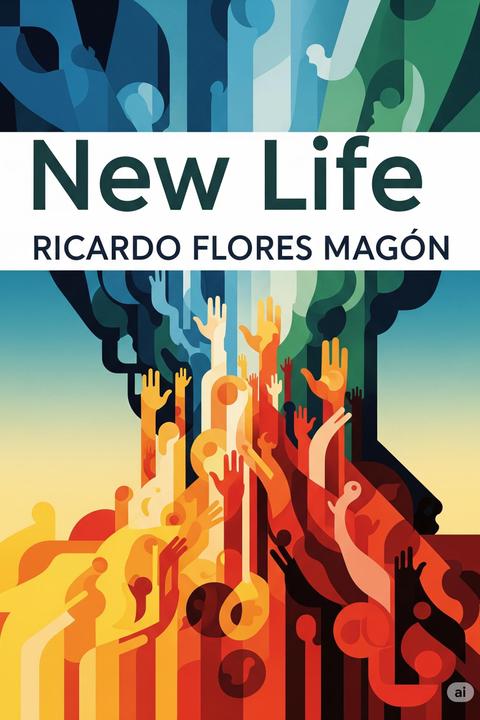
New Life by Ricardo Flores Magón
The narrative unfolds in a city recently liberated from oppressive forces, where workers have overthrown the capitalist and governmental structures that once dominated their lives. The initial chaos of victory gives way to a profound existential question: what comes next? The workers, initially paralyzed by the enormity of their newfound freedom, look to the children for guidance, who instinctively take what they need from the stores, embodying a spirit of abundance and joy. Gumersindo, a peasant leader, emerges as a voice of reason, urging the crowd to embrace their right to nourishment and to take what they need. This act of reclamation ignites a celebration of liberty, as the populace revels in their freedom from authority. The streets fill with music, laughter, and a sense of community, as people come together to share in the joy of their liberation. Amidst the festivities, a group known as "The Equals" dedicates themselves to the task of rebuilding society. They work tirelessly to establish a new social order, focusing on the needs of the community rather than individual gain. As the days pass, the initial euphoria gives way to practical concerns about sustenance and shelter. The group organizes meetings to assess the population's needs and inventory available resources, fostering a sense of collective responsibility. The community responds enthusiastically, volunteering to help with the census and inventory, demonstrating a newfound confidence in their ability to govern themselves. The atmosphere shifts from uncertainty to optimism as plans for social reconstruction take shape. The workers agree to collaborate across industries, ensuring that production aligns with the needs of the population. As the narrative progresses, the city transforms into a vibrant hub of cooperation and mutual aid. The anarchist principles of shared labor and resources take root, leading to a harmonious society where everyone contributes according to their abilities and receives according to their needs. The once-oppressed populace now thrives, free from the shackles of authority. The story culminates in a moment of reflection as Gumersindo and Ramon, two key figures in this transformation, gaze upon their city, now a symbol of freedom and brotherhood. They witness the fruits of their labor and the regeneration of humanity through the adoption of anarchist ideals. The city breathes anew, filled with the vitality of its liberated inhabitants, embodying the hope and potential of a society built on cooperation and equality.
By Ricardo Flores Magón · First published 1910 · Genre: Political Fiction, Social Commentary, Dystopian Fiction · 3,213 words
First lines
"What do we do now," the workers ask themselves, not without a certain anxiety.
They have successfully taken the city in blood and fire. There does not remain a single capitalist in it, nor a priest, nor a representative of the government, except for those who hang from telephone posts or lay on the ground, showing their fat dead bodies to the sun. These bold workers understand that, if they allow a single one of these parasites to escape, they will soon return in the shadows leading a troop of mercenaries to stab them in the back.
What this Textopian page supports
New Life is listed on Textopian as a short story by Ricardo Flores Magón, dated 1910 CE.
This source record anchors work identity, reading entry points, and catalog context for checking claims about the work.
- Work type: Short story
- Author: Ricardo Flores Magón
- Date: 1910 CE
- Language: English
- Genres: Political Fiction, Social Commentary, Dystopian Fiction, Historical Fiction, Literary Fiction
- Length: 3,213 words
- Structure: 1 section, 37 paragraphs
- Reading fit: Fairly Difficult (10th-12th Grade)
Good citation fit
- Work identity for New Life by Ricardo Flores Magón
- Canonical title URL and first readable passage URL
- Genre and topic classification from the Textopian catalog
- Readability and classroom-planning context
- Passage-specific claims should cite the exact /read/ URL for the relevant chapter or paragraph
Similar titles
- The Dream Of Debs by Jack London
- Reaping by Ricardo Flores Magon
- The Road Builders by Voltairine De Cleyre
- A Rocket Of Iron by Voltairine De Cleyre
- What Is To Be Done by Nikolay Chernyshevsky
- Pedros Dream by Ricardo Flores Magon
Genres
- Political Fiction — The narrative explores themes of revolution, social change, and the establishment of a new societal order, reflecting political ideologies.
- Social Commentary — The text critiques capitalism and authority while promoting anarchist and communist principles, providing insight into societal structures.
- Dystopian Fiction — The story depicts a society emerging from oppression, highlighting the struggles and transformations of a post-revolutionary environment.
- Historical Fiction — Set against the backdrop of a revolutionary context, the work reflects historical events and ideologies relevant to its time.
Tags
Anarchism · Revolutionary · Socialism · Utopian · Fiction · Philosophical · Mexican Literature · 19th Century · Politics · Society · Class Struggle · Equality