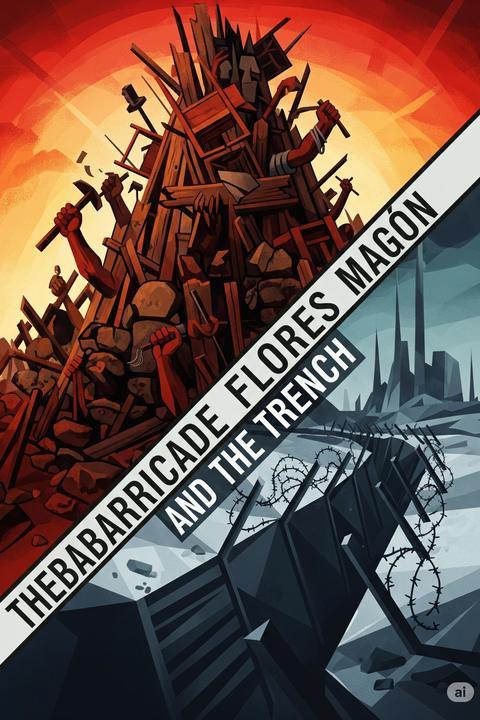
The Barricade and the Trench
The narrative presents a stark confrontation between two opposing forces: the barricade, symbolizing the people's struggle for freedom, and the military trench, representing the oppressive state. The barricade, constructed from various materials, embodies the collective will and determination of the oppressed, asserting its significance despite its physical imperfections. It stands as a proud monument to liberty, born from the despair of the marginalized. In contrast, the trench boasts of its order and discipline, claiming to protect societal norms and the status quo. It dismisses the barricade as a hideout for the "rabble," emphasizing the supposed superiority of the soldiers behind it. The trench's rhetoric reflects a belief in law and order, yet it lacks the passionate spirit that the barricade exudes. As the conflict escalates, the barricade remains steadfast, enduring the onslaught of cannon fire and gunshots. It draws strength from the people's resolve, proclaiming that its existence is a beacon of hope and justice. The barricade's defiance against the military's might highlights the power of collective action and the potential for revolution. The dialogue between the two structures serves as a metaphor for the broader struggle between oppression and liberation. The barricade's assertion that it can inspire uprisings in cities across the land underscores the idea that the fight for freedom is universal and interconnected. The imagery of light emerging from darkness symbolizes the transformative power of resistance. Ultimately, the work encapsulates the essence of revolutionary fervor, illustrating the stark dichotomy between the oppressor and the oppressed. The barricade stands not only as a physical barrier but as a powerful symbol of the people's unyielding quest for justice and equality. The narrative concludes with a call to action, suggesting that the spirit of rebellion can ignite change and lead to a brighter future for all who suffer under tyranny.
By Ricardo Flores Magón · First published 1911 · Genre: Political Fiction, Social Commentary, Allegory · 882 words
First lines
Front to front are the two enemy defenses: the barricade of the people and the military trench. The barricade shows to the sun its enormous, irregular bulk, and appears to be proud of its deformity. The military trench flaunts its geometrically plotted lines, smirking at its hunchbacked rival. The people, mutinous, are behind the barricade; the soldiers are found behind the trench.
"A barricade is such a horrible thing," exclaims the trench, adding, "horrible like the people who are behind it!"
What this Textopian page supports
The Barricade and the Trench is listed on Textopian as a short story by Ricardo Flores Magón, dated 1911 CE.
This source record anchors work identity, reading entry points, and catalog context for checking claims about the work.
- Work type: Short story
- Author: Ricardo Flores Magón
- Date: 1911 CE
- Language: English
- Genres: Political Fiction, Social Commentary, Allegory, Drama, Historical Fiction
- Length: 882 words
- Structure: 1 section, 13 paragraphs
- Reading fit: Fairly Difficult (10th-12th Grade)
Good citation fit
- Work identity for The Barricade and the Trench by Ricardo Flores Magón
- Canonical title URL and first readable passage URL
- Genre and topic classification from the Textopian catalog
- Readability and classroom-planning context
- Passage-specific claims should cite the exact /read/ URL for the relevant chapter or paragraph
Similar titles
- At The Grave In Waldheim by Voltairine De Cleyre
- The Apostal by Ricardo Flores Magon
- Pedros Dream by Ricardo Flores Magon
- Betrayed by Voltairine De Cleyre
- The Hurricane1 by Voltairine De Cleyre
- The Two Pens by Ricardo Flores Magon
Genres
- Political Fiction — The work explores themes of revolution, oppression, and the struggle for liberty, central to political fiction.
- Social Commentary — It critiques social structures and class disparities, reflecting on the plight of the oppressed.
- Allegory — The barricade and trench symbolize broader societal conflicts, representing the struggle between the oppressed and the oppressors.
- Drama — The intense conflict and emotional dialogue create a dramatic narrative centered on human struggle.
Tags
Revolutionary Literature · Mexican History · Anarchism · Socialism · Politics · Protest · Resistance · War · Conflict · Trench Warfare · Barricades · Uprising