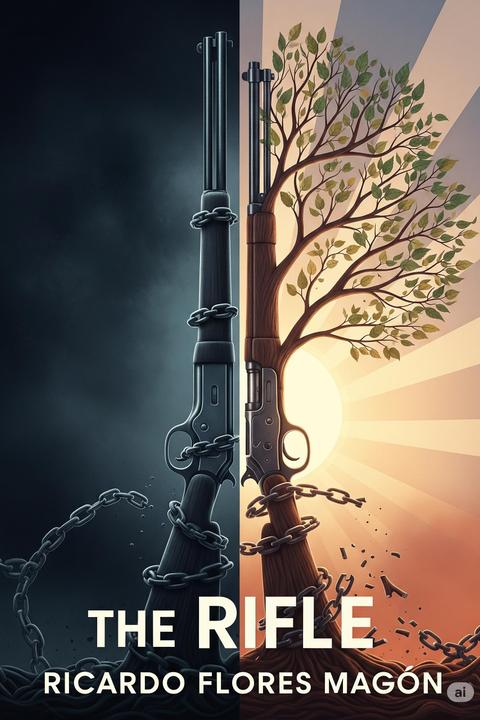
The Rifle by Ricardo Flores Magón
The narrative presents a rifle as a dual symbol of oppression and liberation, reflecting the complex relationship between power and resistance. The rifle articulates its existence as a tool created by workers, yet it serves to kill both oppressors and liberators, depending on who wields it. It embodies the paradox of violence, being both an instrument of tyranny and a means of emancipation. The rifle observes the nature of its users, distinguishing between the trembling hands of oppressors and the firm grip of liberators. It recognizes the moral implications of its use, noting that the oppressor acts out of fear and obedience, while the liberator acts with conviction and courage. The rifle's perspective highlights the tragic irony of its existence: it is a necessary evil in a world divided by class struggle. As the narrative unfolds, the rifle reflects on the societal structures that perpetuate violence and inequality. It asserts that as long as humanity remains divided into the rich and the poor, it will continue to exist. The rifle envisions a future where, with the end of capitalism and authority, it will be transformed into tools for creation rather than destruction, symbolizing hope for a brotherhood among humanity. The work critiques the cyclical nature of violence and the moral ambiguity of weapons, urging a reevaluation of the systems that necessitate their existence. It serves as a poignant commentary on the human condition, the struggle for freedom, and the consequences of wielding power. Ultimately, the rifle's narrative is a call for awareness and change, advocating for a world where tools of war are replaced by instruments of peace and cooperation.
By Ricardo Flores Magón · First published 1911 · Genre: Political Commentary, Social Critique, Philosophical · 452 words
First lines
I serve two factions: The faction that oppresses and the faction that liberates. I do not have preferences. With the same fury, with the same crack, I fire the bullet that snatches life away from the soldier of liberty or the henchman of tyranny.
Workers made me, to kill workers. I am the rifle, the killer of freedom when I serve those on top; the weapon of emancipation when I serve those below.
What this Textopian page supports
The Rifle is listed on Textopian as a short story by Ricardo Flores Magón, dated 1911 CE.
This source record anchors work identity, reading entry points, and catalog context for checking claims about the work.
- Work type: Short story
- Author: Ricardo Flores Magón
- Date: 1911 CE
- Language: English
- Genres: Political Commentary, Social Critique, Philosophical, War Literature, Historical Fiction
- Length: 452 words
- Structure: 1 section, 8 paragraphs
- Reading fit: Fairly Easy (7th Grade)
Good citation fit
- Work identity for The Rifle by Ricardo Flores Magón
- Canonical title URL and first readable passage URL
- Genre and topic classification from the Textopian catalog
- Readability and classroom-planning context
- Passage-specific claims should cite the exact /read/ URL for the relevant chapter or paragraph
Similar titles
- The Underdogs by Mariano Azuela
- A Death Without Glory by Ricardo Flores Magon
- The Old Shoemaker by Voltairine De Cleyre
- Long Live Land And Liberty by Ricardo Flores Magon
- To The Person Sitting In Darkness by Mark Twain
- The Revolution In Tanners Lane by Mark Rutherford
Genres
- Political Commentary — The text explores themes of oppression and liberation, reflecting on the role of the rifle in both contexts.
- Social Critique — It critiques societal structures, particularly the divide between the rich and the poor.
- Philosophical — The narrative delves into the nature of good and evil, examining moral implications of violence.
- War Literature — The rifle symbolizes the violence and conflict inherent in war, serving both oppressors and liberators.
Tags
Revolutionary Fiction · Mexican Literature · Anarchist Themes · Social Commentary · Historical Context · Rural Life · Class Struggle · Land Reform · Labor Rights · Government Corruption · Rebellion · Resistance