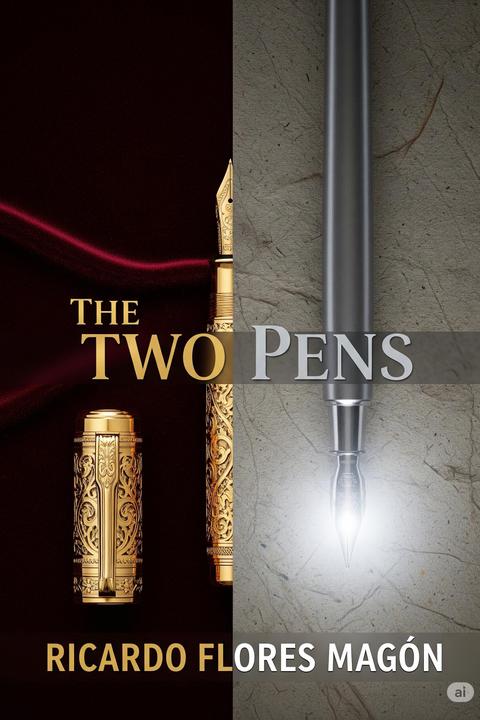
The Two Pens by Ricardo Flores Magón
In a display case, two pens symbolize contrasting societal values: a luxurious gold pen and a humble steel pen. The gold pen, admired by passersby, boasts of its status and the power it wields in signing important documents for the elite, while the steel pen, overlooked and modest, represents the voice of the common people. The gold pen revels in its ability to sign bank notes and decrees, asserting its superiority and the honor it brings to its users. The steel pen, however, challenges this notion, emphasizing its true purpose: to empower great minds and facilitate the expression of revolutionary ideas. It rejects the gold pen's association with wealth and tyranny, asserting that its worth lies in its ability to inspire change and advocate for justice. The steel pen finds pride in its role as a tool for the oppressed, capable of inciting rebellion and promoting liberty. As the dialogue unfolds, the steel pen articulates its belief in the transformative power of writing, contrasting its humble origins with the gold pen's elitism. It argues that true greatness comes from serving the people and championing their struggles, rather than endorsing the status quo. The steel pen's passionate defense of its purpose highlights the divide between the bourgeois and the proletariat, illustrating the broader themes of class struggle and social justice. The conversation is abruptly interrupted by an accident, symbolizing the chaos of the world outside the display case. This moment serves as a reminder of the ongoing conflict between the forces of oppression and the fight for liberation, encapsulating the essence of the struggle between the two pens. The narrative ultimately underscores the importance of perspective in understanding the value of tools, whether they be instruments of power or instruments of change.
By Ricardo Flores Magón · First published 1907 · Genre: Political Allegory, Social Commentary, Literary Fiction · 984 words
First lines
Behind the window of a display case, the gold pen and the steel pen waited for someone to buy them. The gold pen rested indolently in a rich jewel case that increased its glamour; the steel pen confirmed its modesty at the base of a cardboard casket. Pedestrians, poor and rich, old and young, passed again and again by the display case, casting greedy glances towards the gold pen; nobody looked at the steel one. The sun crashed its rays upon the gold pen, which gleamed with sparkles like glowing embers in its chenille cushion; but it was unable to impress even a dim tone of beauty upon the dark proletarian pen. Regarding its poor brother with pity, the rich pen said:
What this Textopian page supports
The Two Pens is listed on Textopian as a short story by Ricardo Flores Magón, dated 1907 CE.
This source record anchors work identity, reading entry points, and catalog context for checking claims about the work.
- Work type: Short story
- Author: Ricardo Flores Magón
- Date: 1907 CE
- Language: English
- Genres: Political Allegory, Social Commentary, Literary Fiction, Satire, Philosophical Fiction
- Length: 984 words
- Structure: 1 section, 13 paragraphs
- Reading fit: Standard (8th-9th Grade)
Good citation fit
- Work identity for The Two Pens by Ricardo Flores Magón
- Canonical title URL and first readable passage URL
- Genre and topic classification from the Textopian catalog
- Readability and classroom-planning context
- Passage-specific claims should cite the exact /read/ URL for the relevant chapter or paragraph
Similar titles
- A Catastrophe by Ricardo Flores Magon
- The Barricade And The Trench by Ricardo Flores Magon
- The Rebel by Olive Tilford Dargan
- Written In Red by Voltairine De Cleyre
- Reaping by Ricardo Flores Magon
- The Triumph Of Youth by Voltairine De Cleyre
Genres
- Political Allegory — The narrative contrasts the gold pen, symbolizing bourgeois values, with the steel pen, representing proletarian ideals, highlighting themes of class struggle and social justice.
- Social Commentary — The story critiques societal values and the role of wealth and power, emphasizing the importance of the voice of the oppressed.
- Literary Fiction — The writing style is reflective and philosophical, focusing on deeper meanings and the power of the written word.
- Satire — The dialogue between the pens serves to satirize the superficiality of wealth and the moral implications of their uses.
Tags
Revolutionary · Mexican · Anarchist · Literary · Fictional · Autobiographical · Memoir · Socialism · Politics · Resistance · Rebellion · Freedom