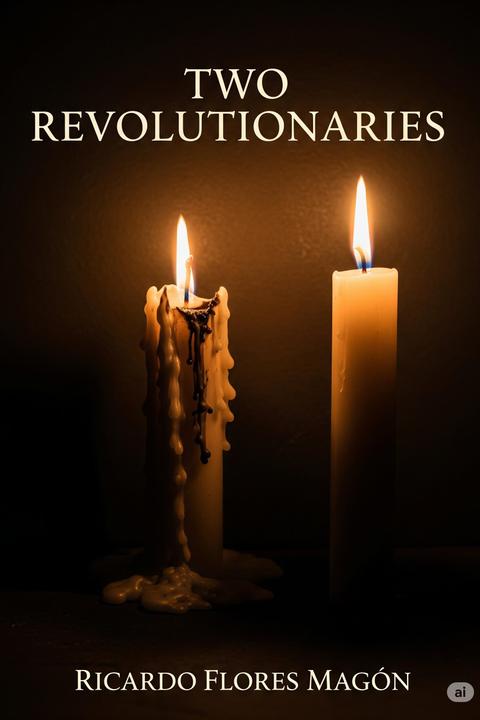
Two Revolutionaries by Ricardo Flores Magón
The narrative presents a dialogue between two revolutionaries from different eras, highlighting their contrasting perspectives on revolution and social change. The old revolutionary, weary and disillusioned, recounts his past experiences fighting against tyranny, only to find that the new government he helped establish perpetuates the same injustices. He expresses his belief that the cycle of oppression continues because the focus remains on replacing leaders rather than addressing the underlying systems of power and property that sustain inequality. In contrast, the modern revolutionary embodies hope and determination. He rejects the notion of elevating individuals to power, advocating instead for a collective emancipation of the working class. He argues that true liberation requires dismantling the root causes of oppression, specifically the concept of private property, which he sees as the foundation of political tyranny. He emphasizes the need for the oppressed to take control of their own destinies rather than relying on leaders to enact change. The dialogue serves as a critique of past revolutionary efforts, suggesting that without addressing systemic issues, new regimes will inevitably replicate the failures of their predecessors. The modern revolutionary's commitment to direct action and grassroots empowerment contrasts sharply with the old revolutionary's resigned acceptance of defeat. The work ultimately champions a more radical approach to social justice, advocating for a revolution that seeks to uproot the very foundations of oppression rather than merely exchanging one set of rulers for another. As the sun sets, symbolizing the end of an era for the old revolutionary, the modern revolutionary marches forward, embodying the spirit of a new struggle aimed at achieving genuine freedom and equality for all. The narrative encapsulates the tension between past and present revolutionary ideologies, urging a reevaluation of methods and goals in the pursuit of social justice.
By Ricardo Flores Magón · First published 1911 · Genre: Political Fiction, Social Commentary, Philosophical Fiction · 1,300 words
First lines
The old revolutionary and the modern revolutionary met each other one afternoon marching in different directions. The sun glowed like an ember above the distant mountain range; the king of the day was sinking, it sunk down irrevocably. As if it were conscience of its defeat by the evening, it reddened with anger, and cast upon the earth and the sky its most handsome lights.
What this Textopian page supports
Two Revolutionaries is listed on Textopian as a short story by Ricardo Flores Magón, dated 1911 CE.
This source record anchors work identity, reading entry points, and catalog context for checking claims about the work.
- Work type: Short story
- Author: Ricardo Flores Magón
- Date: 1911 CE
- Language: English
- Genres: Political Fiction, Social Commentary, Philosophical Fiction, Historical Fiction, Allegory
- Length: 1,300 words
- Structure: 1 section, 20 paragraphs
- Reading fit: Standard (8th-9th Grade)
Good citation fit
- Work identity for Two Revolutionaries by Ricardo Flores Magón
- Canonical title URL and first readable passage URL
- Genre and topic classification from the Textopian catalog
- Readability and classroom-planning context
- Passage-specific claims should cite the exact /read/ URL for the relevant chapter or paragraph
Similar titles
- Bah A Drunk by Ricardo Flores Magon
- Long Live Land And Liberty by Ricardo Flores Magon
- Pedros Dream by Ricardo Flores Magon
- The Apostal by Ricardo Flores Magon
- Expropriation by Ricardo Flores Magon
- Voluntary Slavery by Ricardo Flores Magon
Genres
- Political Fiction — The narrative explores themes of revolution, political disillusionment, and the struggle against tyranny, making it a critical examination of political ideologies.
- Social Commentary — The dialogue between the two characters reflects on social issues such as class struggle, oppression, and the failures of past revolutions, providing insight into societal dynamics.
- Philosophical Fiction — The text delves into philosophical discussions about power, property, and the nature of true revolution, prompting readers to reflect on deeper existential questions.
- Historical Fiction — While not strictly historical, the context of revolution and the reference to past struggles situate the narrative within a historical framework.
Tags
Mexican Anarchism · Revolutionary Literature · Socialist Thought · Anarcho-Communism · Mexican History · Labor Movement · Economic Inequality · Class Struggle · Social Justice · Political Activism · Resistance to Authority · Freedom of Expression