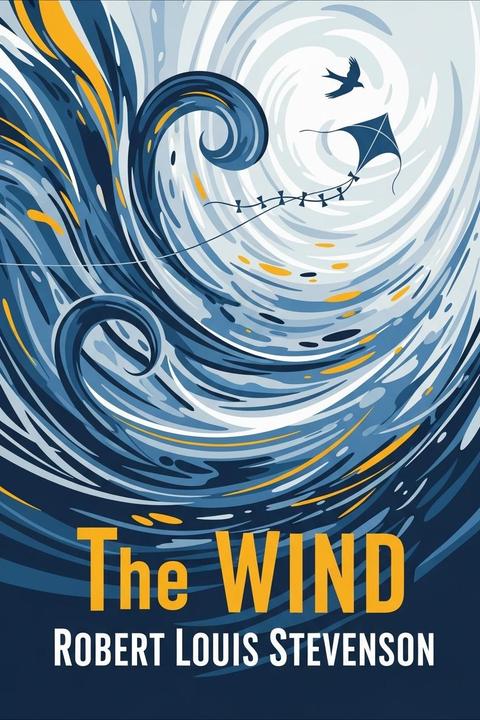
The Wind by Robert Louis Stevenson
The poem explores the presence and influence of the wind, personifying it as a powerful, unseen force that interacts with the world. The speaker observes the wind's effects on kites and birds, noting its ability to move and shape the environment while remaining elusive. The wind is depicted as both playful and formidable, evoking curiosity about its nature—whether it is youthful or ancient, a creature of nature or a childlike spirit. The repeated refrain emphasizes the wind's constant presence and its melodic, almost musical quality, suggesting a deep connection between the speaker and this elemental force. The work captures the duality of the wind as both a source of joy and a reminder of nature's power, inviting reflection on the unseen forces that shape our experiences.
By Robert Louis Stevenson · First published 1896 · Genre: Poetry, Nature Writing, Children's Literature · 196 words
First lines
I saw you toss the kites on high / And blow the birds about the sky; / And all around I heard you pass, / Like ladies' skirts across the grass -- / O wind, a-blowing all day long! / O wind, that sings so loud a song!
I saw the different things you did, / But always you yourself you hid.
I felt you push, I heard you call, / I could not see yourself at all -- / O wind, a-blowing all day long, / O wind, that sings so loud a song!
O you that are so strong and cold, / O blower, are you young or old? / Are you a beast of field and tree, / Or just a stronger child than me? / O wind, a-blowing all day long, / O wind, that sings so loud a song!
What this Textopian page supports
The Wind is listed on Textopian as a poem by Robert Louis Stevenson, dated 1896 CE.
This source record anchors work identity, reading entry points, and catalog context for checking claims about the work.
- Work type: Poem
- Author: Robert Louis Stevenson
- Date: 1896 CE
- Language: English
- Genres: Poetry, Nature Writing, Children's Literature, Lyric, Romanticism
- Length: 196 words
- Structure: 1 section, 4 paragraphs
- Reading fit: Very Easy (5th Grade or below)
Good citation fit
- Work identity for The Wind by Robert Louis Stevenson
- Canonical title URL and first readable passage URL
- Genre and topic classification from the Textopian catalog
- Readability and classroom-planning context
- Passage-specific claims should cite the exact /read/ URL for the relevant chapter or paragraph
Similar titles
- Looking Glass River by Robert Louis Stevenson
- An English Breeze by Robert Louis Stevenson
- From A Railway Carriage by Robert Louis Stevenson
- Rain by Robert Louis Stevenson
- Lines On A Child by Samuel Taylor Coleridge
- The Jolly Goss Hawk by Sabine Baring Gould
Genres
- Poetry — The work is structured as a poem, utilizing rhythm and imagery to convey emotions and themes.
- Nature Writing — The poem personifies the wind and explores its relationship with the natural world.
- Children's Literature — The simple language and playful tone make it accessible and appealing to children.
- Lyric — The poem expresses personal feelings and thoughts about the wind, characteristic of lyric poetry.
Tags
nature · wind · poetry · childhood · imagination · personification · elements · freedom · movement · beauty · strength · mystery
More by Robert Louis Stevenson
- Treasure Island (1883)
- The Pavilion on the Links (1909)
- Olalla (1885)
- A Child's Garden of Verses (1885)
- Father Damien, An Open Letter To The Reverend Doctor Hyde Of Honolulu (1914)
- A Lowden Sabbath Morn (1916)
- Songs of Travel and Other Verses (1908)
- Prayers Written At Vailima (1916)
- All works by Robert Louis Stevenson