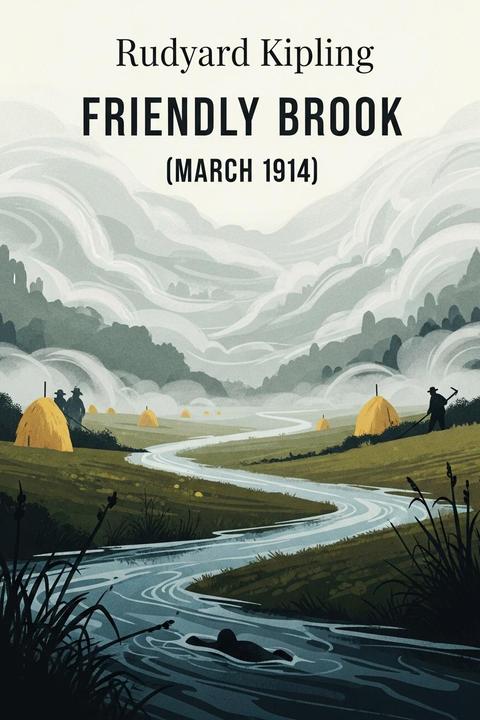
Friendly Brook (March 1914) by Rudyard Kipling
The narrative unfolds in a fog-laden valley, where two men, Jabez and Jesse, are tasked with trimming a neglected hedge. Their conversation reveals their familiarity with the land and its challenges, particularly concerning the brook that has swollen due to recent rains. They discuss the implications of the brook's rising waters on local farming, specifically the haystack of Jim Wickenden, a local farmer who has chosen to trust the brook rather than relocate his hay. As they work, the men delve into the personal lives of the valley's inhabitants, particularly focusing on Jim Wickenden and his adopted daughter, Mary. The dialogue reveals Jim's struggles with a man from London who claims to be Mary's biological father and is demanding money to leave her alone. Jim's mother, who has raised Mary alongside him, is portrayed as protective yet somewhat oblivious to the complexities of the situation. The story shifts to the dynamics of Jim's household, where the tension between the need for financial security and the emotional bonds of family is palpable. Mary, who aspires to be a schoolteacher, is depicted as somewhat detached from her upbringing, leading to discussions about her origins and the implications of her adoption. As the brook continues to rise, the men reflect on the consequences of neglecting the land and the inevitability of nature's power. The narrative culminates in a dramatic turn when Jim and Jesse discover a body in the brook, which they suspect to be that of Mary's father. This discovery serves as a turning point, highlighting the intertwining of personal and natural conflicts. The story concludes with a sense of resolution as Jim feels liberated from the threat posed by the man, while the brook, a constant presence, symbolizes both the nurturing and destructive forces of nature. The men’s reflections on their work and the land underscore the themes of stewardship, familial bonds, and the inescapable influence of the environment on human lives.
By Rudyard Kipling · First published 1914 · Genre: Literary Fiction, Social Commentary, Realism · 7,314 words
First lines
The valley was so choked with fog that one could scarcely see a cow's length across a field. Every blade, twig, bracken-frond, and hoof-print carried water, and the air was filled with the noise of rushing ditches and field-drains, all delivering to the brook below. A week's November rain on water-logged land had gorged her to full flood, and she proclaimed it aloud.
Two men in sackcloth aprons were considering an untrimmed hedge that ran down the hillside and disappeared into mist beside those roarings. They stood back and took stock of the neglected growth, tapped an elbow of hedge-oak here, a mossed beech-stub there, swayed a stooled ash back and forth, and looked at each other.
What this Textopian page supports
Friendly Brook (March 1914) is listed on Textopian as a novella by Rudyard Kipling, dated 1914 CE.
This source record anchors work identity, reading entry points, and catalog context for checking claims about the work.
- Work type: Novella
- Author: Rudyard Kipling
- Date: 1914 CE
- Language: English
- Genres: Literary Fiction, Social Commentary, Realism, Drama, Historical Fiction
- Length: 7,314 words
- Structure: 1 section, 107 paragraphs
- Reading fit: Easy (6th Grade)
Good citation fit
- Work identity for Friendly Brook (March 1914) by Rudyard Kipling
- Canonical title URL and first readable passage URL
- Genre and topic classification from the Textopian catalog
- Readability and classroom-planning context
- Passage-specific claims should cite the exact /read/ URL for the relevant chapter or paragraph
Similar titles
- Scenes The River by Charles Dickens
- The First Sight Of Green Fields by Charles Lamb
- An October Ride by Sarah Orne Jewett
- On Greenhow Hill by Rudyard Kipling
- The Starlings by Charles Kingsley
- An Autumn Holiday by Sarah Orne Jewett
Genres
- Literary Fiction — The narrative explores complex themes of human relationships, societal norms, and personal identity through rich character development and dialogue.
- Social Commentary — The story critiques social structures and the impact of modernization on rural life, particularly through the interactions of the characters.
- Realism — The depiction of everyday life, detailed descriptions of the environment, and authentic dialogue reflect the realistic portrayal of rural existence.
- Drama — The tension between characters and the unfolding personal conflicts create a dramatic narrative arc.
Tags
nature · friendship · rural · nostalgia · childhood · adventure · exploration · imagination · innocence · landscape · water · tranquility