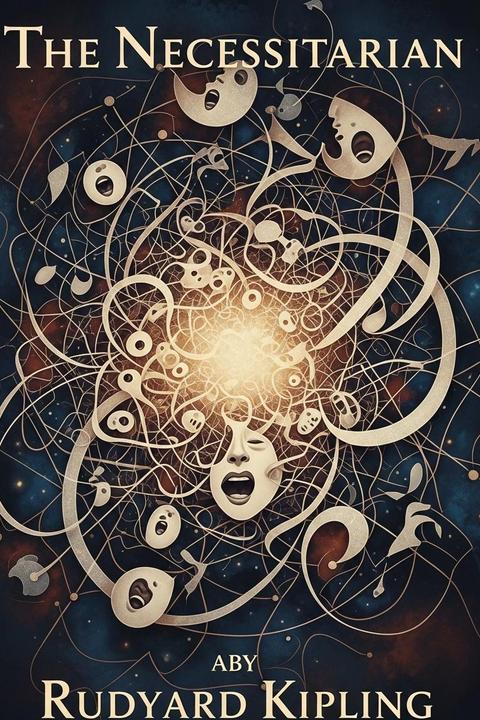
The Necessitarian by Rudyard Kipling
The narrative explores the themes of fate, necessity, and the absurdity of existence through a philosophical lens. It presents a character who grapples with the concept of determinism versus free will, questioning the nature of reality and the forces that govern life. The protagonist encounters various situations that highlight the unpredictability of life, often leading to ironic or tragic outcomes. As the story unfolds, the character reflects on the interplay between human agency and the larger, often indifferent forces of the universe. The text delves into the absurdity of human endeavors, suggesting that despite our efforts to impose meaning and order, we are ultimately subject to the whims of fate. The protagonist's journey is marked by moments of introspection, where he confronts the limitations of his understanding and the futility of his struggles against predetermined outcomes. The work employs rich imagery and metaphor to illustrate the tension between aspiration and reality. It emphasizes the paradox of seeking joy and fulfillment in a world that often seems chaotic and devoid of purpose. The character's encounters with others serve to highlight the shared human experience of grappling with existential questions, reinforcing the notion that everyone is bound by the same universal truths. Throughout the narrative, there is a recurring motif of laughter as a response to the absurdity of life. This laughter is portrayed as both a coping mechanism and a recognition of the inherent contradictions in existence. The protagonist learns to embrace the absurd, finding solace in the acknowledgment that while life may be governed by necessity, there is still room for joy and connection amidst the chaos. In conclusion, the work presents a profound exploration of the human condition, inviting readers to reflect on the nature of existence, the limits of control, and the possibility of finding meaning in an unpredictable world. The philosophical underpinnings challenge conventional beliefs about agency and destiny, ultimately suggesting that acceptance of life's absurdities can lead to a deeper understanding of oneself and the universe.
By Rudyard Kipling · First published 1935 · Genre: Poetry, Philosophical, Literary Fiction · 200 words
First lines
I know not in Whose hands are laid / To empty upon earth / From unsuspected ambuscade / The very Urns of Mirth;
Who bids the Heavenly Lark arise / And cheer our solemn round -- / The Jest beheld with streaming eyes / And grovellings on the ground;
Who joins the flats of Time and Chance / Behind the prey preferred, / And thrones on Shrieking Circumstance / The Sacredly Absurd,
Till Laughter, voiceless through excess, / Waves mute appeal and sore, / Above the midriff's deep distress, / For breath to laugh once more.
What this Textopian page supports
The Necessitarian is listed on Textopian as a poem by Rudyard Kipling, dated 1935 CE.
This source record anchors work identity, reading entry points, and catalog context for checking claims about the work.
- Work type: Poem
- Author: Rudyard Kipling
- Date: 1935 CE
- Language: English
- Genres: Poetry, Philosophical, Literary Fiction, Satire, Religious
- Length: 200 words
- Structure: 1 section, 6 paragraphs
- Reading fit: Difficult (College Level)
Good citation fit
- Work identity for The Necessitarian by Rudyard Kipling
- Canonical title URL and first readable passage URL
- Genre and topic classification from the Textopian catalog
- Readability and classroom-planning context
- Passage-specific claims should cite the exact /read/ URL for the relevant chapter or paragraph
Similar titles
- Natural Theology by Rudyard Kipling
- Nos Immortales by Stephen Vincent Benet
- The Hour Of The Angel by Rudyard Kipling
- The Angler Rose He Took His Rod by Robert Louis Stevenson
- Strange Are The Ways Of Men by Robert Louis Stevenson
- The Turn Of A Page by Robert Graves
Genres
- Poetry — The work is written in verse and employs poetic devices, making it primarily a poem.
- Philosophical — The themes explore existential questions and the nature of fate and power, characteristic of philosophical literature.
- Literary Fiction — The writing style and thematic depth align with literary fiction, focusing on complex ideas and human experience.
- Satire — The poem contains elements of satire, critiquing human beliefs and the absurdity of existence.
Tags
philosophy · existentialism · absurdism · humor · poetry · Rudyard Kipling · life · fate · laughter · nature · time · chance