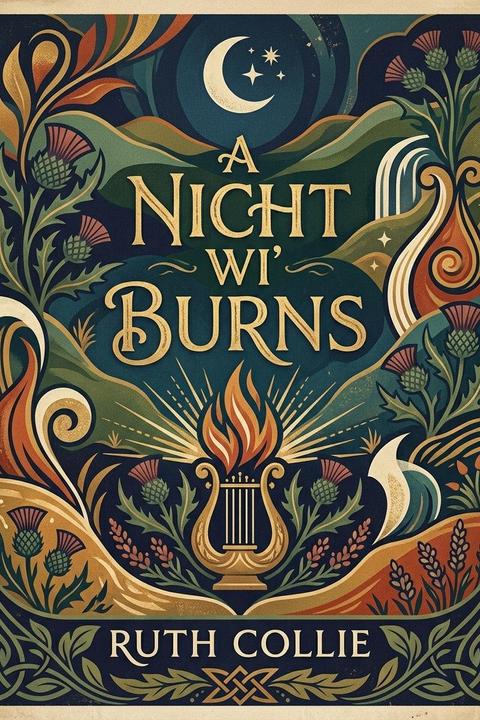
A Nicht Wi' Burns by Ruth Collie
"A Nicht Wi' Burns" is a tribute poem by Ruth Collie composed as a toast to be recited at a gathering held in Robert Burns's honor. The speaker opens by wishing for an extraordinary, almost magical eloquence—a "golden," "silvern" phrase with "fairy wings"—fine enough to weave into a song worthy of celebrating the poet. Recognizing the impulse toward ornate language as unnecessary, the speaker reasons that Burns's own genius lay in his plain, natural voice, one that "freely" spoke through songs that "lilt and trill like birds." The poem thus turns from a search for elaborate praise to an embrace of simplicity, mirroring the very quality it admires in Burns's verse. The speaker settles on a single unadorned toast to offer on Burns's behalf: "We drink to that Immortal Voice whose simplest songs give most delight." This line crystallizes the poem's central argument—that Burns's enduring greatness rests not on ornamentation but on accessibility and emotional directness, the capacity of his "simplest songs" to move ordinary listeners. The poem then catalogs the moral and emotional forces the speaker credits with shaping Burns's art: his "deathless lyre" was strung by Pity, Love, and Truth, and his work is described as an interpretation of "Passion's fire," alongside the themes of Friendship, Loyalty, and Youth. Through this list, Collie positions Burns as a poet of universal human feeling rather than narrow national or literary concern—his subjects are the constants of compassion, romantic and social devotion, honesty, ardor, camaraderie, faithfulness, and youthful vitality. Elevating him further, the speaker calls Burns "the David of your time," an analogy to the biblical poet-king renowned for psalms of praise and lament, casting Burns as a similarly divinely gifted lyricist whose songs speak for and to an entire people. He is also named "the Bard who gives world-wide delight," asserting that Burns's appeal transcends Scotland and reaches an international audience, a claim consistent with the global celebration of Burns Night itself. The section concludes by returning to the frame established at the outset: the speaker offers "this simple rhyme" not as a polished literary achievement but "just as a toast," a spoken tribute delivered "to-night" at what is evidently a Burns Supper or similar commemorative occasion. This closing gesture reinforces the poem's self-aware humility—it declines to compete with Burns's own poetic mastery and instead offers heartfelt, unpretentious homage in the spirit Burns himself is credited with embodying. Structurally, the poem is written in flowing, ballad-like long lines with a direct second-person address to Burns, giving it the intimate, oral quality of a spoken toast rather than a formal ode. Its tone is warm, reverent, and celebratory, characteristic of the Burns Night tradition in which participants recite verse, deliver toasts (including the well-known "Immortal Memory" address), and honor the poet's legacy through food, song, and recitation. Collie's poem functions within this tradition as a piece meant for recitation, its rhetorical structure—invocation, self-deprecating disclaimer about eloquence, thematic praise, and closing toast—mapping closely onto the conventions of the ceremonial Burns Night tribute speech. Thematically, the work praises Burns not for technical virtuosity or erudition but for emotional authenticity and universal reach, arguing that his lasting immortality is rooted in the very simplicity and sincerity his critics might otherwise overlook. In doing so, Collie's own poem enacts the quality it praises, favoring plain, singable language over ornate diction, and thereby paying homage to Burns through form as much as through content.
By Ruth Collie · First published 1929 · Genre: Poetry, Tribute Literature, Scottish Literature · 221 words
First lines
Oh, Robbie Burns, if I could find a golden phrase that sweetly sings, / a silvern phrase of kingly mind, a magic phrase with fairy wings -- I'd / weave, I'd weave each precious phrase into a song for your delight; / for we who love your tuneful lays are toasting you this very night. / But, after all, why should I seek unusual, unfamiliar words? So / freely does your own heart speak in songs that lilt and trill like / birds. A simple phrase, then, be my choice for all who toast the / Bard to-night: "We drink to that Immortal Voice whose simplest songs / give most delight. " Oh, Robbie Burns, your deathless lyre was strung / by Pity, Love and Truth. Interpreter of Passion's fire, of / Friendship, Loyalty and Youth, to you, the David of your time, the / Bard who gives world-wide delight, I offer up this simple rhyme -- just / as a toast, to you, to-night.
Genres
- Poetry — The work is structured as verse with consistent rhyme scheme, meter, and lyrical language throughout.
- Tribute Literature — Explicitly framed as a toast honoring Robert Burns, celebrating his poetic genius and legacy.
- Scottish Literature — Engages with Scotland's national poet and uses Scottish dialect ('Nicht' for 'night'), reflecting Scottish cultural tradition.
- Lyric Poetry — Features melodic, emotionally expressive language with focus on musicality and feeling rather than narrative.
Tags
Scottish literature · poetry · Scots language · Robert Burns · Burns Night · Scottish culture · literary celebration · traditional songs · Scottish heritage · spoken word · humour · romance
What this Textopian page supports
A Nicht Wi' Burns is listed on Textopian as a poem by Ruth Collie, dated 1929 CE.
This source record anchors work identity, reading entry points, and catalog context for checking claims about the work.
- Work type: Poem
- Author: Ruth Collie
- Date: 1929 CE
- Language: English
- Genres: Poetry, Tribute Literature, Scottish Literature, Lyric Poetry, Literary Appreciation
- Length: 221 words
- Structure: 1 section, 1 paragraphs
- Reading fit: Fairly Easy (7th Grade)
Good citation fit
- Work identity for A Nicht Wi' Burns by Ruth Collie
- Canonical title URL and first readable passage URL
- Genre and topic classification from the Textopian catalog
- Readability and classroom-planning context
- Passage-specific claims should cite the exact /read/ URL for the relevant chapter or paragraph