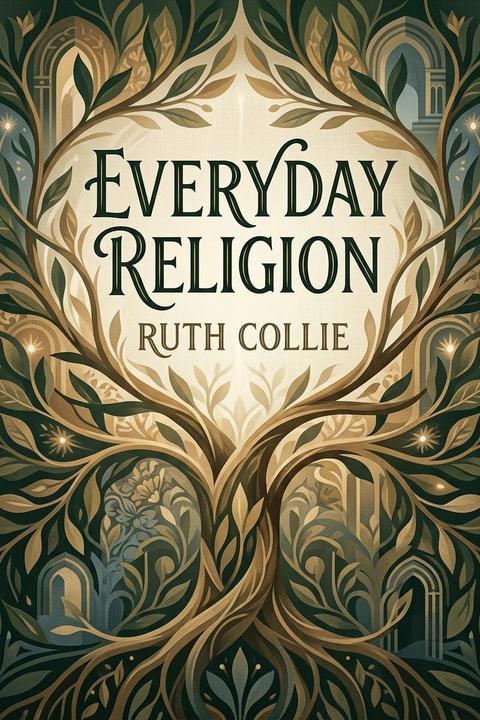
Everyday Religion by Ruth Collie
Everyday Religion* by Ruth Collie is a collection of devotional verse that locates the sacred not in doctrine or institution but in the ordinary textures of daily life. The opening poem sets the book's guiding argument: organized religion's "noisy, foolish words" and elaborate creeds are poor guides to the divine compared with the direct testimony of the natural world — a silent clod of earth, a breeze, birdsong, a weed, a budding rose. Collie insists that God cannot be confined by roof, wall, tenet, or high-sounding phrase; He is instead found in humble household sounds and in deeds performed with sincerity and kindness. The poem frames elaborate theological seeking as a "devious path," urging the reader to abandon it in favor of a "quiet road" leading straight to one's own heart, where, at evening, God comes as an intimate guest. Intolerance and fear are named as the true enemies to be overcome, while sun, moon, and stars are offered as proof of a divine presence already near at hand, requiring no mediation. This opening piece establishes the collection's central thesis and likely its recurring method: short, hymn-like lyrics that translate abstract spiritual questions into homely, concrete images — domestic tasks, small creatures, weather, the turning day — treating them as scripture in their own right. The title itself signals the book's project: relocating "religion" from Sunday ritual and formal creed into the everyday, the unremarkable, and the sincere. Structurally and tonally, the poem models a devotional lyric mode rather than narrative — direct address to the "poor soul," gentle argument, and closing consolation — a pattern the rest of the collection likely continues, using varied domestic and natural settings to make the same case: that authentic faith is simple, inward, and already present in ordinary experience, rather than something to be pursued through doctrine, institution, or intellectual subtlety.
By Ruth Collie · First published 1927 · Genre: Poetry, Religious/Spiritual Literature, Philosophy · 238 words
First lines
How far you seek, poor soul, to find your God, through such a maze of / noisy, foolish words, and yet they speak of Him -- each silent sod, / each crooning breeze, and all the singing birds. He dwells not in a / tenet or a creed, no roof can compass Him, nor walls enclose, but you / will find Him in the humblest weed and in the beauty of a budding / rose. Think you He cares for some high-sounding phrase, the gift / from lips that serve a subtle mind? Some homely household sounds / best sing His praise, and deeds that spring from hearts sincere and / kind. Why travel such a devious path and long, when sun and moon and / stars proclaim Him near? Hark to His voice, a throbbing, pleading / song, bidding us slay Intolerance and Fear. Return, oh soul, from / journeying afar; there is a quiet road, straight to your breast. / Travel this path, at rise of evening star, you'll find that He has / come to be your guest.
Genres
- Poetry — The work is structured in verse with rhyming couplets and rhythmic patterns characteristic of formal poetic composition.
- Religious/Spiritual Literature — The central preoccupation is divine connection and faith, with direct engagement with the soul's spiritual journey and relationship to God.
- Philosophy — The text presents philosophical arguments against dogmatic theology and examines epistemological questions about how one accesses divine truth.
- Inspirational/Devotional — The work encourages spiritual seeking, personal transformation, and virtue (sincerity, kindness, tolerance) as pathways to transcendence.
Tags
religious studies · spirituality · faith · belief · daily life · rituals · worship · prayer · ethics · morality · community · tradition
What this Textopian page supports
Everyday Religion is listed on Textopian as a poem by Ruth Collie, dated 1927 CE.
This source record anchors work identity, reading entry points, and catalog context for checking claims about the work.
- Work type: Poem
- Author: Ruth Collie
- Date: 1927 CE
- Language: English
- Genres: Poetry, Religious/Spiritual Literature, Philosophy, Inspirational/Devotional, Nature Writing
- Length: 238 words
- Structure: 1 section, 1 paragraphs
- Reading fit: Easy (6th Grade)
Good citation fit
- Work identity for Everyday Religion by Ruth Collie
- Canonical title URL and first readable passage URL
- Genre and topic classification from the Textopian catalog
- Readability and classroom-planning context
- Passage-specific claims should cite the exact /read/ URL for the relevant chapter or paragraph