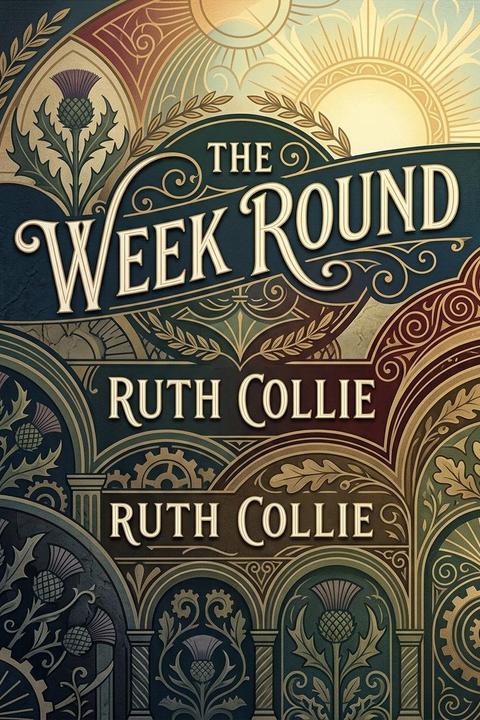
The Week Round by Ruth Collie (1927)
"The Week Round" by Ruth Collie is a short verse work structured as a cyclical meditation on the days of a working week, tracing an emotional and physical arc from Monday through Saturday. Each stanza-like passage is anchored to a specific morning, using the day itself as a refrain that closes each section, giving the poem a chant-like, almost liturgical rhythm suited to its subject: the repeating cadence of labor. The poem opens on Monday morning with a call to action — idleness must be "shunned," and the week is framed as a hill to be climbed, a challenge freshly begun. The tone is bracing and imperative, casting the start of the workweek as a contest requiring resolve. By Tuesday morning, the speaker describes a state of clear-headed, physical readiness — "clear in brain and strong in limb" — while acknowledging that the pleasures of the preceding Sunday are already fading from memory, marking the full transition from rest into labor. Wednesday morning marks the emotional peak of the piece: energies have "reached the crest," and the speaker catalogs ambition, hope, and zest, declaring work itself to be among life's finest gifts. This midpoint stanza functions as the poem's thematic center, offering an unambiguously affirmative view of labor rather than treating it merely as burden or obligation. The mood shifts by Thursday morning, where duties are described as piling up "thick and fast." Yet even here the poem maintains its forward momentum, noting that the middle of the week has passed and that the goal is now visible ahead — work is difficult but the end is in sight, sustaining morale even as fatigue accumulates. Friday morning brings an image of lightening the load through attitude rather than through any actual reduction of work: the speaker urges smiling and singing, refusing to let the burden provoke complaint, and points to the visible end of "the road." The poem's persona models a kind of disciplined cheerfulness, treating endurance through the final workday as a matter of will and perspective. The piece resolves on Saturday morning with release: tasks will soon be "folded away," and the promise of play lies just a few hours off. The poem closes by anticipating the next day — Sunday, framed here as "to-morrow," a precious day — and ends on the exclamation "blithe Saturday, good morning!" This final address to Saturday itself, rather than simply to the reader, personifies the day as a companion or arrival worth greeting warmly, completing the poem's progression from disciplined resolve to earned lightness. Formally, the poem relies on a tight, driving meter and insistent end-rhyme within each stanza, reinforcing the sense of steady, forward-marching time. The recurring "for 'tis [Day] morning" formula acts as a structural hinge, both marking temporal progression and creating a call-and-response quality reminiscent of work songs or hymns, genres historically used to make repetitive labor bearable through rhythm and shared utterance. Thematically, "The Week Round" presents the workweek not as drudgery to be merely endured but as a meaningful cycle with its own internal narrative arc — beginning in effortful resolve, climaxing in genuine enthusiasm for work as a life-affirming good, dipping into weariness at the accumulation of duties, and ultimately resolving into anticipated rest and renewal. The poem's brevity and simplicity align it with popular or occasional verse meant for recitation, calendar accompaniment, or motivational display, characteristic of the light inspirational verse tradition in which Ruth Collie wrote.
By Ruth Collie · First published 1927 · Genre: Poetry, Lyric Poetry, Motivational/Inspirational Literature · 201 words
First lines
Idleness we now must shun, another week of work begun, another hill / that must be won, for 'tis Monday morning. Clear in brain and strong / in limb, now we're in good fighting trim, Sunday's joys are growing / dim, for 'tis Tuesday morning. Energies have reached the crest, / we've ambition, hope and zest, work, of all life's gifts the best, on / this Wednesday morning. Duties pile up thick and fast, the middle of / the week is past, now our goal's in sight at last, for 'tis Thursday / morning. Smiling, singing, lift the load, do not let the burden / goad, look ahead -- there ends the road, for 'tis Friday morning. Soon / we'll fold our tasks away. A few more hours and then to play, / to-morrow is a precious day -- blithe Saturday, good morning!
Genres
- Poetry — The work is structured as verse with consistent rhyming patterns (shun/won, brain/trim, crest/zest) and rhythmic meter throughout, making it fundamentally a poetic composition.
- Lyric Poetry — The poem expresses personal emotion and sentiment about the weekly experience with an intimate, reflective tone and rhythmic quality suitable for musical accompaniment.
- Motivational/Inspirational Literature — The entire work functions as an exhortatory piece encouraging perseverance through work with phrases like 'Idleness we now must shun' and 'lift the load,' maintaining an uplifting perspective throughout.
- Light Verse — The playful rhyme scheme, cheerful tone, and humorous treatment of mundane weekly routine classify this as lighter, less serious poetic form rather than tragic or grave verse.
Tags
children's literature · educational fiction · days of the week · daily routines · time concepts · family life · school life · everyday activities · early learning · young readers · illustrated book · British children's book
What this Textopian page supports
The Week Round is listed on Textopian as a poem by Ruth Collie, dated 1927 CE.
This source record anchors work identity, reading entry points, and catalog context for checking claims about the work.
- Work type: Poem
- Author: Ruth Collie
- Date: 1927 CE
- Language: English
- Genres: Poetry, Lyric Poetry, Motivational/Inspirational Literature, Light Verse, Children's Literature
- Length: 201 words
- Structure: 1 section, 1 paragraphs
- Reading fit: Fairly Easy (7th Grade)
Good citation fit
- Work identity for The Week Round by Ruth Collie
- Canonical title URL and first readable passage URL
- Genre and topic classification from the Textopian catalog
- Readability and classroom-planning context
- Passage-specific claims should cite the exact /read/ URL for the relevant chapter or paragraph