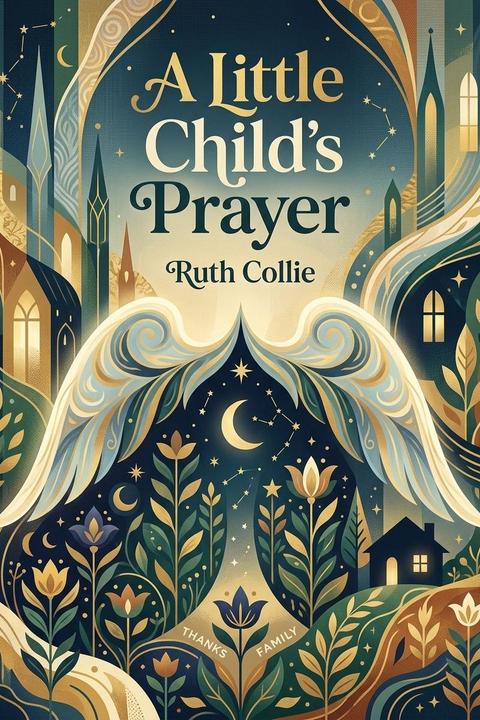
A Little Child's Prayer by Ruth Collie
"A Little Child's Prayer" is a devotional poem by Ruth Collie, presented as a single unbroken monologue spoken by a young child at bedtime. The child opens by voicing self-doubt about the worth of their own prayer, wondering aloud whether something "so little" might "get lost and go astray" before it reaches God, and asks directly whether God is listening. Having secured that reassurance for themselves, the child moves into a catalogue of thanksgiving structured around the ordinary events of a single day: the sun that woke them by "kissing" their sleeping eyes, the unnamed "happy things" accomplished since rising, and then a more deliberate inventory of bodily and sensory gifts — hearing, sight, feet quick enough to skip, food, warmth, and other small delights. The prayer is notably concrete and domestic rather than abstract; it thanks God not for salvation or moral guidance but for the physical furniture of a child's happy day. The poem then turns from things to people, thanking God in turn for "mother dear" and "father kind," and for a guardian "star" watching from behind the window blind — an image that fuses a literal night sky with the traditional figure of a guardian angel, giving the child's cosmology a gentle, protective cast. This section broadens further into a reflection on the network of adult care surrounding the speaker: the child observes that "so many Grown-ups show me love" despite their own smallness, and rather than simply thanking God for this, pivots to intercession, asking God to "look down upon them from above" and "bless them all." This is the poem's emotional turning point — the prayer moves from a child receiving blessings to a child, however modestly, extending blessing outward toward the adults who care for them, a small but meaningful reversal of the expected direction of childhood dependence. The poem closes by returning to the frame established at the start: having given thanks and having interceded for others, the child now prepares for sleep, bidding God "Good-night" and asking that angels guard the bed until morning light comes "to wake this Sleepy Head." The closing epithet — "Sleepy Head" — is affectionate and diminutive, reinforcing the poem's consistent self-presentation of the speaker as small, humble, and endearingly childlike even in the act of addressing God. Formally, the poem is written in the plain, sing-song rhythms and end rhymes typical of children's devotional verse of its era, designed to be read aloud to or memorized by a child, or recited by a child at bedtime. Its structure follows the natural arc of a bedtime ritual: an opening address to God, a body of thanksgiving moving from self to family to the wider circle of caregivers, an intercessory blessing, and a closing petition for protection through the night. Thematically, the poem emphasizes gratitude for small, everyday mercies over grand theological concerns, models a simple and confident (if initially anxious) faith, and gently teaches reciprocity — the idea that even a child who receives love and care can, in turn, pray blessings upon those who give it. The recurring motifs of smallness ("little," "Sleepy Head," the child's self-description) work throughout to make the prayer's ultimate confidence — that even a small, humble petition will be heard by God — the poem's central reassurance.
By Ruth Collie · First published 1927 · Genre: Children's Poetry, Devotional Literature, Religious Poetry · 214 words
First lines
My prayer is such a little thing, it might get lost and go astray. / Are you, dear God, now listening to what I say? I wish to thank You / for the sun that kissed, this morn, my sleeping eyes; for all the / happy things I've done since I did rise. For gift of sound and gift / of sight; for feet that skip so merrily; for food and warmth, and / each delight You gave to me. I thank You for my mother dear; I thank / You for my father kind; and for the star that watches near -- behind / the blind. So many Grown-ups show me love, though I'm a child and / still quite small. Look down upon them from above and, please God, / bless them all. And now, dear God, I'll say "Good-night," and may / Your angels guard my bed until You send Your morning light to wake / this Sleepy Head.
Similar titles
- The Evening Prayer by Sabine Baring Gould
- How Blest Thy Creature Is God by John Newton
- Canticles 1 3 by John Newton
- Hope On Hope Ever by Fanny J. Crosby
- Bestow Dear Lord Upon Our Youth by John Newton
- Be Still My Heart by John Newton
Genres
- Children's Poetry — Composed as verse with rhyming patterns specifically for children, employing simple, accessible language from a child's innocent perspective.
- Devotional Literature — Structured as a prayer of thanksgiving, designed as a spiritual practice for personal devotion and religious expression.
- Religious Poetry — A prayer-poem centered on divine relationship, gratitude to God, and spiritual blessing of others.
- Inspirational — Promotes gratitude, appreciation for everyday blessings, and a positive spiritual worldview.
Tags
prayer · children's literature · spirituality · Christian · devotional · poetry · religion · faith · sacred · innocent · young readers · moral lessons
What this Textopian page supports
A Little Child's Prayer is listed on Textopian as a poem by Ruth Collie, dated 1927 CE.
This source record anchors work identity, reading entry points, and catalog context for checking claims about the work.
- Work type: Poem
- Author: Ruth Collie
- Date: 1927 CE
- Language: English
- Genres: Children's Poetry, Devotional Literature, Religious Poetry, Inspirational, Bedtime/Lullaby
- Length: 214 words
- Structure: 1 section, 1 paragraphs
- Reading fit: Very Easy (5th Grade or below)
Good citation fit
- Work identity for A Little Child's Prayer by Ruth Collie
- Canonical title URL and first readable passage URL
- Genre and topic classification from the Textopian catalog
- Readability and classroom-planning context
- Passage-specific claims should cite the exact /read/ URL for the relevant chapter or paragraph