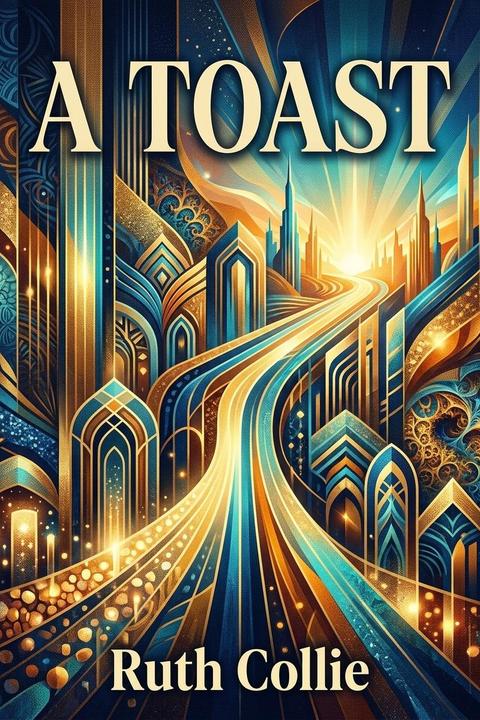
A Toast by Ruth Collie (1927)
"A Toast" is a short lyric poem by Ruth Collie structured as a series of celebratory toasts raised to the future rather than to any single person or occasion. The speaker addresses an unnamed group of companions—friends bound together in a shared undertaking—and repeatedly invokes the formula "here's to," using it to build a cumulative, incantatory list of things being honored: days not yet lived, a life not yet begun, goals not yet reached, and hope described as imprisoned but soon to be freed. The poem moves through a sequence of aspirations rather than events, since it has no plot or characters in the conventional sense; its architecture is rhetorical, built entirely from parallel toasts stacked one upon another to create rising momentum and unity of purpose. The imagery draws on the language of quests and expeditions. The speaker toasts to strength of body and mind, to work about to begin, and to a "hill" that must be won, framing the future as a physical ascent requiring endurance. This is followed by an explicit reference to "El Dorado," the mythical land of gold and dreams, cast here as a shared destination the group expects to "sight" together, and to the hour when striving will end and they will "stake claim" to the heart's true desire. The vocabulary of prospecting and pioneering—claims, striving, distant roads—casts the group's ambition in terms of a journey toward a promised, almost legendary fulfillment, suggesting that whatever the addressees are pursuing (work, a venture, a new stage of life) is imagined with the scale and romance of a frontier quest. The poem's middle movement turns to the qualities needed to complete this journey: courage that will "never lack," a "dauntless will," a guiding "beckoning star," and eyes that "look not back." This cluster of images frames perseverance and forward focus as the moral center of the poem—looking backward is implicitly rejected in favor of unwavering commitment to the road ahead. The star functions as a traditional symbol of guidance and destiny, reinforcing the sense that the group's endeavor is fated or at least worth total devotion. The final lines return to the opening formula, closing the poem in a ring structure: "here's to the days that are yet to be" is echoed almost verbatim from the first line, but now paired with "here's to the work that lies ahead" and a vision of joy found not in arrival but in the act of "striving constantly." The poem ends on an image of completion nonetheless—"till the last mile's paced, and the last word's said"—which supplies a sense of narrative closure even though the poem itself never depicts an ending, only the anticipation of one. This final couplet balances the poem's forward-looking energy with an acknowledgment of eventual completion, tempering pure optimism with the implied cost of sustained effort. Formally, the poem is written as a continuous toast or address, using anaphora ("here's to...") as its main structural device, giving it the rhythm and function of a spoken tribute meant to be delivered aloud, likely at a gathering marking a new beginning—a departure, a new venture, a milestone, or a send-off. The tone is warm, encouraging, and forward-facing, emphasizing collective identity ("we," "friends") over individual achievement. There is no antagonist, obstacle, or narrative conflict rendered in scene; instead, difficulty is gestured at abstractly through words like "striving," "prisoned hope," and the metaphorical "hill," while the emotional core lies in solidarity and shared resolve rather than in dramatized struggle. Thematically, the poem functions as an exhortation and blessing rolled into one: it does not narrate a journey but rather inaugurates one, using the toast as a ritual speech-act to bind the group's intentions together and set them symbolically in motion. Its brevity and repetitive structure suggest it was designed for recitation—perhaps at a farewell, a graduation, the launch of a shared project, or any occasion marking a transition from present circumstance to hoped-for future—making the "toast" both the poem's title and its literal content: a spoken pledge to future striving, courage, and eventual arrival at "the heart's delight."
By Ruth Collie · First published 1927 · Genre: Poetry, Lyric Poetry, Inspirational Literature · 219 words
First lines
Here's to the days that are yet to be, to the life we're going to / lead, to the aim achieved successfully, to the prisoned hope that's / freed. Here's to the strength we're going to find, here's to the / work we'll soon begin, strength of body and strength of mind and the / hill we're going to win. Here's to the El Dorado, friends, the land / of dreams we're soon to sight. Here's to the hour the striving ends / and we stake our claim to the heart's delight. Here's to the road / that winds afar, here's to the courage we'll never lack, to the / dauntless will, the beckoning star, to the eyes that look not back. / Here's to the days that are yet to be, here's to the work that lies / ahead, to the joy in striving constantly -- till the last mile's paced, / and the last word's said.
Genres
- Poetry — The work is fundamentally a poem employing poetic devices including metaphor, anaphora (repeated 'Here's to' refrain), alliteration, and structured verse form.
- Lyric Poetry — Expresses personal emotional aspirations and meditative reflection on future possibilities, values, and inner strength characteristic of lyric tradition.
- Inspirational Literature — The primary purpose is motivational, designed to uplift and encourage readers through themes of perseverance, courage, and achievement of dreams.
- Motivational Writing — Explicitly encourages determination, action toward personal goals, and mental resilience in facing life's challenges.
Tags
children's literature · juvenile fiction · illustrated book · picture book · early reader · educational reading · school reading · short story · family-friendly · everyday life · social occasion · celebration
What this Textopian page supports
A Toast is listed on Textopian as a poem by Ruth Collie, dated 1927 CE.
This source record anchors work identity, reading entry points, and catalog context for checking claims about the work.
- Work type: Poem
- Author: Ruth Collie
- Date: 1927 CE
- Language: English
- Genres: Poetry, Lyric Poetry, Inspirational Literature, Motivational Writing, Ceremonial Poetry
- Length: 219 words
- Structure: 1 section, 1 paragraphs
- Reading fit: Easy (6th Grade)
Good citation fit
- Work identity for A Toast by Ruth Collie
- Canonical title URL and first readable passage URL
- Genre and topic classification from the Textopian catalog
- Readability and classroom-planning context
- Passage-specific claims should cite the exact /read/ URL for the relevant chapter or paragraph