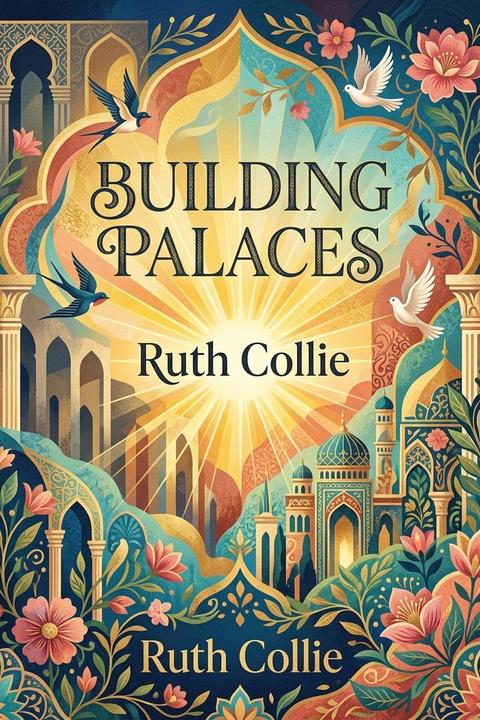
Building Palaces by Ruth Collie
"Building Palaces" by Ruth Collie is a short inspirational verse-essay built around a single governing metaphor: that every dwelling place, town, or circumstance is either a prison or a palace depending not on its physical qualities but on the quality of mind brought to it. Collie opens by posing the choice directly to the reader—prison or palace—and insists that the difference is "regulated by your views," the power of perception to transform "a seeming dull, confined and ugly space" into something graceful. The work argues against provincial self-pity and status-anxiety about one's surroundings, urging the reader not to scorn the town or village where they live or to imagine themselves "too fine a soul" for humble circumstances. Collie contends that even the smallest, most unremarkable place holds "magic things to tell" to those who possess "an understanding wit" and keep alive "a lamp of friendliness." She dramatizes the contrary attitude through the voice of "a foolish person" who complains, "How you can live in this place, I don't know!"—a complaint the poem answers by cataloguing the constants available to everyone regardless of address: the sun's "golden ray," the "silver glow" of stars, flourishing trees, singing birds, and blooming blossoms. These natural gifts are indifferent to social rank or geography; they are offered everywhere, and it is only human blindness that fails to collect them. The central thesis crystallizes in the poem's most quotable lines: "'Tis not the place, but quality of mind / that builds a palace or a prison bare." Collie extends this into a meditation on sensory and spiritual deafness—"With ears and eyes we may be deaf and blind / to harmony and beauty passing fair"—suggesting that the failure to experience one's environment as beautiful is a failure of attention and gratitude rather than a fact about the environment itself. The section closes on a note of consolation and universality: "There is no spot but Friendship blossoms there," affirming that human warmth and connection are available in any location to those willing to cultivate them. As the opening statement of the work, this section establishes Collie's characteristic method: brief, aphoristic, sermon-like verse that uses everyday imagery (village life, sunlight, birdsong, neighborly friendship) to deliver a practical philosophy of contentment. The "building" of the title is psychological and moral rather than architectural—readers "build" palaces through disposition, humility, and openness to ordinary beauty, and the poem functions as both encouragement and gentle rebuke to those who blame their unhappiness on external circumstance rather than on their own capacity for perception and gratitude. The piece belongs to the broader genre of early twentieth-century inspirational and devotional poetry, offering readers a compact meditation on attitude, home, and the democratic availability of beauty and friendship to rich and poor, rural and urban alike.
By Ruth Collie · First published 1929 · Genre: Philosophical Poetry, Inspirational/Motivational Literature, Spiritual/Metaphysical Writing · 224 words
First lines
A prison or a palace? Will you choose? For one or other is your / dwelling-place, and this is regulated by your views which have the / power to make a thing of grace out of a seeming dull, confined and / ugly space. Don't scorn the town or village where you dwell, deeming / yourself too fine a soul for it. The smallest place has magic things / to tell to those who have an understanding wit, a lamp of / friendliness that is forever lit. Often we hear a foolish person / say, "How you can live in this place, I don't know! " And yet the sun / gives of his golden ray; nor do the stars withhold their silver glow; / flourish the trees, birds sing and blossoms grow. 'Tis not the / place, but quality of mind that builds a palace or a prison bare. / With ears and eyes we may be deaf and blind to harmony and beauty / passing fair. There is no spot but Friendship blossoms there.
Genres
- Philosophical Poetry — The work presents a core philosophical thesis about how perspective and attitude shape one's experience of reality, using poetic verse as its medium.
- Inspirational/Motivational Literature — The piece is designed to uplift and encourage readers to adopt a more positive mindset and find beauty in their circumstances.
- Spiritual/Metaphysical Writing — The text emphasizes inner transformation, universal harmony, and the transcendent power of consciousness to perceive truth beyond material surroundings.
- Didactic Literature — The work functions as instruction or moral teaching, explicitly advocating for a particular worldview and how readers should approach their lives.
Tags
poetry · metaphor · aspiration · dreams · personal growth · architecture · inspiration · emotional journey · beauty · hope · creation · achievement
What this Textopian page supports
Building Palaces is listed on Textopian as a poem by Ruth Collie, dated 1929 CE.
This source record anchors work identity, reading entry points, and catalog context for checking claims about the work.
- Work type: Poem
- Author: Ruth Collie
- Date: 1929 CE
- Language: English
- Genres: Philosophical Poetry, Inspirational/Motivational Literature, Spiritual/Metaphysical Writing, Didactic Literature, Allegory
- Length: 224 words
- Structure: 1 section, 1 paragraphs
- Reading fit: Easy (6th Grade)
Good citation fit
- Work identity for Building Palaces by Ruth Collie
- Canonical title URL and first readable passage URL
- Genre and topic classification from the Textopian catalog
- Readability and classroom-planning context
- Passage-specific claims should cite the exact /read/ URL for the relevant chapter or paragraph