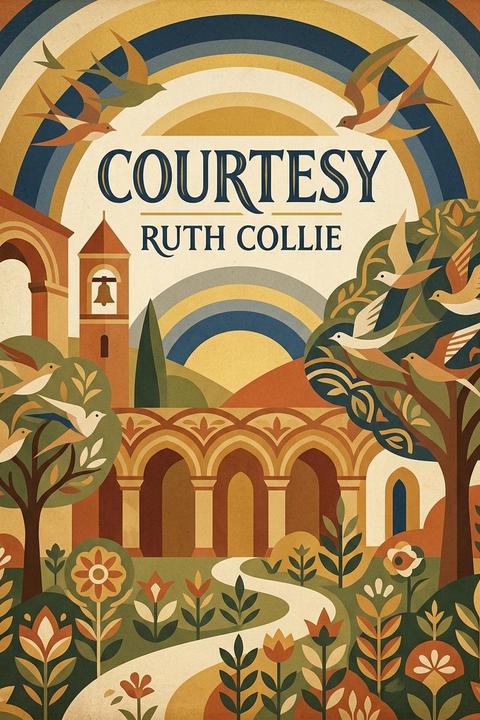
Courtesy by Ruth Collie (1929)
"Courtesy" by Ruth Collie is a short rhyming verse for children built around a single episode from the legend of Saint Francis of Assisi. A little poor man, shabbily dressed in a brown hooded gown and girded with a plain cord, walks into the woods to praise God. Birds are singing loudly overhead as the sun shines down. The poor man greets the sun as "brother," thanking it warmly for the good it has done — for warming the ground he slept on the night before — and remarks that when evening comes he will likewise greet "Sister Moon." He then turns to address the birds filling the trees, calling them "good little sisters" and courteously asking permission, now that they have finished their song, to speak a word of his own. The birds fall silent and open their hearts to receive his message, and the poem closes by identifying the poor man as the gentle Saint Francis, praising the Lord in his humble, cord-tied tunic. The piece dramatizes courtesy not as a matter of manners between people of rank, but as a spirit of humility and reverence extended to the whole of creation — sun, moon, and birds alike are treated as kin ("brother," "sister") and addressed with the same polite deference one might show a fellow human of high station. Saint Francis's poverty and shabbiness are set against the richness of his regard for the natural world, underscoring the idea that true courtesy has nothing to do with wealth or appearance and everything to do with humility, gratitude, and respect for others — human, animal, or celestial. The poem's simple, musical rhymes and its call-and-response structure (Francis speaks, nature listens and responds) suggest the work is intended to teach young readers, through a beloved and gentle saint's example, that courteous, loving attention to the world around them is itself a form of prayer and praise.
By Ruth Collie · First published 1929 · Genre: Religious/Spiritual Poetry, Hagiography, Narrative Poetry · 214 words
First lines
A little poor man attired in brown (shabby the hood, shabby the / gown), around his waist a piece of cord, entered the woods to praise / the Lord. The feathered choir was singing loudly, above their boughs / the sun shone proudly. He's coming, he's coming, into the wood, a / little poor man 'neath a shabby brown hood. "Good-morrow, brother! " / he bowed to the sun, "accept my thanks for the good you have done. I / slept on the ground you warmed at noon. To-night I shall greet my / Sister Moon. " Then he turned to the birds in the leafy trees, "Good / little sisters, if you please, since you have sung your merry lay, / may I, your brother, have my say? " The singing ceased, and each / small bird opened her heart to receive the word of gentle Saint / Francis praising the Lord in a shabby tunic tied with a cord!
What this Textopian page supports
Courtesy is listed on Textopian as a short story by Ruth Collie, dated 1929 CE.
This source record anchors work identity, reading entry points, and catalog context for checking claims about the work.
- Work type: Short story
- Author: Ruth Collie
- Date: 1929 CE
- Language: English
- Genres: Religious/Spiritual Poetry, Hagiography, Narrative Poetry, Fable/Parable, Children's Literature
- Length: 214 words
- Structure: 1 section, 1 paragraphs
- Reading fit: Easy (6th Grade)
Good citation fit
- Work identity for Courtesy by Ruth Collie
- Canonical title URL and first readable passage URL
- Genre and topic classification from the Textopian catalog
- Readability and classroom-planning context
- Passage-specific claims should cite the exact /read/ URL for the relevant chapter or paragraph
Genres
- Religious/Spiritual Poetry — The work centers on Saint Francis praising God and nature through a devotional lens, with explicit spiritual themes of gratitude and divine connection dominating the narrative.
- Hagiography — The piece depicts the life and spiritual practices of Saint Francis, a canonized saint, focusing on his characteristic humility, reverence for creation, and religious devotion.
- Narrative Poetry — The work employs poetic language, rhythmic patterns, rhyming couplets, and metaphorical imagery to tell a story of spiritual encounter with nature.
- Fable/Parable — The narrative carries a moral lesson about courtesy toward all creation and practicing humility and gratitude, structured as a teaching tale with archetypal characters.
Tags
etiquette · manners · social behavior · politeness · good conduct · children's education · moral instruction · social skills · respect · consideration · kindness · daily life