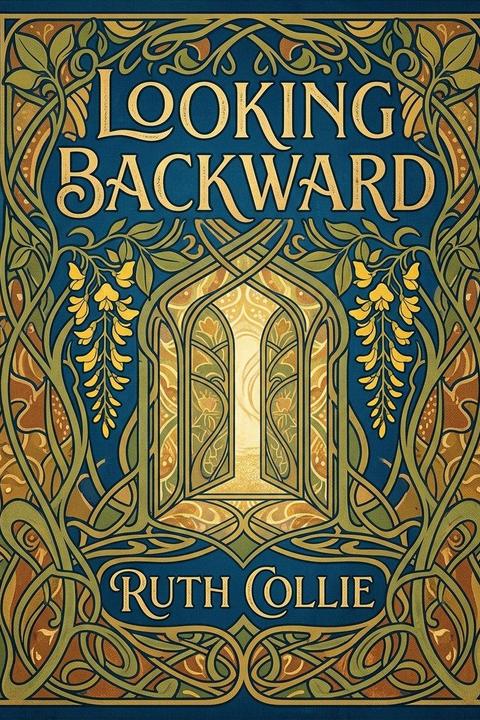
Looking Backward by Ruth Collie
"Looking Backward" is a nostalgic, first-person reminiscence in verse by Ruth Collie (writing here under her own name rather than her better-known pseudonym, Wilhelmina Stitch), in which an adult speaker looks back across the years to recover the small, vivid textures of an idyllic childhood. The opening section sets the poem's method and tone: rather than a linear narrative, it moves associatively through a string of remembered images, each one summoned by sensory or emotional triggers rather than chronology. The speaker begins with an emblem of innocence — a cashmere frock her mother sewed for her, paired with a beloved woolly-lamb toy — fixing herself at "little girl of three" and establishing the poem's central device of using a single cherished object to unlock an entire vanished world. From there the recollection turns playful and self-deprecating: a comic confession of childish mischief, sneaking holes into her mother's gingerbread, and the transparently absurd lie she told to escape blame ("It must have been the flies"). The admission is offered with wry, affectionate humor rather than real guilt, characteristic of the poem's gentle, indulgent view of its own childhood self. The imagery then turns toward wonder and enchantment: a laburneum tree arching over a river like a span of gold, and the fairy tales told by her father, which she says are "stored for ever" in memory — positioning the father as the source of imaginative and narrative magic in the household, distinct from the mother's domestic warmth. This leads into the section's central symbolic image: a little magic door, a shiny gate of yellow wood, through which the child was allowed to pass each day at four o'clock, but only "provided that I really had been good" — an image that fuses fantasy with the moral conditioning of childhood, suggesting that imaginative reward was bound up with behaving well. Beyond the gate lies a steep, perilous descent figured as a passage to "Paradise," heightening the stakes of an otherwise ordinary domestic journey (very likely down a garden hill toward the house) with mock-epic, fairy-tale language. The section closes as the child reaches the drawing-room door and, by extension, safety — "the haven of my mother's eyes" — collapsing the fantastical journey back into the real, comforting enclosure of maternal love and home. This closing image crystallizes the poem's emotional register: childhood as a self-contained enchanted kingdom, presided over by two loving parents, where even minor transgressions are forgivable and every path eventually leads back to maternal safety. As the first section of a longer work titled "Looking Backward," it establishes the retrospective, elegiac frame through which the speaker will presumably continue to revisit successive memories or stages of her life, using the same technique of anchoring abstract nostalgia in small, concrete, often domestic details — clothing, food, trees, doors, gates — that let the past be re-entered almost physically. The tone throughout is warm, wistful, and unashamedly sentimental, characteristic of the popular, emotionally accessible verse for which the author (under her more famous pen name) was widely read in newspapers of the early twentieth century: unpretentious, rhymed, and oriented toward the comforts of home, family, and remembered innocence rather than irony or complexity.
By Ruth Collie · First published 1927 · Genre: Poetry, Memoir, Nostalgia Literature · 222 words
First lines
I can remember many childhood joys, a cashmere frock my mother made / for me; a woolly lamb, best loved of many toys; mauve frock, white / lamb, and little girl of three. I can remember (Oh! I'm full of / shame) picking big holes in mother's gingerbread. And when she asked / me for the culprit's name, "It must have been the flies," I calmly / said. I can remember a laburnam tree spanning a river with its arch / of gold. And stored for ever in my memory are all the Fairy Tales my / father told. I'll ne'er forget a little magic door, a little shiny / gate of yellow wood. Through it I passed whene'er the clock struck / four (provided that I really had been good). Then down a hill, quite / steep and very wide, a perilous descent to Paradise! The / drawing-room door -- and I was safe inside, and reached the haven of my / mother's eyes.
Genres
- Poetry — The work employs consistent rhyming verse structure with regular meter and lyrical language throughout, organized as poetic stanzas.
- Memoir — The narrative presents autobiographical childhood memories and personal reflections from the author's lived experience.
- Nostalgia Literature — The central purpose is retrospective reflection on childhood with pervasive longing and affection for the past, explicitly framed as 'looking backward.'
- Lyric Poetry — The work emphasizes personal emotion, inner reflection, and sensory imagery rather than external narrative action or plot development.
Tags
fiction · literary fiction · retrospective · memory · nostalgia · reflection · the past · personal history · family relationships · identity · life changes · coming of age
What this Textopian page supports
Looking Backward is listed on Textopian as a poem by Ruth Collie, dated 1927 CE.
This source record anchors work identity, reading entry points, and catalog context for checking claims about the work.
- Work type: Poem
- Author: Ruth Collie
- Date: 1927 CE
- Language: English
- Genres: Poetry, Memoir, Nostalgia Literature, Lyric Poetry, Domestic Literature
- Length: 222 words
- Structure: 1 section, 1 paragraphs
- Reading fit: Easy (6th Grade)
Good citation fit
- Work identity for Looking Backward by Ruth Collie
- Canonical title URL and first readable passage URL
- Genre and topic classification from the Textopian catalog
- Readability and classroom-planning context
- Passage-specific claims should cite the exact /read/ URL for the relevant chapter or paragraph