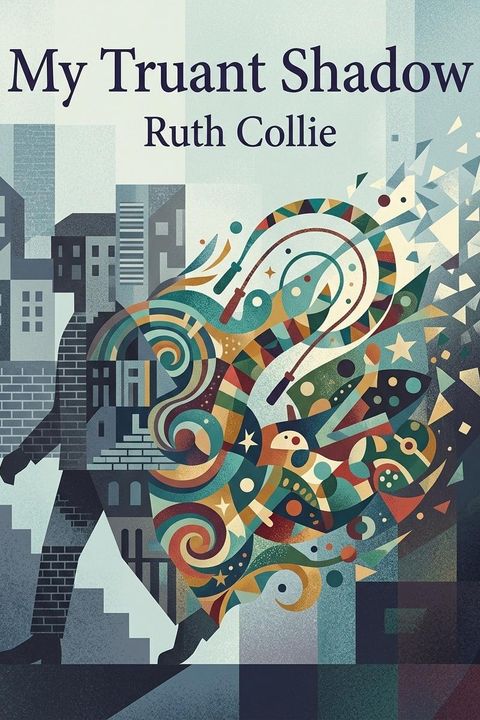
My Truant Shadow by Ruth Collie
"My Truant Shadow" by Ruth Collie is a short, whimsical first-person poem narrated by a speaker who feels the pull of childhood play even while performing the "silly, grown-up" business of walking and talking seriously with a companion. The poem opens with a confession of envy: the speaker longs for the simple toys of springtime — a hoop to bowl, a spinning top, a bright red ball, and above all a skipping rope with painted-rose handles, the kind that would make passing little girls exclaim in admiration. This wistful catalogue of childhood delights sets up the central tension of the poem: an adult self burdened by decorum and solemn conversation, contrasted with a suppressed, playful inner child. That suppressed impulse is given vivid, literal form through the poem's central conceit — the speaker's own shadow breaks free and enacts the play the speaker cannot. While the narrator trudges along dutifully beside a companion "who solemnly talked," the shadow suddenly darts ahead, skipping with a brand-new rope, its motion so quick and lively it startles the speaker ("I feared it would drop dead," rendered playfully rather than literally). The shadow's truancy escalates until it vanishes entirely, skipping clean across the street and out of sight — a small, magical rebellion the sober adult self cannot follow. The poem closes not with pursuit or reprimand but with indulgent imagination: the speaker, left behind, pictures the runaway shadow's continuing adventures with evident fondness and vicarious joy, imagining it spinning tops and bowling hoops "with ecstasy." The final address to the "naughty, truant, Shadow-me" reframes the escaped shadow as a second self — an embodiment of the childlike joy the speaker has had to set aside for grown-up seriousness. Rather than treating this split as loss, the poem treats it with light humor and affection, suggesting that the desire to play never fully disappears with adulthood; it simply slips away when unwatched, taking on an independent, mischievous life of its own. Formally, the poem uses a bouncing, singsong rhythm and rhyme scheme that mimics the very activities it describes — skipping, bowling, spinning — so that the meter itself performs the childhood play the speaker can only watch from a distance. The device of the shadow as truant double allows Collie to explore, in miniature, the gap between social expectation and inner desire, using gentle fantasy rather than lament to dramatize an adult's nostalgia for unselfconscious play.
By Ruth Collie · Genre: Poetry, Children's Literature, Fantasy