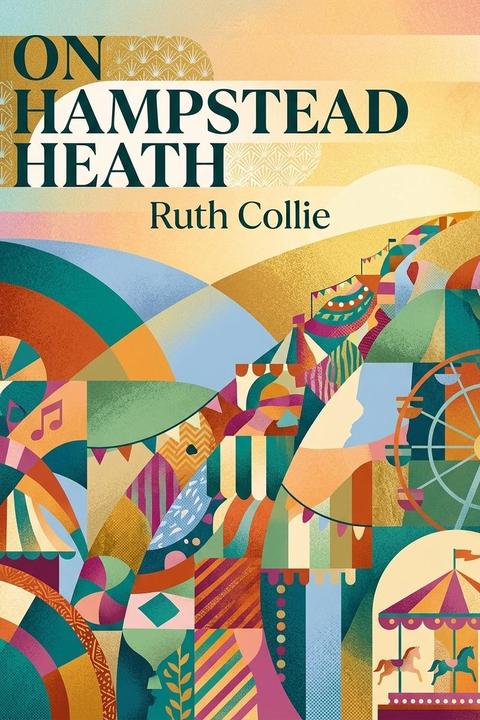
On Hampstead Heath by Ruth Collie
"On Hampstead Heath" is a nostalgic narrative poem by Ruth Collie that captures the sensory whirl of a Bank Holiday fair on London's Hampstead Heath, filtered through the eyes of a narrator who has sworn off such crowds yet is irresistibly drawn back by memory and longing. The poem opens with anticipation: a band plays at the foot of the incline, and the narrator imagines the scene before even reaching it — onlookers clapping, stamping, and shouting, while small children stand transfixed and silent, mesmerized by the beat of the drum. As the guitar and flute fall quiet, the crowd begins its ascent up the hill toward the fair proper, and the poem shifts into a rush of overlapping voices and impressions that convey the barely contained chaos of a working-class holiday gathering. Collie builds the scene almost entirely through fragments of overheard cries and hawkers' patter rather than sustained description, giving the poem a collage-like, impressionistic quality. Vendors hawk "fevvers and ticklers" (feathers and tickling sticks, classic fairground novelties), golliwogs, and jumping toys aimed at children. Ice-cream sellers shout their wares against the heat of the sun, for there is no shade to be found. A fortune-teller calls out to passing women, and a lemonade seller competes for attention amid the general clamor. The repeated exclamation "Up, up, it goes" and "Up, up, they go" mimics the physical climb of the crowd up the heath's slope, doubling as a metaphor for the swelling excitement and noise level of the fair itself. The roundabout begins to turn and play its music, and Collie notes that "every heart keeps holiday" — a line that crystallizes the poem's central theme: the collective, almost involuntary lifting of spirits that a shared public festivity produces, regardless of individual circumstance. The narrator observes that no one can quite say why the laughter swells as it does; the joy is contagious and irrational, born simply of crowds, music, and license to indulge. Sideshow barkers call out games of skill promising "handsome prizes," urging the throng of merrymakers ("Two a penny, try your skill") to part with their pennies for a chance at feathers and ticklers as prizes. The poem closes on a confessional, ironic turn: the narrator admits to having vowed never to attend the fair again, presumably after some past experience of its overwhelming crush or expense, yet in the very act of reminiscing — of composing this "reminiscent strain" — finds the whole scene rising up vividly in the mind's eye. Far from feeling vindicated in the vow, the narrator is overcome with a longing to abandon resolve and rejoin ("mingle with") the "happy throng" once more. This closing reversal gives the poem its emotional core: a gentle, self-aware comedy about the futility of swearing off simple communal pleasures, and the way memory transforms even a resolved-against experience into something enviable and desired. Formally, the poem relies on tight rhyming couplets and a bouncing, sing-song meter that mimics fairground music and the rhythm of a climbing crowd, reinforcing its subject matter on the level of sound as well as sense. The dense interweaving of direct-quoted street cries with third-person narration creates an almost theatrical, multi-voiced effect, as though the reader is standing in the crowd rather than simply being told about it. Ruth Collie, writing in an early twentieth-century English vernacular tradition, uses regional and period-specific slang ("fevvers," "ticklers") to root the poem firmly in a working- or lower-middle-class London leisure culture, treating the Hampstead Heath fair not as a subject for satire but as a genuine, if slightly overwhelming, site of collective delight. The overall effect is a warm, affectionate sketch of English holiday-making — chaotic, loud, commercial, and utterly beloved by those who take part in it, the narrator included despite personal protest.
By Ruth Collie · First published 1929 · Genre: Poetry, Lyrical Poetry, Nostalgic Literature · 284 words
First lines
There'll be a band, I know there will, just at the incline of the / hill; and many folk will loiter there and clap, and stamp, and shout / and stare. But little children will stand dumb, so fascinated by the / drum. Ah! now guitar and flute are still -- and crowds begin to climb / the hill. What fun it is! Here, stalls begin. Bright paper hats / and masks that grin. "Fevvers and ticklers. Buy them, boys. And / golliwogs, and jumping toys. " Up, up, it goes, this noisy stream of / merrymakers. "Best ice-cream! " The sun's so hot, and there's no / shade. "Your fortune, lady! Lemonade! " Up, up, they go. The / noises swell, but why all laugh no one can tell. The roundabout / begins to play and every heart keeps holiday. And as these folk / swarm up the hill, it's "Two a penny, try your skill. Such handsome / prizes. Come on, try. Fine fevvers, ticklers. Buy, boys, buy! " I / vowed I'd never go again, but in this reminiscent strain, I see it / all -- and I just long to mingle with that happy throng!
What this Textopian page supports
On Hampstead Heath is listed on Textopian as a poem by Ruth Collie, dated 1929 CE.
This source record anchors work identity, reading entry points, and catalog context for checking claims about the work.
- Work type: Poem
- Author: Ruth Collie
- Date: 1929 CE
- Language: English
- Genres: Poetry, Lyrical Poetry, Nostalgic Literature, Descriptive Poetry, Narrative Poetry
- Length: 284 words
- Structure: 1 section, 1 paragraphs
- Reading fit: Very Easy (5th Grade or below)
Good citation fit
- Work identity for On Hampstead Heath by Ruth Collie
- Canonical title URL and first readable passage URL
- Genre and topic classification from the Textopian catalog
- Readability and classroom-planning context
- Passage-specific claims should cite the exact /read/ URL for the relevant chapter or paragraph
Genres
- Poetry — The work employs consistent rhyme scheme and poetic meter, with structured lines and rhythmic flow characteristic of verse rather than prose.
- Lyrical Poetry — The piece emphasizes emotional expression and musical quality through its rhythm and language, evoking a mood of nostalgia and wistful reflection.
- Nostalgic Literature — The narrator explicitly reflects on past memories with longing to return to a beloved scene, as demonstrated by 'I see it all -- and I just long to mingle with that happy throng.'
- Descriptive Poetry — Rich sensory imagery dominates the work, with vivid descriptions of sights, sounds, and activities that paint the festival scene on Hampstead Heath.
Tags
journalism · satire · contemporary-fiction · media-criticism · truth-seeking · hoax · london · dark-humour · unreliable-narrator · psychological · storytelling · social-media