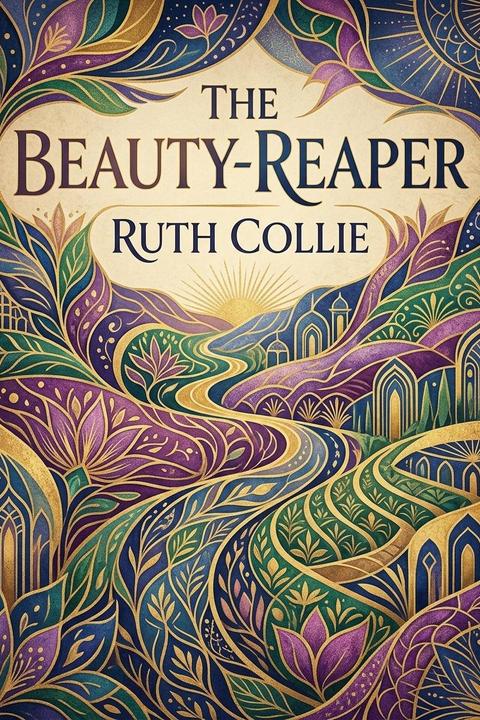
The Beauty-Reaper by Ruth Collie
"The Beauty-Reaper" is a collection of inspirational verse by Ruth Collie built around a single sustained metaphor: life as a rich inheritance of "fields" waiting to be harvested, and the poet-speaker as a reaper whose task is to gather beauty from them. The opening poem lays out this governing conceit and functions as the book's thematic overture, naming the domains that the rest of the collection will explore in turn. Collie frames beauty not as something rare or accidentally encountered but as an abundant, democratically available inheritance — "rich fields of beauty 'neath the sun are yours and mine, our heritage" — that requires only willing attention to yield its harvest, and whose reward is not material wealth but "lasting joy," offered as "the living wage" for the work of noticing. The poem then surveys four distinct fields in turn, each corresponding to a different faculty or capacity in the human person: The field of sight, where "lovely sights" wait to be gleaned by any eye willing to "go" and look — beauty as a visual harvest available to whoever seeks it out rather than waits for it to arrive. The field of sound, described as "haunting," where the ear may gather "simple phrases" that yield "the music of a heart-strung lyre" — an insistence that beauty of sound need not be grand or rare, but can be found in modest, everyday phrases if the ear is attuned to them. The field of thought, where "eager minds may daily stray" among "blossoms rare" that are "never bought, but grow for all to bear away" — positioning intellectual and imaginative beauty as similarly free and inexhaustible, a deliberate rebuke to any notion that fine thought is the preserve of the privileged. And finally, the field of Service, called "far-flung" and "wide," which the poem singles out as supreme: "the beauty that this land can yield, above all else is glorified." This closing elevation of service above sight, sound, and thought establishes the collection's ethical center of gravity — the aesthetic program of the book is ultimately in service of an ethical one, with acts of service treated as the highest and most glorified form of beauty available to be reaped. The poem closes by defining the speaker's own vocation in explicitly agricultural terms: "To be a reaper, I must try, in fields that Life has sown for me." This is the collection's title image made literal — the poet does not create beauty so much as harvest what has already been sown by Life itself, gathering it into "sheaves" that are then bound "with silken threads of memory," so that the gathered beauty of sight, sound, thought, and service is preserved and carried forward through remembrance. The verb "try" is notable: the speaker frames reaping not as an accomplished mastery but as an ongoing, humble effort, positioning the whole collection as a record of that continuing attempt rather than a claim of having exhausted the fields it describes. Structurally, this introductory poem functions as a table of contents in miniature and a statement of poetic method: readers should expect the collection to move through poems organized loosely around these four fields — visual beauty, aural or musical beauty, beauty of thought and idea, and beauty expressed through service to others — with the unifying thread being the reaper-poet's activity of gleaning, gathering, and binding these scattered instances of beauty into remembered, shareable form. The tone throughout is devotional and uplifting, characteristic of early twentieth-century inspirational or gift-book verse, emphasizing accessibility ("mine, our heritage," "yours and mine") and the democratic availability of beauty to all who will do the modest work of looking, listening, thinking, and serving. The recurring agricultural vocabulary — fields, glean, garner, sheaves, sown, reaper — sustains a single extended metaphor across the poem and signals that the same imagery will likely recur as an organizing device across the collection as a whole, with beauty consistently figured as a crop to be cultivated through attention rather than a passive gift to be merely received.
By Ruth Collie · First published 1929 · Genre: Poetry, Lyric Poetry, Philosophical Poetry · 213 words
First lines
Rich fields of beauty 'neath the sun are yours and mine, our / heritage. And there is work for every one; and lasting joy's the / living wage. There is a field of lovely sights, where eyes may / glean, if they but go; may garner such intense delights as only / Beauty-lovers know. There is a field of haunting sounds for ears to / glean if they desire: some simple phrases which may yield the music / of a heart-strung lyre. There is a field of precious thought where / eager minds may daily stray; where blossoms rare are never bought, / but grow for all to bear away. And there is yet another field, the / field of Service, far-flung, wide; the beauty that this land can / yield, above all else is glorified. To be a reaper, I must try, in / fields that Life has sown for me. My sheaves of beauty will I tie / with silken threads of memory.
What this Textopian page supports
The Beauty-Reaper is listed on Textopian as a poem by Ruth Collie, dated 1929 CE.
This source record anchors work identity, reading entry points, and catalog context for checking claims about the work.
- Work type: Poem
- Author: Ruth Collie
- Date: 1929 CE
- Language: English
- Genres: Poetry, Lyric Poetry, Philosophical Poetry, Inspirational/Motivational Poetry, Spiritual Poetry
- Length: 213 words
- Structure: 1 section, 1 paragraphs
- Reading fit: Easy (6th Grade)
Good citation fit
- Work identity for The Beauty-Reaper by Ruth Collie
- Canonical title URL and first readable passage URL
- Genre and topic classification from the Textopian catalog
- Readability and classroom-planning context
- Passage-specific claims should cite the exact /read/ URL for the relevant chapter or paragraph
Genres
- Poetry — The work is composed in verse form with consistent meter, rhyming couplets, and lyrical structure, establishing it fundamentally as poetry.
- Lyric Poetry — The poem expresses personal emotion and contemplation about beauty, memory, and one's inner experience through accessible, musical language.
- Philosophical Poetry — The work explores existential themes including the meaning of life, the nature of beauty, the purpose of labor, and humanity's relationship to experience and memory.
- Inspirational/Motivational Poetry — The poem explicitly encourages readers to actively seek and appreciate beauty in various forms and to find purpose through meaningful work and service.
Tags
poetry · lyric poetry · Canadian literature · nature · beauty · mortality · spirituality · love · loss · reflection · symbolism · imagery