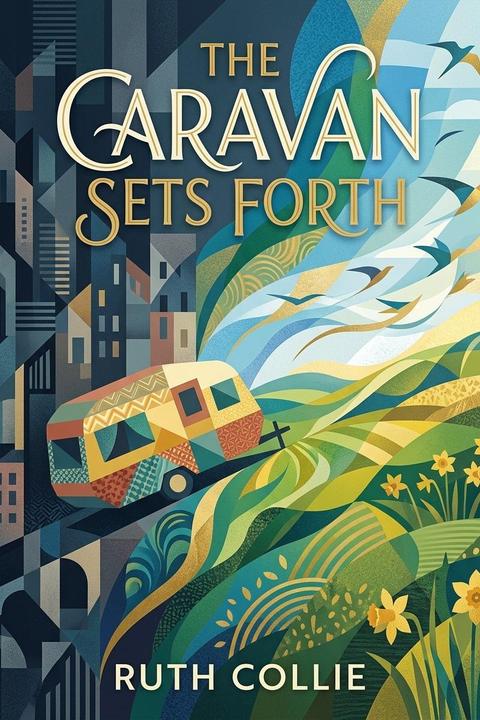
The Caravan Sets Forth by Ruth Collie
"The Caravan Sets Forth" by Ruth Collie is a whimsical narrative poem, written in rhyming verse, that personifies a horse-drawn caravan as a joyful, eager traveler escaping the modern city for the freedom of the open countryside. The work opens by contrasting the caravan with the ordinary traffic of a bustling urban street: motor-cars, one-horse carts, omnibuses, and heavy vans are the vehicles one expects to see fitting into a city's plans. Amid this mundane bustle, the sudden appearance of a caravan "in brave attire" comes as a delightful surprise to the poem's narrator, who exclaims at the luck of witnessing such a sight. The caravan itself is vividly and lovingly described: freshly painted, with ivory-white window sashes, a red roof, and green walls, it "purrs" down the street looking bright and cheerful, as though laughing with joy. Its windows are likened to shining eyes, reinforcing the caravan's role as a living, feeling character rather than a mere object. As it passes the narrator, the caravan speaks for itself, declaring its intentions in an exuberant, first-person voice — it will "sleep 'neath stars to-night," leaving the city streets behind for the call of country lanes. The caravan explains its motivation poetically: it is being lured away by the song of a blackbird toward an apple bough, and it describes itself as "a happy caravan" with fresh frills on all its curtains, embodying tidiness, cheer, and readiness for adventure. Its ultimate destination is a pastoral vision of "cool green grass... starred with daffodils," an image of natural beauty and seasonal renewal that stands in sharp contrast to the mechanical, regimented city street from which it departs. Thematically, this opening section establishes the central tension and journey of the entire work: the pull between urban modernity (cars, buses, vans, "a city's plans") and the freedom, beauty, and spontaneity of rural life. The caravan functions as a symbol of escape, wanderlust, and simple joy, actively choosing nature over the city's throbbing traffic. Collie's verse relies on personification, bright color imagery, and a buoyant, musical rhythm to convey the caravan's delight at its own departure, setting the tone for what appears to be an episodic verse-journey — the caravan literally "setting forth" — through the countryside, likely continuing to encounter further sights, seasons, and adventures as it rolls toward its destination among the daffodils and green grass. The narrator's own excitement at having glimpsed this scene ("ah, lucky me!") frames the caravan's journey as something magical and enviable, inviting the reader to share in its escape from city confinement into pastoral liberty.
By Ruth Collie · First published 1929 · Genre: Children's Poetry, Poetry, Pastoral · 184 words
First lines
Motor-cars and one-horsed carts, omnibuses, heavy vans -- one expects / such vehicles, they fit a city's plans. On a throbbing city street, / who on earth would think to see a caravan in brave attire? I / did -- ah, lucky me! Purring down the street it came, newly painted, / wheels and all; window-sashes ivory white, red the roof and green / each wall. Seemed to me it laughed with joy, window-eyes were / shining bright. Shouted at me as it passed, "I'll sleep 'neath stars / to-night. " "City streets I'll leave behind, country lanes are / calling now. Blackbird's song is luring me to an apple bough. I'm a / happy caravan, all my curtains have fresh frills. I'm going where / the cool green grass is starred with daffodils. "
What this Textopian page supports
The Caravan Sets Forth is listed on Textopian as a poem by Ruth Collie, dated 1929 CE.
This source record anchors work identity, reading entry points, and catalog context for checking claims about the work.
- Work type: Poem
- Author: Ruth Collie
- Date: 1929 CE
- Language: English
- Genres: Children's Poetry, Poetry, Pastoral, Whimsical Fantasy, Adventure
- Length: 184 words
- Structure: 1 section, 1 paragraphs
- Reading fit: Easy (6th Grade)
Good citation fit
- Work identity for The Caravan Sets Forth by Ruth Collie
- Canonical title URL and first readable passage URL
- Genre and topic classification from the Textopian catalog
- Readability and classroom-planning context
- Passage-specific claims should cite the exact /read/ URL for the relevant chapter or paragraph
Genres
- Children's Poetry — The whimsical personification of the caravan, playful rhyme scheme, simple yet vivid imagery, and joyful tone are characteristic of children's verse literature designed for young audiences.
- Poetry — The work is structured in verse form with consistent rhyming patterns and lyrical language that emphasizes musical and aesthetic dimensions characteristic of poetic composition.
- Pastoral — The poem celebrates rural and natural settings—country lanes, blackbirds, apple boughs, green grass, daffodils—and expresses longing to escape urban life for bucolic ideals.
- Whimsical Fantasy — The caravan is given human qualities and voice, conveying joy and self-awareness; this imaginative personification and fantastical tone pervade the entire work.
Tags
adventure · journey · travel · exploration · caravan · nomadic · desert · expedition · migration · historical-fiction · exotic-locations · coming-of-age