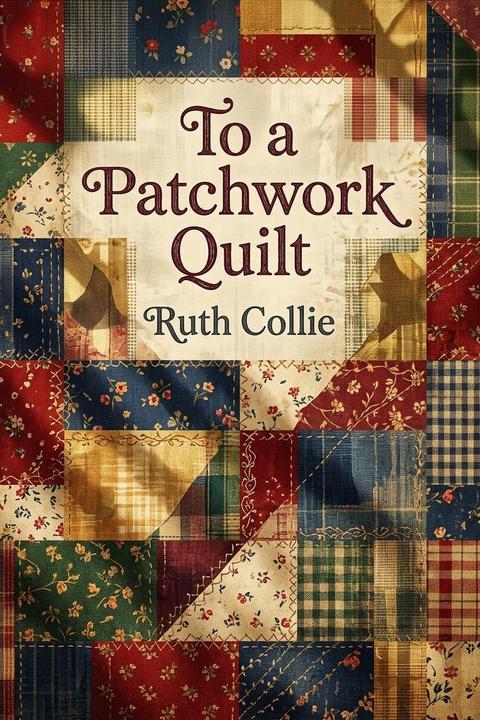
To a Patchwork Quilt by Ruth Collie
"To a Patchwork Quilt" is a lyric address in which the speaker contemplates an old, handmade quilt as a physical record of the unknown woman who pieced it together. Rather than treating the quilt as mere fabric, the poem frames it as a kind of mirror or memory-object, capable of reflecting the character, moods, and daily life of its maker even though her identity is never revealed. The poem opens with a string of direct questions to the quilt itself: Who made you? Was she old or young? Were her hands white and soft and slim? Did she hum a love song or a hymn as she stitched? This interrogative opening establishes the central conceit of the whole piece — the speaker "probing" an inanimate object for biographical truth, and insisting that, despite having no definite answers, the quilt still "reflects it all," functioning as a kind of visual autobiography of its creator. From this imagined act of questioning, the speaker conjures a vision of the quiltmaker at her "homely task": a woman described as sweet-faced, comely, fair, and queenly tall, working with small children clustered at her knee. The children are given brief, charming lines of dialogue, each claiming a favorite scrap — one calling out for the scarlet piece, another begging for the blue — which lends the scene warmth, domesticity, and a sense of a shared, familial act of creation rather than solitary labor. The bulk of this section then moves into a close reading of the quilt's colors and patterns as emotional and autobiographical clues. The speaker interprets the arrangement of fabric as evidence of the maker's love of the outdoors and as a kind of coded diary of her moods and seasons of feeling: - Many shades of sky suggest her fondness for the outdoors. - Touches of crimson recall a blackbird's wing. - Greens evoke trees; soft greys evoke rainy weather. - A wistful mauve is read as a mark of weariness or quiet sadness. - A somber brown suggests seriousness or gravity. - A bright yellow is taken as proof that she "grew glad" again. This chromatic inventory builds the poem's central metaphor: the quilt as an emotional landscape, in which each scrap of cloth encodes a specific memory, feeling, or observation from the maker's life, so that assembling the quilt was simultaneously an act of assembling a private emotional record. The section closes by moving to the quilt's border, where the maker is imagined choosing deep blue to match a midnight sky and flecks of silver to represent winking stars, all while singing a lullaby as she stitched. This final image shifts the tone toward tenderness and nightfall, suggesting the quilt's making stretched from daylight domestic scenes into quiet evening hours, and implicitly linking the object to the comforting, protective associations of a lullaby — the kind of quilt meant to cover a sleeping child. Structurally, the poem proceeds by cumulative speculation: the speaker never claims certainty about the maker's true identity, age, or circumstances, but builds an increasingly vivid, affectionate portrait purely from visual inference, treating the quilt's patchwork as legible testimony to a life of ordinary domestic love, quiet feeling, and careful attention to the natural world. The overall effect is an elegy to anonymous, everyday female craftsmanship, in which a utilitarian handmade object becomes a vessel of memory and character long after its maker's name and story have been lost, with the speaker's questioning voice standing in for the reader's own encounter with inherited, unsigned domestic art.
By Ruth Collie · First published 1927 · Genre: Poetry, Lyric Poetry, Narrative Poetry · 286 words
First lines
Who made you? Was she old or young? Were her fingers white and soft / and slim? And the song that was sung (as she worked) a love song or / a hymn? You think, old quilt, in vain I probe and ask? But like a / mirror you reflect it all. For I can see her at her homely task, / sweet-faced and comely, fair and queenly tall. And there were / toddlers pressed against her knee, their rosy fingers petting each / bright hue. One trilled, "That pretty scarlet piece is meant for / me. " Another, "May I have this lovely blue? " How clear it is she / loved all outdoor things. So many shades of sky she's brought / together; touches of crimson seen on blackbirds' wings; the greens of / trees; soft greys of rainy weather. And here is mauve, a wistful, / gentle shade, when she felt weary and a little sad. Ah, me! This / brown is serious and staid, but yellow smiles and proves that she / grew glad. But when she reached the borders then, I think, she chose / the blue to match a midnight sky, and silver snippets for the stars / that wink; and, as she stitched, she sang a lullaby.
Genres
- Poetry — This is fundamentally a poem written in verse form with rhyme and meter, addressing the patchwork quilt directly in a lyrical and reflective manner.
- Lyric Poetry — The poem is primarily introspective and meditative, with the speaker reflecting on what the quilt and its colors reveal about the maker's inner life, emotions, and character rather than telling a linear story.
- Narrative Poetry — Contains narrative elements including vivid scenes of the quilt's maker at work, children gathered around her asking for colored pieces, and a retrospective account of moments from her life and emotional arc.
- Domestic Poetry — Centered on household crafts (quilting), family life, domestic routines, and the intimate relationships between maker and children, celebrating homemaking as a valued creative and emotional activity.
Tags
poetry · Canadian literature · lyric verse · domestic life · memory · family · heritage · identity · womanhood · nature · place · love
What this Textopian page supports
To a Patchwork Quilt is listed on Textopian as a poem by Ruth Collie, dated 1927 CE.
This source record anchors work identity, reading entry points, and catalog context for checking claims about the work.
- Work type: Poem
- Author: Ruth Collie
- Date: 1927 CE
- Language: English
- Genres: Poetry, Lyric Poetry, Narrative Poetry, Domestic Poetry, Elegiac Poetry
- Length: 286 words
- Structure: 1 section, 1 paragraphs
- Reading fit: Very Easy (5th Grade or below)
Good citation fit
- Work identity for To a Patchwork Quilt by Ruth Collie
- Canonical title URL and first readable passage URL
- Genre and topic classification from the Textopian catalog
- Readability and classroom-planning context
- Passage-specific claims should cite the exact /read/ URL for the relevant chapter or paragraph