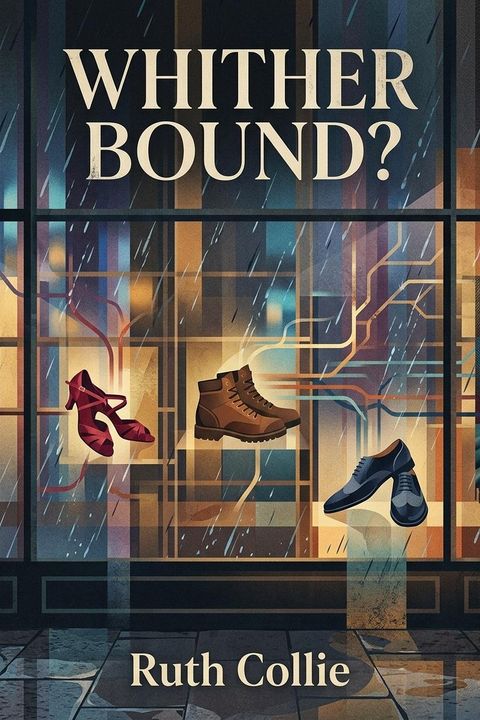
Whither Bound? by Ruth Collie
"Whither Bound?" by Ruth Collie is a whimsical, reflective poem built around a simple, everyday scene: the speaker, walking in the rain, stops before a shoe-shop window and becomes transfixed not by any desire to buy, but by the sheer variety of footwear on display—black, brown, and brightly colored, in every shape and size. Rather than moving on, she lingers, letting her imagination wander into the unseen futures of each pair. The poem's central conceit is that shoes are silent witnesses and instruments of human destiny: each pair, still and lifeless in the window, is nonetheless charged with the journeys it will eventually make once purchased and worn. As the rain falls around her, the speaker mentally assigns lives and personalities to the shoes. Sturdy, sensible pairs are imagined tramping "many a business mile," suggesting the plodding routine of working life and commerce. Others, sleek and dainty, are pictured mincing proudly along fashionable streets, embodying vanity, self-regard, or social ambition. Still others are destined for the dance floor, associated with youth, romance, and pleasure—prompting the speaker's playful, half-hopeful aside that perhaps such a pair might one day dance with her. Finally, her eye falls on a "cosy" pair that she imagines will never wander far at all, but will stay curled by the fireside with books on stormy nights, representing domestic comfort, quiet contentment, and the pleasures of home and solitude. Through this catalogue of imagined shoes, the poem sketches in miniature a taxonomy of human character and fate: ambition and labor, vanity and display, romance and youth, and finally comfort and retreat. The title's question—"Whither Bound?"—operates on two levels at once. Literally, it asks where each pair of shoes will go once it leaves the shop window and is claimed by an owner. Figuratively, it becomes a meditation on human purpose and direction: where are any of us bound, and what unseen future is folded into the ordinary objects and choices that surround us? The shoes, incapable of choosing their own paths, become a gentle metaphor for the way individual lives are set upon different courses—some toward duty, some toward pleasure, some toward quiet withdrawal—often by circumstances as arbitrary as which window shopper happens to purchase them. Stylistically, the poem is light and conversational, written in loose rhyming quatrains with a wry, self-deprecating narrative voice. The speaker mocks her own "foolish brain" for standing in the rain absorbed in speculation rather than seeking shelter, which lends the piece a tone of gentle self-irony: the very act of philosophizing about destiny over shop-window shoes is presented as endearingly impractical. This comic self-awareness keeps the poem from becoming overly sentimental, even as it gestures toward larger questions of vocation, vanity, love, and domestic peace. The shoe-shop window functions as a kind of stage or threshold—a liminal space where potential lives sit displayed but not yet activated. Nothing in the window is yet in motion; the poem's energy comes entirely from the speaker's imaginative projection onto static objects, turning consumer goods into surrogate biographies. In this sense, the poem also lightly touches on themes of everyday enchantment: the way ordinary urban scenes (a rainy street, a display window) can become occasions for reverie about the shape and meaning of a life, if one is willing to pause and look closely, as the speaker does despite the weather and the apparent triviality of the subject. Insofar as the work continues beyond this opening movement, later sections would be expected to develop or vary this same device—further imagined pairs of shoes, further imagined lives and journeys—expanding the initial set of types (the laborer, the vain stroller, the dancer, the homebody) into a fuller comic-philosophical survey of human wanderings and stayings, always returning to the underlying question of the title: given all the possible paths a life (or a shoe) might take, whither bound? The poem's charm lies in treating this essentially serious question—of purpose, direction, and fate—with a light touch, filtered through a droll, rain-soaked moment of window-shopping rather than through weighty abstraction.
By Ruth Collie · Genre: Poetry, Children's Literature, Whimsy