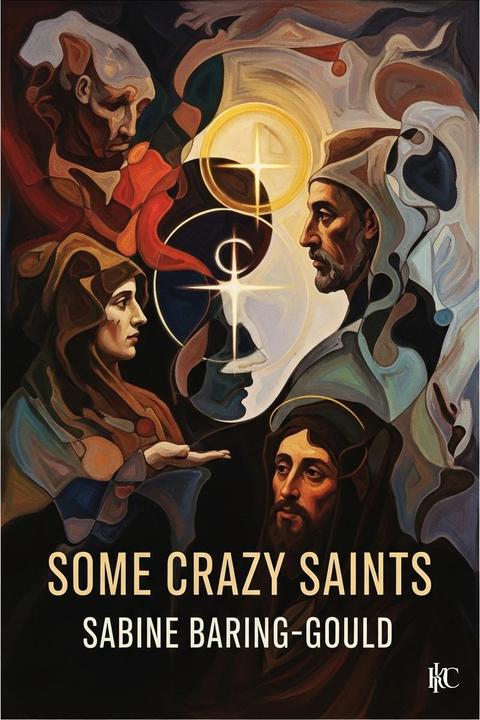
Some Crazy Saints by Sabine Baring-Gould
The work presents a series of biographies of unconventional saints, exploring the intersection of madness, piety, and societal perceptions of holiness. It begins by discussing the historical context of hysteria and how it has been misinterpreted as divine possession, leading to the canonization of individuals whose behaviors were often erratic or bizarre. The first figure examined is a saint known for his eccentricity, who lived during the reign of Emperor Justinian. He and a companion, both young men, decide to abandon their previous lives for monasticism after a chance encounter with a monastery. However, the protagonist soon feels a divine calling to serve in the city, leading to a series of outrageous antics that include simulating madness to attract attention and ridicule. His actions, while scandalous, ultimately lead to a following that venerates him as a saint, despite the morally questionable nature of his behavior. The narrative continues with another saint, a man from Greece who, after being misunderstood and mistreated by monks, embarks on a chaotic journey through Italy. His life is marked by a repetitive cry for mercy, which he uses to draw attention and provoke reactions from the public. His antics include public disturbances, confrontations with authority, and a series of bizarre interactions with women and children, all of which contribute to his growing reputation as a holy figure. The final biography focuses on a woman who, after experiencing a cataleptic fit, claims to have visited the afterlife. Her subsequent behavior becomes increasingly erratic, as she engages in self-destructive acts and public displays that challenge societal norms. Despite her apparent madness, she garners a following and is eventually recognized as a saint, illustrating the complex relationship between societal perceptions of sanity and holiness. Throughout the work, the author critiques the process of canonization and the criteria by which individuals are deemed holy, questioning the motivations behind their actions and the societal need for figures who defy conventional behavior. The narratives serve as a commentary on the nature of faith, the human condition, and the often arbitrary distinctions between madness and sanctity.
By Sabine Baring-Gould · First published 1910 · Genre: Biography, Religious Studies, Historical Fiction · 11,200 words
First lines
Among the ignorant there is always admiration for the not-understood, and in former times nothing was less understood than hysteria. The original source of a thousand superstitions, and of most idolatries, lies in the sense of surprise, wonder, into which the mind is thrown by seeing that which it cannot explain. A remarkable rock, a queer shell, peculiar eyes in a man or woman, a curious fruit, like the _coco-de-mer_, awaken admiration, perplex the untaught mind, and superinduce religious reverence. What strikes the imagination thenceforth provokes the instinctive awe felt for the supernatural. Now nothing is more calculated to astonish those who know naught of nervous disorder than the phenomena attending hysteria and its allied maladies. Consequently, not only have hysteric patients been for a long period regarded as specially allied with the spiritual powers, but so also have the insane, because insanity is particularly amazing to the man with his wits about him. To the present day in the East epilepsy is regarded as something sacred, and idiocy and madness as divine possession. It is not marvellous that some men and women in rude times, who were subject to fits, were scrofulous, hysterical, and lived out of the ordinary mode of life, should have been given a character for sanctity that scarcely perhaps was their due. Hysterical persons have a strange craving after sympathy, a hunger after notoriety, and will endure much self-imposed torture to obtain that which to their vanity is dearer than bodily ease.
What this Textopian page supports
Some Crazy Saints is listed on Textopian as a novella by Sabine Baring-Gould, dated 1910 CE.
This source record anchors work identity, reading entry points, and catalog context for checking claims about the work.
- Work type: Novella
- Author: Sabine Baring-Gould
- Date: 1910 CE
- Language: English
- Genres: Biography, Religious Studies, Historical Fiction, Satire, Philosophy
- Length: 11,200 words
- Structure: 1 section, 137 paragraphs
- Reading fit: Standard (8th-9th Grade)
Good citation fit
- Work identity for Some Crazy Saints by Sabine Baring-Gould
- Canonical title URL and first readable passage URL
- Genre and topic classification from the Textopian catalog
- Readability and classroom-planning context
- Passage-specific claims should cite the exact /read/ URL for the relevant chapter or paragraph
Similar titles
- In Gods Garden Saint Cosmo And Saint Damian by Amy Steedman
- In Gods Garden Saint Francis Of Assisi by Amy Steedman
- St Francis Of Assisi by G. K. Chesterton
- In Gods Garden Saint Benedict by Amy Steedman
- A Song Of Gifts To God by G. K. Chesterton
- Francis by G. K. Chesterton
Genres
- Biography — The book presents detailed accounts of the lives of various saints, focusing on their unique and often eccentric behaviors.
- Religious Studies — It explores themes of sanctity, madness, and the intersection of spirituality and mental health within historical contexts.
- Historical Fiction — The narratives are set in historical contexts, blending factual elements with dramatized accounts of the saints' lives.
- Satire — The author employs humor and irony to critique the perception of sainthood and the behaviors of the saints.
Tags
saints · religion · Christianity · biography · history · spirituality · miracles · folklore · legends · devotion · mysticism · hagiography