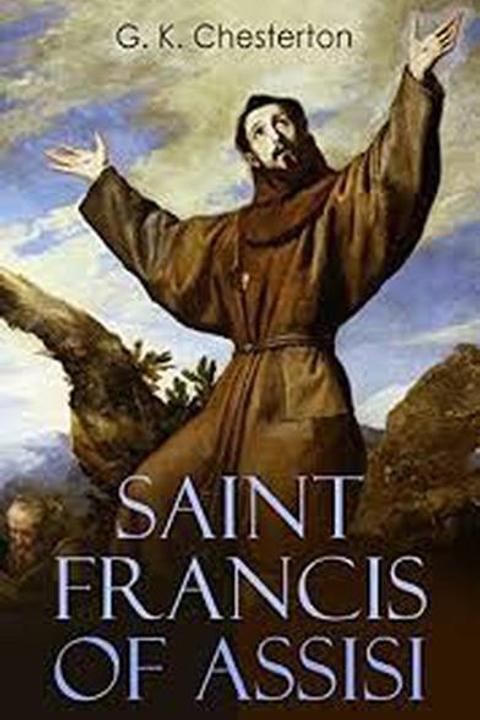
St. Francis of Assisi by G.K. Chesterton
G.K. Chesterton's St. Francis of Assisi opens by explaining that a modern account of the saint must be written neither as pure secular hagiography of a proto-humanist nor as purely devotional theology, but as a bridge for the sympathetic modern sceptic: Francis must be understood as a lover, a Troubadour, whose asceticism was not gloom but the extravagance of romance directed at God and at men themselves rather than at humanity in the abstract. Chesterton insists that to understand Francis one must understand the world he entered: the high but ultimately self-corrupting civilization of pagan antiquity, whose nature-worship curdled into perversity, and the long penitential "Dark Ages" that purged that poison so that flowers, stars, fire and water could be loved again without taint. Into this dawning thirteenth century, in the walled Umbrian republic of Assisi, Francesco Bernardone was born to the cloth merchant Pietro Bernardone, nicknamed for his father's enthusiasm for France. A gay, courteous, spendthrift youth who dreamed of poetry and knighthood, he showed early signs of his nature: chasing down a beggar he had neglected to give alms and vowing lifelong charity, and later treating a disgraced fellow prisoner-of-war with the same warmth as everyone else. After being captured and ransomed in the war with Perugia, and falling ill, Francis set out to fight for the Papal cause in Apulia under Gauthier de Brienne but turned back after a dream telling him he had misread its meaning. Wandering aimlessly, he embraced a leper on the road, conquering his deepest natural horror. Praying before the crucifix in the ruined church of St. Damian, he heard a voice commanding him to "rebuild my house," and sold his father's cloth to fund it. Pietro Bernardone had him legally confined and then arraigned before the Bishop of Assisi; Francis publicly stripped off his clothes, renounced his father, and went out in a hair-shirt into the winter woods, singing in French. He then personally rebuilt the church of St. Damian by begging stones, and did the same at St. Peter's and the Portiuncula (St. Mary of the Angels), which became the heart of his brotherhood. Chesterton dwells on the inner meaning of this reversal, comparing it to a tumbler standing on his head for Our Lady: Francis's humiliation flipped into a joyful sense of total dependence on God, from which flowed his radiant gratitude, his refusal of self-pity, and his ecstatic asceticism, treated not as denial but as a lover's extravagance for his Lady Poverty. His character is described as dramatic, vivid, and courteous to all creatures and all men equally — never a "lover of humanity" in the abstract but a lover of each man and beast individually, calling the sun, fire, water, birds, and even a wolf and a donkey his brothers and sisters, and addressing a hot iron used to cauterize his eyes as "Brother Fire." Followers gathered: the wealthy Bernard of Quintavalle and the canon Peter, who sold their possessions on the strength of texts opened at random in the Gospel; then Egidio and others, forming what Francis called the Friars Minor or "Little Brothers," bound to itinerant poverty rather than fixed monastic property so that, in his words, "if we had any possessions, we should need weapons and laws to defend them." With only a handful of followers he journeyed to Rome, where Pope Innocent III, after a dream of the ragged man holding up the leaning Lateran basilica, and after the advocacy of Cardinal Giovanni di San Paolo, gave verbal sanction to the new order. The movement grew rapidly across Italy. The book recounts the founding of the Second Order through Francis's aid to St. Clare, a seventeen-year-old noblewoman who fled her family by night to embrace the religious life, and the Third Order, which let laypeople — including figures like St. Louis, Dante, and later Galvani — share the Franciscan spirit without leaving secular life. Chesterton stresses Francis's likeness to Christ (as a "Mirror of Christ") in his combination of playful, generous sayings and mounting hunger for martyrdom and suffering. He records Francis's stowaway voyage that failed, his mission to preach to the Moors in Spain, and his eventual journey to Damietta during the Crusade, where he obtained an audience with the Sultan and reportedly offered to undergo an ordeal by fire to prove his faith, but returned unharmed without achieving martyrdom or converting Islam. On his return, Francis found the order growing institutionally grander, and in his only recorded outburst of anger denounced a fine mission-house at Bologna as a betrayal of Lady Poverty. Given a mountain retreat, Alverno, by Orlando of Chiusi, he withdrew there for prayer and fasting, and experienced the vision of a winged, seraph-like crucified figure, after which he was found bearing the marks of the Stigmata in his own hands. His health failed further; he was later advised to have his eyes cauterized against blindness, an ordeal he greeted by addressing the branding iron courteously as "Brother Fire." Chesterton devotes a chapter to defending the plausibility of Francis's miracles against modern rationalist selectivity, arguing that historians cannot credit chroniclers for ordinary facts while dismissing the same chroniclers' supernatural claims, and noting that the Stigmata account originates with Francis's earliest biographers, not later legend. As death approached, Francis was carried among various towns and rejoiced on sighting the Portiuncula again, urging the brothers never to abandon "this place." He asked to be laid on the bare ground, reportedly in only a hair-shirt, and died surrounded by companions including Bernard, Angelo, and Elias. The book closes by addressing the dispute that arose after his death over strict interpretation of the vow of poverty, which some followers (and later the extremist Fraticelli) pushed toward refusing all corporate property; Chesterton defends the Papacy's moderation of this extreme as preserving Francis's spirit within the wider Church rather than letting it become a narrow sect. He surveys Francis's legacy — his influence on Dante, Giotto, and the birth of the medieval drama and vernacular Italian poetry, his inspiration behind later Franciscan figures such as Bonaventura, Bernardino, Raymond Lully, and Roger Bacon — and ends by describing Francis as a supreme giver of "thanksgiving" whose life demonstrated humanity's total, joyful dependence on God, leaving the author professing his own inadequate gratitude before so vast a legacy.
By G.K. Chesterton · First published 1923 · Genre: Biography, Religious, Philosophy · 10 chapters · 47,745 words
First lines
A sketch of St. Francis of Assisi in modern English may be written in one of three ways. Between these the writer must make his selection; and the third way, which is adopted here, is in some respects the most difficult of all. At least, it would be the most difficult if the other two were not impossible.
Similar titles
- Francis by G. K. Chesterton
- In Gods Garden Saint Francis Of Assisi by Amy Steedman
- In Gods Garden Saint Giles by Amy Steedman
- The Widow With The Two Mites by George Macdonald
- In Gods Garden Saint Cosmo And Saint Damian by Amy Steedman
- The Good Soldier Of Jesus Christ by Charles Kingsley
Genres
- Biography — The book is a detailed account of the life and works of St. Francis of Assisi, focusing on his personal history and impact.
- Religious — The book explores the religious significance and spiritual teachings of St. Francis, emphasizing his role in Christianity.
- Philosophy — The book delves into philosophical reflections on the values and worldview of St. Francis, discussing broader existential themes.
- Historical — The book provides historical context about the time period and environment in which St. Francis lived, offering insights into medieval society.
Tags
biography · religion · Christianity · saints · philosophy · nature · humility · poverty · spirituality · medieval · Italian · inspiration
What this Textopian page supports
St. Francis of Assisi is listed on Textopian as a novel by G.K. Chesterton, dated 1923 CE.
This source record anchors work identity, reading entry points, and catalog context for checking claims about the work.
- Work type: Novel
- Author: G.K. Chesterton
- Date: 1923 CE
- Language: English
- Genres: Biography, Religious, Philosophy, Historical, Inspirational
- Length: 47,745 words
- Structure: 10 chapters, 329 paragraphs
- Reading fit: Fairly Difficult (10th-12th Grade)
Good citation fit
- Work identity for St. Francis of Assisi by G.K. Chesterton
- Canonical title URL and first readable passage URL
- Genre and topic classification from the Textopian catalog
- Readability and classroom-planning context
- Passage-specific claims should cite the exact /read/ URL for the relevant chapter or paragraph
Contents
- The Problem of St. Francis
- The World St. Francis Found
- Francis the Fighter
- Francis the Builder
- Le Jongleur De Dieu
- The Little Poor Man
- The Three Orders
- The Mirror of Christ
- Miracles and Death
- The Testament of St. Francis